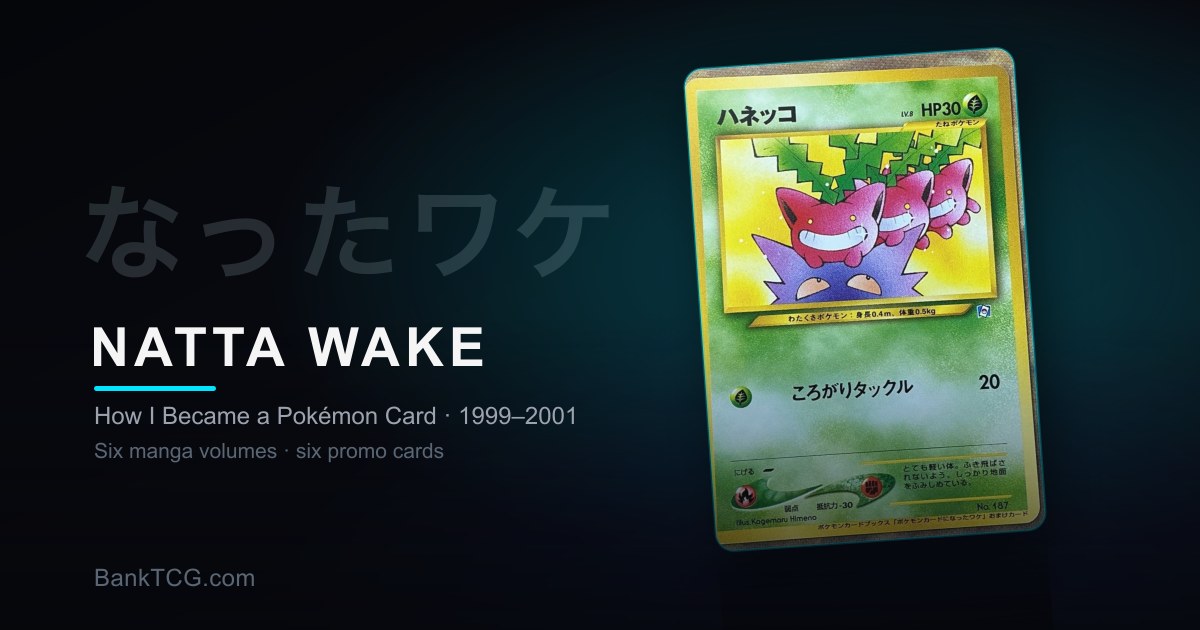
Quick Facts
- What it is: 「ポケモンカードになったワケ」(Pokémon Card ni Natta Wake), "How I Became a Pokémon Card", a six-volume Japanese manga published between May 1999 and September 2001.
- The cards: Every volume came with one exclusive promo card sealed in a paper envelope mounted inside the book. Six volumes, six cards.
- Who made them: Kagemaru Himeno wrote and illustrated the manga, and drew every promo card in it.
- Where you could get them: Japanese bookstores only, for as long as the volume stayed in print.
- The strange part: the scarcest card in the series is the third-cheapest, and the most common one sells for roughly twenty times more.
A Manga That Explains Its Own Card Art
Most Pokémon promos are tied to an event, a tournament, or a magazine giveaway. This one is tied to a story.
Pokémon Card ni Natta Wake is a manga about the cards themselves. Each chapter takes a single existing Pokémon card illustration and tells you what's happening in it: what that Pokémon is doing, or how it ended up in that pose. The title translates roughly as "the reason it became a Pokémon card."
The person behind it is Kagemaru Himeno, and she is not a guest artist. Born in Kanagawa Prefecture in 1972, she started out drawing manga for RIBON Original in 1994 and began working on Pokémon in 1997. Her card art has been in the TCG since the Jungle expansion, and she has now illustrated 635 cards for the game, plus another 53 for Pokémon TCG Pocket. Soft watercolours, bright colours, gentle light. Once you know her work, you spot it instantly.
So the manga is an illustrator writing about her own medium. And each volume shipped with a card she drew specifically for it.
The Complete Checklist
Six volumes, six cards. The card numbers are National Pokédex numbers, not set numbers.
| Vol. | Released | Card | No. | Related card | ISBN |
|---|---|---|---|---|---|
| 1 | May 22, 1999 | Mankey | 56 | Jungle | 4889917179 |
| 2 | Sept 22, 1999 | Psyduck | 54 | Fossil | 4889917284 |
| 3 | Jan 22, 2000 | Jynx ("Singing Jynx") | 124 | Vending S2 | 4889917470 |
| 4 | Aug 23, 2000 | Sunkern | 191 | Neo Genesis | 4889917578 |
| 5 | July 23, 2001 | Hoppip | 187 | Neo Discovery 55 | 4889917918 |
| 6 | Sept 22, 2001 | _____'s Pikachu ("Birthday Pikachu") | 25 | Promo | 4840104026 |
One thing worth being precise about, because it's often described wrongly: these are not reprints. The right-hand column shows the card each promo relates to, but Himeno drew new artwork for every one of them. The Vol. 5 Hoppip corresponds to Hoppip from Neo Discovery, but the illustration is completely different: same artist, new picture.
Two other details separate these from ordinary promos:
Five of the six carry a unique stamp: a small colour graphic of an open book with a trading card resting on it, printed where a set symbol would normally sit. The Vol. 6 Pikachu is the exception and has no stamp.
The Vol. 1 Mankey is the only glossy card in the series. The other five are printed on standard card stock. It's a small production difference, but it makes the Mankey immediately identifiable in hand.
The Vol. 6 Pikachu also has a quirk of its own. Its official name is _____'s Pikachu: there's a blank line where a name should be, meant for the owner to write their own. That's why almost everyone calls it "Birthday Pikachu" instead.
Look along the bottom of any of these cards and you'll find the line ポケモンカードブックス「ポケモンカードになったワケ」おまけカード ("Pokémon Card Books, How I Became a Pokémon Card, bonus card." That's the giveaway that a card came out of a book rather than a booster.
How Many Actually Exist
Here's where a lot of what's written about this series online falls down. You'll frequently read that there are "fewer than 80 copies of each in PSA 10." That isn't right.
These are the real PSA population figures, pulled on July 27, 2026:
| Card | Vol. | PSA 10 | PSA 9 | PSA 8 |
|---|---|---|---|---|
| Mankey (glossy) | 1 | 44 | 147 | 100 |
| Hoppip | 5 | 45 | 134 | 59 |
| Jynx | 3 | 74 | 90 | 42 |
| Psyduck | 2 | 87 | 260 | 202 |
| Sunkern | 4 | 94 | 130 | 55 |
| _____'s Pikachu | 6 | 130 | 555 | 296 |
PSA 10 populations run from 44 to 130, and three of the six are above 80. Across grades 8 through 10, PSA has certified 2,544 copies of these six cards in total.
A couple of things stand out. The Birthday Pikachu accounts for 39% of every graded copy in the series on its own, unsurprising, given what's on it. And Jynx and Sunkern come back as 10s at roughly double the rate of the others: about 34-36% of their PSA 8-10 submissions are gems, against 13-19% for the rest. That may reflect better centring on those two print runs, or it may just mean people only bother submitting clean copies of the cheaper cards. Both explanations fit the data equally well.
What They Sell For
We pulled 958 sales of these six cards, spanning May 2018 to July 27, 2026, across PSA, CGC, BGS and ACE.
These are median prices, not averages. The tails on this data are extreme: there's a listing recorded at $16,800 for a "PSA 10 Psyduck" and another at $34,777 for a raw Pikachu, both of which are almost certainly multi-card lots or mis-titled listings rather than real single-card sales. Medians ignore that noise; averages would swallow it whole.
They're also lifetime medians, covering eight years of sales. That makes them a fair basis for comparing the six cards against each other, which is what this table is for. It does not make them today's asking price. The series has been climbing since spring 2026, and recent sales run well above these figures. See the section below before you use any of these numbers to buy.
| Card | PSA 10 pop | PSA 10 median | Sales | PSA 9 median | Sales |
|---|---|---|---|---|---|
| _____'s Pikachu | 130 | $4,050 | 12 | $1,860 | 69 |
| Psyduck | 87 | $1,470 | 19 | $320 | 34 |
| Hoppip | 45 | $1,140 | 12 | $242 | 16 |
| Mankey (glossy) | 44 | $444 | 14 | $115 | 33 |
| Sunkern | 94 | $348 | 25 | $100 | 17 |
| Jynx | 74 | $199 | 31 | $113 | 14 |
Read those two columns against each other for a moment.
Rarity Doesn't Set the Price Here
The most common card in the series is the most expensive one. The rarest card is third from the bottom.
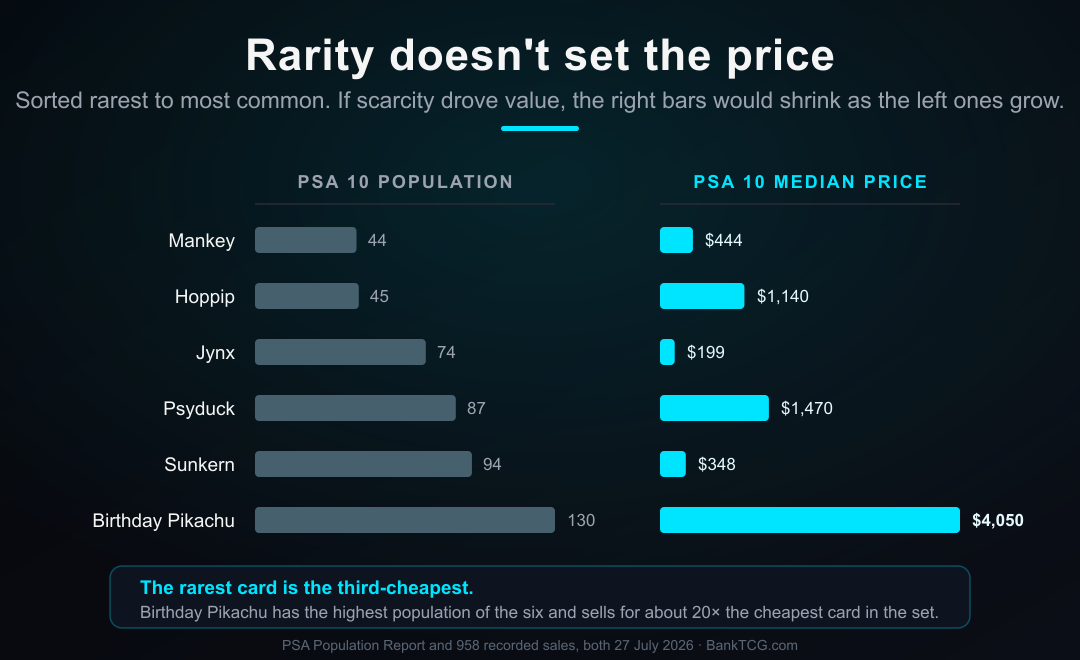
Birthday Pikachu has the highest PSA 10 population of the six (130 copies, nearly three times as many as the Mankey), and its PSA 10 median is $4,050, about twenty times the cheapest card in the set. Mankey has the lowest PSA 10 population at 44, and medians $444.
This is unusual enough to be worth sitting with. Six cards, one illustrator, one distribution method, one narrow window of print years, one format. Almost every variable that normally muddies a comparison is held constant here. And population explains essentially nothing about price.
What does explain it is what's printed on the card.
The clearest example is Hoppip against Mankey. Their PSA 10 populations are 45 and 44, as close to identical as you'll find. Yet Hoppip medians $1,140 and Mankey medians $444, roughly two and a half times the price at the same scarcity.
The difference is on the artwork. The Vol. 5 Hoppip card has a Gengar on it: three Hoppip perched on top of a Gengar's head, all four sharing the same wide grin. Collectors have noticed; sellers routinely list it as the "Gengar promo" rather than as a Hoppip card at all. Gengar is a blue-chip chase character. Hoppip is not, and neither is Mankey.
Run the whole set through that lens and the price order stops looking random: Pikachu, then Psyduck, then the card with Gengar on it, then the three nobody has strong feelings about.
If you're deciding what to buy, that's the useful lesson. In a series this internally consistent, character demand is doing the work that scarcity usually gets credit for. A low population number on its own tells you very little.
The Whole Series Is Being Bid Up Right Now
Everything above is a lifetime median, and there's a good reason to read it as a floor rather than a price tag: this series has been re-rating for months, and the pace has picked up.
The clearest measure isn't price, it's competition. Counting only auctions that drew 20 or more bids:
| Month | Contested auctions |
|---|---|
| April 2026 | 5 |
| May 2026 | 9 |
| June 2026 | 13 |
| July 2026 | 21 |
That's four consecutive months of increasing demand, and it isn't one card. Through July 2026, Birthday Pikachu, Psyduck, Hoppip and Jynx all sold in heavily contested auctions. One drew 120 bids.
The gap between the lifetime medians and recent sales is wide enough to matter. A Jynx PSA 10 sold for $1,525 on July 16, 2026, against a lifetime median of $199. A Mankey PSA 10 took $600 on July 13, against $444. If you're buying today, expect to pay above the table.
We looked for a catalyst (an announcement, a reprint, a video, anything about Kagemaru Himeno) and found nothing. So we're describing the shape of it rather than inventing a cause: broad, auction-driven, and building since roughly April.
One thing we can rule out is ourselves. The run-up starts on July 6, 2026; this article published on July 27.
What it doesn't change: the inversion holds on recent sales too. In July 2026, the rarest card in the series (Mankey, PSA 10 population 44) traded around $600 while the most common (Birthday Pikachu, population 130) traded around $4,300. Rising demand lifted the whole series without reordering it, which is what you'd expect if character appeal, not scarcity, is setting the price.
Update: July 29, 2026
July finished harder than it started, and the sharpest read is on one card in one grade.
Birthday Pikachu in PSA 9 sold seven times at auction during July, at a median of $4,750, with nothing below $4,250, against the $1,860 lifetime median in the table above. Before April 2026, the same card in the same grade medianed $1,346. The 120-bid auction mentioned above closed at $4,800 on July 25.
Something else surfaced that none of the tables on this page capture: copies signed by Kagemaru Himeno trade as a separate market. Four PSA 9 Psyduck copies carrying a Himeno autograph sold in July, between $1,825 and $3,150, every one of them drawing 30 or more bids, against $320 for an unsigned PSA 9 Psyduck. Four sales is a thin sample, but they're consistent with each other and an order of magnitude away from the unsigned price. If you're valuing a copy, check whether it's signed before applying any figure on this page.
We still can't find a catalyst. We looked again for a Himeno appearance or signing that would account for both the autograph sales and the wider run-up; the most recent we can source is a CGC Signature Series signing in March 2025, too early to explain July.
Grading and Buying
If you're considering grading one, a few things are worth knowing. These cards spent twenty-odd years in a paper envelope glued into a book, which is better storage than most promos of the era got, but the envelope doesn't protect corners during handling. Centring is the usual failure point.
Cross-grader spreads are also unusually wide here. A CGC 10 Mankey medians around $126 against $444 for the PSA 10, a much larger gap than you'd see on mainstream vintage. If you're grading with resale in mind, the label matters more than usual on this series. Our PSA vs. BGS vs. CGC guide covers how those labels tend to price against each other, and the PSA profit calculator will tell you whether the submission maths works before you send anything.
Buying is the harder part. These were Japanese bookstore exclusives and they've never had meaningful Western distribution, so most copies still surface on Yahoo Japan Auctions and Mercari Japan rather than eBay. That means a proxy service. Our guide to buying Pokémon cards from Japan walks through how proxies work and what the fees actually come to.
Two related reads if this era interests you: early Japanese Pokémon cards covers the wider 1996-2001 landscape these promos sit inside, and Japanese Unlimited cards explains the print-run markers that decide value on Japanese vintage.
On authenticity: an obscure series with rising prices and low general awareness is exactly the profile counterfeiters like. We found no counterfeit reporting specific to Natta Wake cards, but the standard checks all apply, and these cards carry three marks of their own worth knowing.
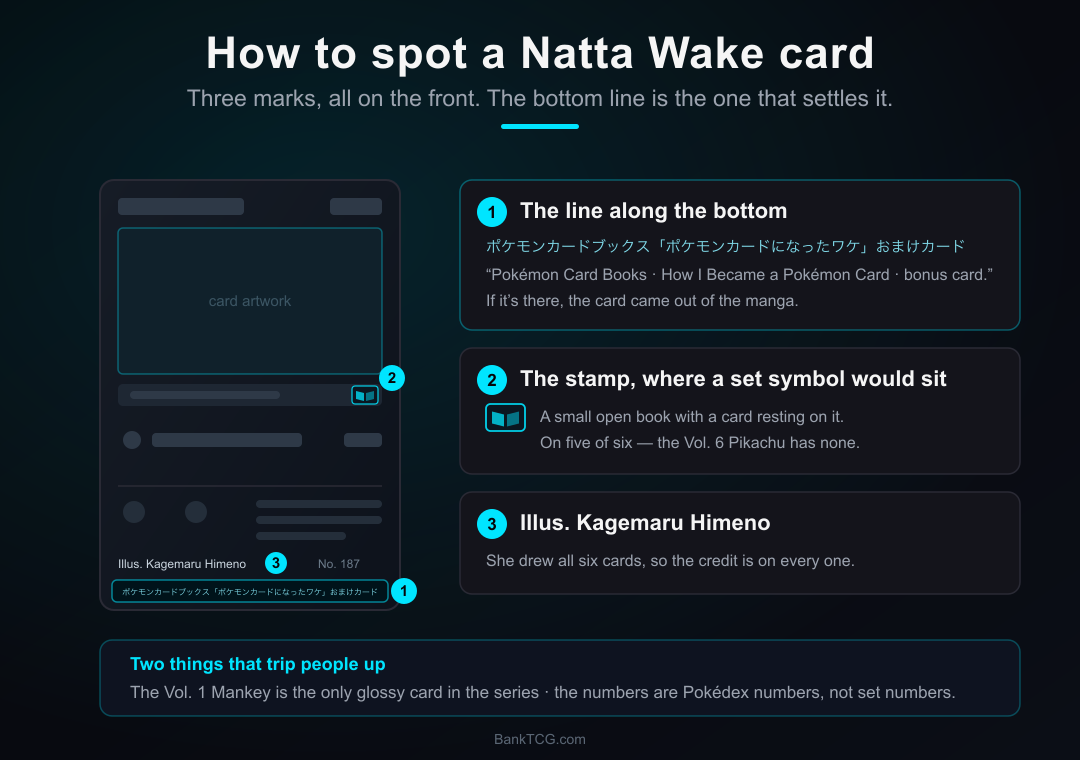
The bottom line is the one that settles it: ポケモンカードブックス「ポケモンカードになったワケ」おまけカード, "Pokémon Card Books, How I Became a Pokémon Card, bonus card." A card without it did not come out of the manga. The open-book stamp is a useful second check and one that fakes tend to render poorly, though remember the Vol. 6 Pikachu doesn't have one. How to spot a fake Pokémon card covers the fundamentals. For anything at Birthday Pikachu money, buy it already graded.
Birthday Pikachu [Natta Wake] #25 on eBay
Frequently Asked Questions
What does "Natta Wake" mean? It's shorthand for 「ポケモンカードになったワケ」(Pokémon Card ni Natta Wake), which translates as "How I Became a Pokémon Card", the title of the manga the cards came in.
How many Natta Wake cards are there? Six, one per manga volume: Mankey, Psyduck, Jynx, Sunkern, Hoppip and _____'s Pikachu, published between May 1999 and September 2001.
Which Natta Wake card is the most valuable? The Vol. 6 _____'s Pikachu, usually called Birthday Pikachu, by a wide margin. Its PSA 10 median is around $4,050 as of July 2026, against $199 for the cheapest card in the set.
Are Natta Wake cards rare? They're genuinely scarce but not as scarce as commonly claimed. PSA 10 populations range from 44 for the Mankey to 130 for the Birthday Pikachu, and PSA has certified 2,544 copies across the series in grades 8-10. The frequently repeated claim of "fewer than 80 in PSA 10 each" is not accurate.
Is the Natta Wake Mankey really glossy? Yes. It's the only card of the six printed with a glossy finish. The other five use standard card stock.
Who illustrated the Natta Wake cards? Kagemaru Himeno, who also wrote and drew the manga itself. She has illustrated 635 Pokémon TCG cards since the Jungle expansion.
Tracking What You Own
Prices on a series this thin move on a handful of sales, which makes a dated record of what you paid and what comparable copies are doing more useful than a single headline number. BankTCG scans and tracks Japanese cards alongside the rest of your collection, so a portfolio spanning JP promos, graded slabs and modern English sets stays in one place with a running valuation rather than a spreadsheet you update twice a year.
Download BankTCG on the App Store and see what your collection is actually worth.
Population figures: PSA Population Report, retrieved July 27, 2026. Sales data: 958 recorded sales, May 2018 to July 27, 2026, medians shown. Figures in the July 29 update come from a separate pull covering the same sources through July 28, 2026. Card values move; every figure here is a snapshot of its stated date.