Quick Facts
| Feature | PSA | BGS (Beckett) | CGC Cards |
|---|---|---|---|
| Top grade | Gem Mint 10 | Pristine 10 (Black Label) | Pristine 10 |
| Subgrades | No | Yes (free, on every card) | Yes (paid add-on) |
| Bulk price (2026) | $24.99/card | $14.95/card | $15/card |
| Express price (2026) | $149/card | $79.95/card | $100/card |
| 2025 TCG market share | ~69% | <5% | ~25% |
| Best for | Vintage Pokémon, max liquidity | Black Label chase on modern | Modern Pokémon, error/promo authentication, value |
The card grading industry just went through its biggest consolidation in history. In December 2025, Collectors, the parent company of PSA, acquired Beckett Grading Services, meaning three of the four major graders (PSA, BGS, and SGC) now share a corporate parent. CGC is the only fully independent major grader left.
That changes the math for every collector deciding where to send a card in 2026. This is a complete updated guide to PSA, BGS, and CGC: how each works, what each costs right now, where each one wins, and how to decide between them.
Why Professional Grading Matters
A professional grade is more than a number. It's an authentication, a condition certification, and the single biggest factor determining a card's resale value. Grading companies act as a trusted third party, giving both buyers and sellers confidence in what they're trading.
For an investor, the difference between a raw card and a top-grade slab can be 10 to 50× the price. For a collector, it's a way to permanently preserve and validate a treasured piece. And in 2026, with $50M+ in counterfeit cards estimated to be circulating online each year, third-party authentication is more important than it has ever been. (Buying a slab secondhand? Cross-check its label against the PSA Label Museum to confirm the style matches the cert year.)
The Industry Shake-Up You Need to Know About
Before getting into the service comparison, here's the context that changes how you should think about grading in 2026:
- December 15, 2025: Collectors (parent of PSA) acquired Beckett. Combined with their February 2024 SGC acquisition, Collectors now controls roughly 80% of the grading market.
- January 2026: New York Congressman Pat Ryan publicly urged the FTC to investigate the consolidation as a potential antitrust issue.
- Beckett's leadership has confirmed BGS will continue to operate independently under Collectors with its own staff, grading standards, and slab design, at least for now. New general manager: Colin Hudson.
- CGC Cards is now the only fully independent major grader, which has become a meaningful selling point for the company.
What this means practically: choosing PSA, BGS, or SGC now means choosing one division of the same parent company. Choosing CGC means choosing the only independent option. Whether that matters to you depends on how much you value market diversity.
Deep Dive: PSA
PSA (Professional Sports Authenticator) is the industry standard. In 2025, PSA graded 19.26 million cards, roughly 72% of all card grading globally, including 76% of sports cards and 69% of TCG. On eBay, cards graded by Collectors-owned services (PSA + BGS + SGC combined) account for around 96% of all graded card sales. PSA alone is responsible for 82% of graded sports card sales on the platform.
Grading Scale
- 1 to 10 scale with half-grades at 1.5, 2.5, 3.5, 4.5, 5.5, 6.5, 7.5, and 8.5
- No PSA 9.5: PSA has explicitly chosen not to introduce one, considering Mint 9 and Gem Mint 10 sufficient
- Top grade: Gem Mint 10
- Important 2025 update: PSA tightened its Gem Mint 10 centering standard to 55/45 front, 75/25 back (previously 60/40 front). PSA 10s graded after this change are theoretically harder to achieve
Subgrades
PSA does not provide subgrades. You receive only the overall grade.
Slab Design
Sonically sealed, tamper-evident hard plastic case. PSA refreshed its label design in 2024 with the new "PSA LightHouse" branding, but the iconic red Gem Mint 10 banner remains.
2026 Pricing (After February 10, 2026 Increase)
PSA raised prices in February 2026, the second increase in roughly five months. Current per-card pricing:
- Value Bulk: $24.99 (95 business days; requires Collectors Club membership $149 to $199/year; 20-card minimum)
- Value: $32.99 (no membership required; max declared value $499)
- Value Plus / Regular: $49.99 to $79.99 (turnarounds extended 5 days in Feb 2026)
- Express: $149 (10 to 15 business days)
- Super Express: $299 (5 to 7 business days)
- Walk-Through: $599 (5 to 7 business days)
- Premium 10: Starting at $9,999 for cards up to $350,000 declared value
In-person same-day grading at major shows runs $150 (Collectors Club members) or $250 (general public).
Turnaround Times
The pain point. Bulk service is currently quoted at 95 business days, roughly 4.5 calendar months. PSA president Ryan Hoge himself called this "an unacceptable level" in January 2026. PSA processes around 90,000 cards daily globally as of 2026 (vs. 15,000/day in 2021) and now employs 3,000+ people.
Pros and Cons
Pros: Highest resale value across nearly every category. The most liquid graded card market by a wide margin. The most recognised name in the industry by serious collectors and casual sellers alike.
Cons: No subgrades. Slowest turnaround times among the three majors. Most expensive at every tier. Recent service issues, including a December 2025 buyback program controversy where submitters reported PSA 9 cards being repurchased then reappearing as PSA 10s in the registry.
Deep Dive: BGS (Beckett)
Beckett Grading Services has been the connoisseur's choice for decades, particularly for collectors who want the most detailed feedback and the chance at the rarest grade in modern card grading.
Grading Scale
- 1 to 10 scale with 0.5 increments throughout
- Top grade hierarchy:
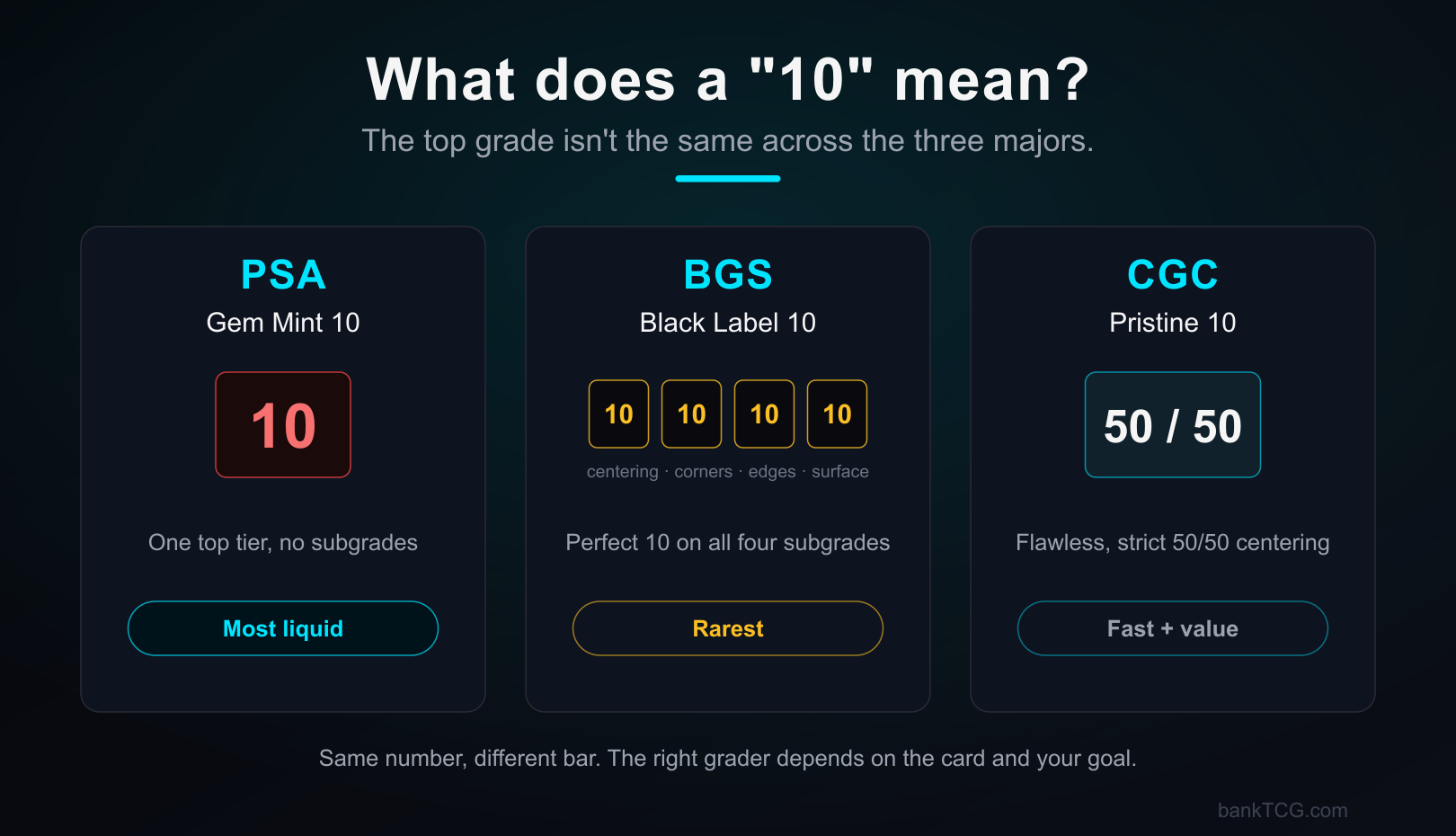
- Pristine 10 "Black Label": perfect 10 in all four subgrades. Extraordinarily rare; can sell for multiples of a PSA 10
- Pristine 10 (gold label): overall 10 without all-perfect subgrades
- Gem Mint 9.5: the most common "top tier" grade collectors actually receive; conceptually equivalent to a PSA 10
- Mint 9 below that
A common misconception worth clearing up: a BGS 9.5 is NOT the equivalent of a PSA 9. It's the equivalent of a PSA 10 in condition terms, it just typically sells for slightly less due to PSA's market dominance.
Subgrades
This is BGS's defining differentiator. Every BGS-graded card includes four free subgrades: centering, corners, edges, and surface. A BGS 9.5 with a 10/9.5/9.5/9.5 subgrade breakdown sells for substantially more than one with 9/9.5/9.5/9.5.
Slab Design
Sonically welded, water-resistant case with a sealed archival inner sleeve. Labels are color-coded by grade tier: silver/black for most cards, gold for Pristine 10, and the iconic black label for the perfect-subgrade Pristine 10. Subgrades appear on the front of every label, which is the visual hallmark of a BGS slab.
2026 Pricing (Direct from Beckett)
Pricing has not changed since the Collectors acquisition. Per Beckett's official site:
- Base: $14.95/card (no subgrades) or $17.95/card (with subgrades), 75+ business days
- Standard: $34.95/card with subgrades, 45 business days
- Express: $79.95/card with subgrades, 15 business days
- Priority: $124.95/card with subgrades, 5 business days
Add-ons: Autograph Card +$5, Oversized +$8, Relabel $10, Recase $10. No membership fees, no value-based upcharges, no minimum or maximum declared value per service level, a notable contrast to PSA's tier-by-value pricing — where a card that grades above your declared value gets rebilled at a higher tier. (Our PSA Upcharge Calculator works out what that second bill would be.)
Turnaround Times
In late 2025, Beckett published an advisory acknowledging TCG submission backlog and adjusting timelines. Current quotes are 75+ business days for Base and 45 business days for Standard. Beckett also introduced a limited-availability TCG-specific Express tier to keep accepting TCG submissions despite the backlog. BGS has not halted TCG submissions; that's a persistent rumor that's incorrect.
Pros and Cons
Pros: The four free subgrades give buyers transparent insight into a card's flaws. The Black Label creates a rare "chase" element that can produce massive premiums on modern cards. Slab is the most durable of the three majors. No value-based upcharges.
Cons: Lower resale value than PSA across most categories (with the major exception of Black Label modern cards). Bulkier slab some collectors find harder to display. Now under Collectors ownership, raising long-term independence questions.
Deep Dive: CGC Cards
CGC Cards is the newest of the three majors, and the fastest growing. Originally launched as CGC Trading Cards in 2020, then merged with Certified Sports Guaranty (CSG) into a single CGC Cards brand in July 2023, the company has graded over 6 million cards lifetime, including more than 4 million TCG/non-sports and over 3 million Pokémon cards.
In 2025, CGC graded 4.92 million cards, a 121% year-over-year increase, capturing approximately 25% of the TCG market, second only to PSA. They're the only fully independent major grader left after the December 2025 Collectors-Beckett deal.
Grading Scale
- 1 to 10 scale with half-point grades (CGC offers a 9.5; PSA does not)
- Pristine 10 (special gold label): Virtually flawless. Requires 50/50 centering on both front and back, flawless color and gloss, perfect under 10× magnification
- Gem Mint 10: Receives a 10 overall but one criterion doesn't quite meet Pristine standards. Centering not to exceed ~55/45 front, 75/25 back
- Mint+ 9.5, Mint 9, 8.5, 8 and so on down to Poor 1
- Authentic Altered designation for trimmed or recolored cards
- Autographs are graded separately on a 5 to 10 scale
The Pristine 10 vs Gem Mint 10 distinction is CGC's structural advantage: they recognise two tiers of perfect grade, with stricter centering for the top tier. PSA doesn't subdivide its 10s; BGS does (with the Black Label) but requires perfect quad-10 subgrades, which is a different standard.
Subgrades
CGC offers subgrades only as a paid add-on, not standard. This sits between BGS (always free) and PSA (not offered at all).
Slab Design
Refreshed in 2022 with a streamlined silver design and holographic CGC logo. Pristine 10 cards receive a distinctive gold foil label. Inner well plus separately sealed sleeve for impact protection. Stackable design. Widely praised for crystal-clear optics, UV protection, and display friendliness compared to BGS's bulkier slabs.
2026 Pricing (After January 6, 2026 Increase)
CGC raised prices across the board on January 6, 2026:
- Bulk: $15/card (25-card minimum)
- Economy: $18/card
- Standard: $55/card
- Express: $100/card
- Walk-Through: $300/card
- Unlimited Value: $300 + 1% of fair market value
- Pack-pulled autograph add-on: $5/card
Membership tiers (Free Collector, Associate, Premium, Elite) save 10 to 20% on grading depending on level.
Turnaround Times
CGC marketed itself as "Fastest in the hobby" through late 2025, and the data largely supports that. Bulk runs around 120 business days at the slowest tier; Standard typically clears in 20 to 45 business days; Express in around 5 business days. Bulk modern Pokémon submissions have been quoted at end-to-end turnarounds as low as 18 days in recent reporting.
Pros and Cons
Pros: The only fully independent major grader. Fastest turnaround times of the three. Strongest authentication record on obscure variants and error cards (CGC was the first to grade the Prerelease Raichu in 2023). Pristine 10 commands genuine premiums on certain modern Pokémon and MTG cards. International offices in London, Munich, Dubai, Hong Kong, and Shanghai.
Cons: Lower resale value than PSA on mainstream vintage cards. Smaller registry community. Subgrades cost extra rather than coming standard.
Notable CGC-Graded Sales
CGC's growing reputation is reflected in recent record sales:
- $3,000,000: 1993 Magic: The Gathering Black Lotus, CGC Pristine 10 (private sale, 2024). All-time MTG record
- ~$2,000,000: Pikachu Illustrator, CGC Gem Mint 10 (February 2026)
- $640,507: 1998 Trophy Kangaskhan, CGC Pristine 10 (Goldin, March 2026). All-time public Kangaskhan record
- $360,000: 1998 Galaxy Star Blastoise, CGC 8.5 (Heritage, January 2021)
The Prerelease Raichu story specifically cemented CGC's authentication reputation: a card PSA initially refused to grade because it "shouldn't exist," CGC successfully authenticated using XRF scanning, multi-spectral imaging, and provenance research in 2023.
Resale Value Head-to-Head
Which graded card sells for more depends entirely on what kind of card you have. Some general rules for 2026:
Vintage Pokémon (1996 to 2003): PSA wins, often dramatically. A PSA 10 1st Edition Charizard sells for around $550,000; equivalent BGS 9.5 and CGC Pristine 10 copies sell for substantially less. The vintage market has trusted PSA for decades, and that liquidity premium is real.
Modern Pokémon (Scarlet & Violet era SIRs, ultra-modern chase cards): Closer race. PSA's premium over CGC on modern compresses to roughly 5 to 10%, and CGC Pristine 10 has actually outsold PSA 10 on certain ultra-modern cards. A Disney Lorcana Mickey Mouse 5/C1 CGC Pristine 10 recently sold for $20,770 vs $18,000 for the top PSA 10. Mega Zygarde ex SIR copies have sold for roughly 6% more in CGC Pristine 10 than PSA 10.
Black Label / quad-10 chase: BGS dominates by definition. A BGS Black Label 10 on a chase modern card or Reserved List MTG can sell for multiples of a PSA 10.
Trophy and error cards: CGC's authentication reputation makes them increasingly competitive here, though PSA still leads on mainstream trophy cards by sale price.
A persistent myth worth correcting: a BGS 9.5 is not equivalent to a PSA 9 in value. BGS 9.5 is conceptually the same condition tier as a PSA 10. In resale, BGS 9.5s typically sell between PSA 9 and PSA 10, much closer to PSA 10 than PSA 9.
TCG Decision Matrix
| Use case | Best service | Why |
|---|---|---|
| Vintage Pokémon (1996 to 2003) | PSA | Highest liquidity; vintage market strongly favors PSA; Gem Mint 10 premium is material |
| Modern Pokémon (SIRs, chase cards) | CGC or PSA | PSA premium has compressed; CGC is significantly faster and cheaper, and Pristine 10 outsells PSA 10 on certain ultra-modern cards |
| Japanese Pokémon | PSA or CGC | PSA dominates; CGC has growing Asian-market presence |
| Trophy / promo / error cards | CGC for esoteric authentication, PSA for max liquidity | CGC's Prerelease Raichu work and Trophy Kangaskhan Pristine 10 demonstrate technical depth |
| Modern cards you believe are flawless | BGS | Only company offering the Black Label; massive premium when achieved |
| Speed-priority submissions | CGC | Fastest turnarounds at every tier |
Cross-Grading: Cracking and Resubmitting
All four major graders (PSA, BGS, CGC, SGC) offer formal "Crossover" services. You submit a card already in another company's slab; the grader will only crack and reholder it if the new grade meets your specified minimum.
A common 2026 strategy is cracking a strong-subgrade BGS 9.5 (e.g., 10/9.5/9.5/9.5) and resubmitting to PSA hoping for a 10. The risk is real: outcomes range from a profitable PSA 10 to a value-destroying PSA 9. AI pre-grading apps have become a standard pre-submission step in 2026 to hedge this risk, with several services claiming 90%+ accuracy.
The Bank TCG app provides AI pre-grade estimates with 94% PSA accuracy, helping you decide whether a card is worth submitting before you commit to grading fees.
Before submitting, also make sure you can spot fake Pokémon cards, since counterfeit submissions are a costly mistake, and grading services will return them ungraded with no refund.
How Bank TCG Helps You Choose
The Bank TCG AI grading tool analyses your card's centering, corners, edges, and surface to predict which grading service will give you the best return on investment. The technology helps you decide whether to send a card to PSA for liquidity, BGS for the Black Label chase, or CGC for value and speed, before spending hundreds in grading fees.
If you're trying to figure out whether you have a 1st Edition or Shadowless card before grading, our complete guide to print run identification walks through every visual indicator. And if you want to see what your cards could be worth at the top of the market, check our most valuable Pokémon cards in 2026 for current record sales by grade.
Frequently Asked Questions
Should I grade my cards with PSA, BGS, or CGC?
For vintage Pokémon (pre-2000), PSA almost always offers the best resale value. For modern cards in potentially perfect condition, BGS offers the chance at a Black Label 10, which can command massive premiums. For modern cards where you want speed, value, and a fast turnaround, CGC is increasingly the smart choice. Use the Bank TCG app to pre-grade your card and determine which service is best for your specific situation.
What's the difference between a PSA 10, BGS Black Label 10, and CGC Pristine 10?
A PSA 10 is the highest grade PSA offers, and they don't subdivide it further. A BGS Black Label 10 requires perfect 10 subgrades in all four categories (centering, corners, edges, surface) and is the rarest of the three. A CGC Pristine 10 is a perfect overall grade with strict 50/50 centering requirements but doesn't require all-perfect subgrades. Pristine 10s are rarer than PSA 10s but more achievable than BGS Black Labels.
How much does it cost to grade cards with PSA vs BGS vs CGC in 2026?
After February 2026 price increases at PSA and CGC, the cheapest entry points are: BGS Base $14.95/card, CGC Bulk $15/card, and PSA Value Bulk $24.99/card. Express services run $149 (PSA), $79.95 (BGS), and $100 (CGC). Beckett does not charge value-based upcharges, while PSA's pricing scales significantly with declared value.
Can I cross-grade a card from PSA to BGS or CGC?
Yes. All four major graders offer formal Crossover services that let you submit a card already in another company's slab. The grader will only crack and reholder if the new grade meets your specified minimum, protecting against downgrades. Even with that protection, cross-grading carries risk and is best done with high-confidence cards or AI pre-grading support.
How long does PSA vs BGS vs CGC grading take in 2026?
PSA bulk is currently around 95 business days (about 4.5 calendar months), and PSA's own president called this "unacceptable" in January 2026. BGS Base is 75+ business days; Standard is 45 business days. CGC is the fastest of the three at every tier, with Standard typically clearing in 20 to 45 business days and bulk modern Pokémon submissions sometimes finishing end-to-end in around 18 days.
Is BGS still a good choice now that it's owned by PSA's parent company?
Beckett's leadership has confirmed that BGS will continue to operate independently within the Collectors umbrella, with its own staff, grading standards, and use of subgrades. The slab and grading scale will remain unchanged. The long-term question is whether independence holds, but as of April 2026, BGS still operates as a distinct service.
Why is CGC Cards growing so fast in 2026?
A combination of factors: faster turnaround times than PSA, lower per-card costs than PSA, the only fully independent major grader after the Collectors-Beckett acquisition, strong technical reputation on error/promo authentication, and a Pristine 10 grade tier that's rarer than PSA 10 and now commands premiums on certain modern cards. CGC graded 4.92M cards in 2025, a 121% year-over-year increase.
Should I worry about counterfeit slabs?
Yes. Counterfeit slabs exist for all three services. Always verify a slab's certification number on the grader's official website (PSA, BGS, and CGC all offer free online lookup tools). For high-value cards, buy from established auction houses or dealers with verifiable track records. Industry estimates put roughly $50 million in counterfeit Pokémon cards circulated through online marketplaces in 2025 alone.