Quick Facts
- An error card is a mistake made at the factory, such as a missing ink layer, a miscut or a wrong word. Damage that happens after the pack is opened is not an error.
- CGC grades four corrected cards from the 2001 reprint of the Japanese Gold, Silver, to a New World set as separate variants: Pichu, Donphan, Quilava and Darkness Energy.
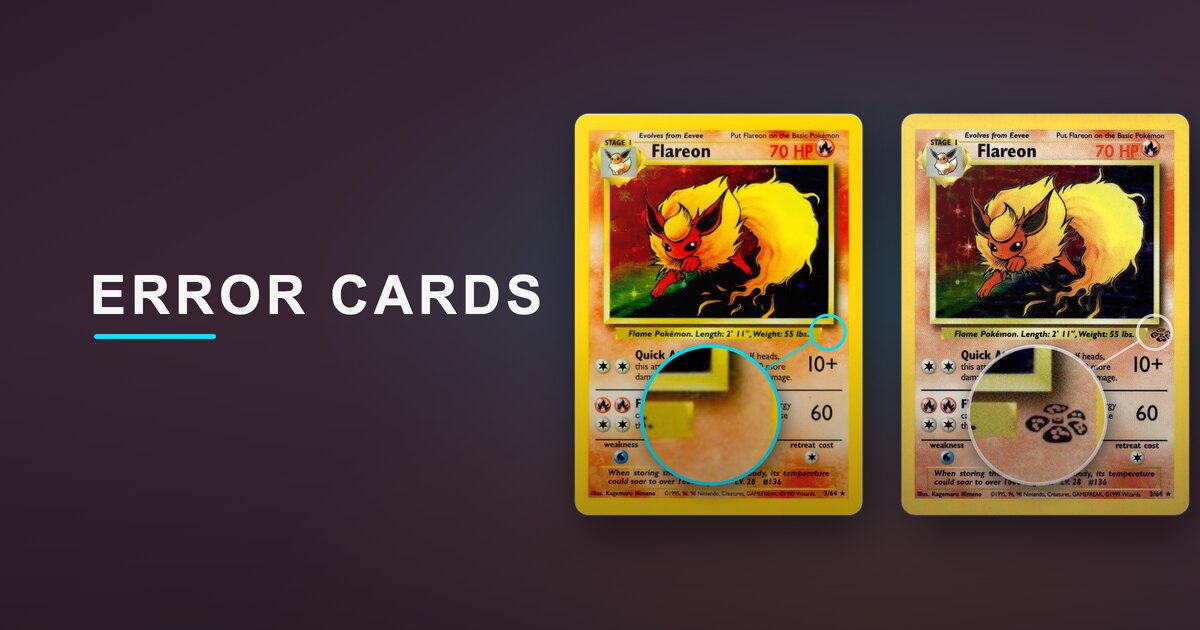
- A batch of the 16 holo rares from English Jungle (1999) was printed without the set symbol. These No Symbol holos are among the best known English errors.
- An error only earns a premium when it is documented and repeats across copies. A single ink spot is usually damage, and square cut cards are often faked from uncut sheets.
- Grading companies name recognised variants on the slab label, which is the strongest proof an error is real.
Most cards sold as "rare errors" are ordinary cards with damage. A scuff is not an error, and neither is a bent corner. A factory mistake is, and that difference decides whether a card is worth more than its normal version.
An error card left the printing plant wrong: an ink layer that never landed, a cut that drifted on the sheet, or text the publisher fixed in a later printing. Once a mistake is caught and corrected, the wrong version stops being made, and that limited supply is what collectors pay for.
This guide covers the main types of vintage Pokémon errors, the specific errors grading companies recognise, and how to tell a factory error from damage or a fake.
A Documented Example: The Corrected 2001 Japanese Reprint
The clearest case of an error and its correction is the Japanese Gold, Silver, to a New World set, the Johto era set that became English Neo Genesis. Media Factory released it on 4 February 2000, with 96 cards including 60 new Pokémon.
The 2000 printing had several mistakes, and a short reprint in 2001 corrected them. That leaves two versions of the affected cards. In December 2022 CGC announced that it would grade the two printings as separate variants, and it updated the certification data on cards it had already graded. The four cards it named:
| Card | The 2000 printing | The 2001 correction |
|---|---|---|
| Pichu (No. 172) | The Pokédex entry used the word denki | Changed to dengeki, with the period on the second line moved to make room |
| Donphan (No. 232) | No 10× damage figure next to its first attack, so it looked like it did no damage | The damage figure was added |
| Quilava (No. 156) | The second attack's text ran five lines | Shortened to four lines |
| Darkness Energy | Told players to put 10 damage counters on the attached Pokémon at the end of the turn | Corrected to 1 damage counter |
CGC added that it would also grade other variants from the set, such as Typhlosion (No. 157), without describing that card's difference.
This is what a solid error looks like: the difference is specific, documented and the same on every copy. A genuine error has to meet that standard before it carries any premium.
This set is Japanese, and Japanese slabs read differently from English ones. If you're buying graded copies, our PSA Japan vs USA slab guide explains the label and authentication differences.
The Main Types of Error Cards
Grading companies sort factory errors into a few repeatable types. The ones below are the ones that matter for vintage Pokémon, based on CGC's guide to error card types.
Cutting errors
- Off center: the margins are clearly uneven. This is very common, and only the extreme cases count as errors. Mild off centering just lowers the grade (more on that below).
- Miscut: the cut drifted on the sheet. A minor miscut shows part of an alignment mark or loses some of the design. A major miscut shows parts of other cards.
- Square cut: the card skipped the corner rounding step and kept square corners. Be careful with these. Sellers cut cards out of uncut sheets and pass them off as errors, and CGC will not grade a square cut card unless it can be traced back to a Wizards of the Coast employee.
Ink errors
- Missing print layer: the sheet went through without one of the four CMYK colours, so the colours look wrong. Sun fading can look similar, which is why graders check how the card reacts under UV light.
- Additional ink: extra ink on a plate or roller leaves a splotch where there shouldn't be one.
- Insufficient ink: low ink left the white layer thin, so much more of the holofoil pattern shows through than intended.
- Offset printing: a loose plate shifted during printing and left a faint "ghost" image behind the main one.
Holofoil errors
- Missing holo layer: a card that should be holo came out flat, usually because the wrong stock was used or the foil was never applied.
- Holo splice and end of roll: splice tape from joining two foil rolls ended up on a sheet, or the roll ran out partway and left part of the art without foil.
- Holo bleed: the holo pattern spreads beyond the art box. Collectors call this an error, but CGC does not recognise holo bleed as one, so don't expect a CGC label to name it.
Packaging and back errors
- Crimp: a card was caught in the heat sealer that closes booster packs and took the sealer's pattern on its edge. A partial crimp shows part of the pattern; a "crimped and cut" card also lost part of its edge.
- Inverted back: the sheet was fed the wrong way round, so the front is upside down relative to the back.
- Blank back: a sheet with no back printing was used for the fronts. CGC describes this as rare.
Famous English Errors
A few vintage English errors are documented well enough that grading companies and collectors treat them as named variants.
Jungle No Symbol holos (1999)
The best known English error. During the Unlimited printing of Jungle, a batch of the set's 16 holo rares was printed without the Jungle set symbol, the small flower that normally sits below the bottom right corner of the artwork. Only the holos are affected. The symbol was restored on later copies, so No Symbol versions of cards like Flareon, Jolteon, Vaporeon, Snorlax and Wigglytuff are collected as their own variant. PSA runs a Set Registry showcase for the complete 16 card set. Our Base Set print run guide also covers it, because it is often confused with Base Set holos.
Snorlax [No Symbol] #11 on eBay
Butterfree "d Edition" (Jungle 1st Edition)
On some 1st Edition copies of Jungle Butterfree (33/64), the "1" in the "Edition 1" stamp looks like a lowercase "d", so the stamp reads "Edition d". Bulbapedia and other collector sources put it down to a small ink obstruction on the stamp. Wizards of the Coast never published an explanation.
Butterfree [D Edition Error] #33 on eBay
Faint and partial 1st Edition stamps
Some 1st Edition cards have a grey, faint or incomplete stamp instead of a clean black one, caused by uneven ink during stamping. These are different from a stamp that has worn away on a played card. The print run guide has more on 1st Edition stamps.
Error, Damage or Fake?
Most error claims fail here. Before treating a card as an error, rule out damage and fakes.
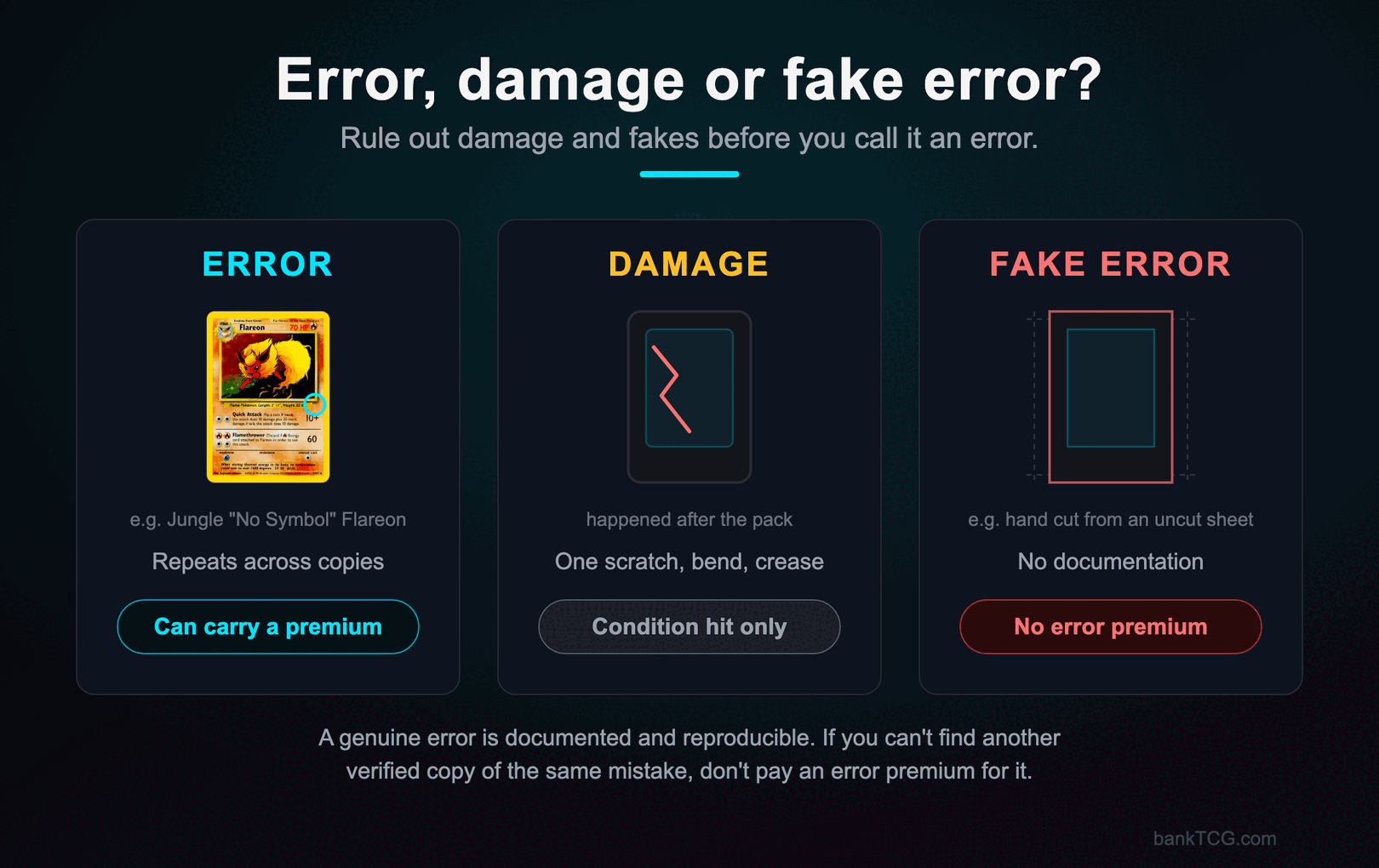
It's probably damage if:
- No other known copy has the same mark. A single scratch, dent, crease or ink rub is damage. Factory errors repeat across many cards.
- It sits on the surface and looks mechanical, like a scuff, bend or fingerprint, rather than printed into the card.
- A "miscut" has rough or uneven edges from hand cutting rather than the straight factory cut of a real sheet miscut.
It's probably a fake error if:
- The card has square corners and a story that sounds too good. Square cut cards are among the most faked errors.
- The "error" shows up on an expensive chase card and nowhere else, with no record from collectors or grading companies. Real errors get catalogued.
- Anything about the stock, weight, texture or print quality is off. If you're not sure the card itself is genuine, start with our guide to spotting a fake Pokémon card.
The rule: a genuine error is documented and repeats. If you can't find another verified copy with the same mistake and no grading company will name it on a label, don't pay an error premium for it.
This is why grading matters for errors. PSA, BGS and CGC name recognised variants on the slab label, so a graded No Symbol Jungle holo or a graded 2001 corrected reprint carries its proof with it. A raw card sold on a story does not.
A Note on Value
Be wary of any fixed price for an error card. The premium depends on how well known and how scarce the error is, which card it's on and its condition, and it moves with the wider vintage market. A No Symbol holo of a popular Pokémon in high grade sells for more than the normal version; a minor ink spot on a common usually adds nothing.
Check recent sold prices for the exact card and variant before you buy or sell, rather than a figure from a forum post.
How BankTCG Helps
When you sort through a vintage binder, the first job is knowing what each card is and what it's worth.
BankTCG lets you:
- Scan several cards in one photo and get a price for each, from a database of 190,000+ cards across Pokémon, Yu-Gi-Oh!, Magic and One Piece.
- Measure a card's centering from a photo, so you can see whether an off center card is extreme enough to matter or just a lower grade.
- Track your collection in the Vault, with what you paid and what it's worth now.
Scanning is free and needs no account.
If you find an error worth grading, check the costs first with the free PSA Profit Calculator, see whether it's worth sending in with our data driven grading guide, and learn to read the label with the PSA Label Museum.
FAQ
What counts as a real Pokémon error card? A mistake made during manufacturing, such as a missing ink layer, a miscut, a wrong word or a missing set symbol, that repeats across copies. Damage after the pack is opened, like scratches, dents and creases, is not an error, however unusual it looks.
Are error cards always valuable? No. Value depends on how well known and scarce the error is, which card it's on and the condition. Mild off centering or a stray ink spot on a common is worth little. Documented, named errors on popular cards, like the Jungle No Symbol holos, are the ones that sell for a premium.
What is the corrected 2001 Japanese reprint? The Japanese Gold, Silver, to a New World set (2000) had text and gameplay mistakes that a short 2001 reprint fixed. Since December 2022, CGC has graded the 2000 and 2001 versions of Pichu, Donphan, Quilava and Darkness Energy as separate variants.
How do I avoid buying a fake error card? Be very careful with square cut cards and with unique "errors" on expensive cards that no collector or grading company has documented. Both are often faked. For anything valuable, buy a copy already graded by PSA, BGS or CGC with the variant named on the label.
Is an off center card an error? Only when it's extreme. Mild off centering is normal printing variation and just lowers the grade. An off center or miscut card that shows part of the next card on the sheet is the kind collectors treat as an error.
Sources & Further Reading
- CGC: "CGC Trading Cards Now Grading Variants for 2001 Pokémon TCG Set" (the Pichu, Donphan, Quilava and Darkness Energy variants)
- CGC: "Error Card Types" (every error category CGC recognises)
- PSA: Pokémon Error Guide and the Jungle No Symbol Error Holos showcase
- Bulbapedia: Error cards
