Quick Facts
- "Unlimited" means any print run after the first. In Japan, the distinction carried an official stamp only from 2001 (the Pokémon VS and Web sets) to 2016 (the 20th Anniversary expansion): first prints got a "1 EDITION" mark, reprints didn't.
- Japan flips the English rule: Japanese sets sold most of their supply in the stamped first print, so for many sets the Unlimited reprint is the scarcer version — community research on Elite Fourum documents examples across the e-card, PCG, Legend, and XY eras.
- The stamp sits opposite the rarity symbol on most sets. For the bulk of the era (ADV through XY) the "1 EDITION" mark is in the bottom-left corner; on the earliest stamped sets (VS, Web, e-card era) it sits bottom-right, next to the rarity symbol. It never appears on Energy cards.
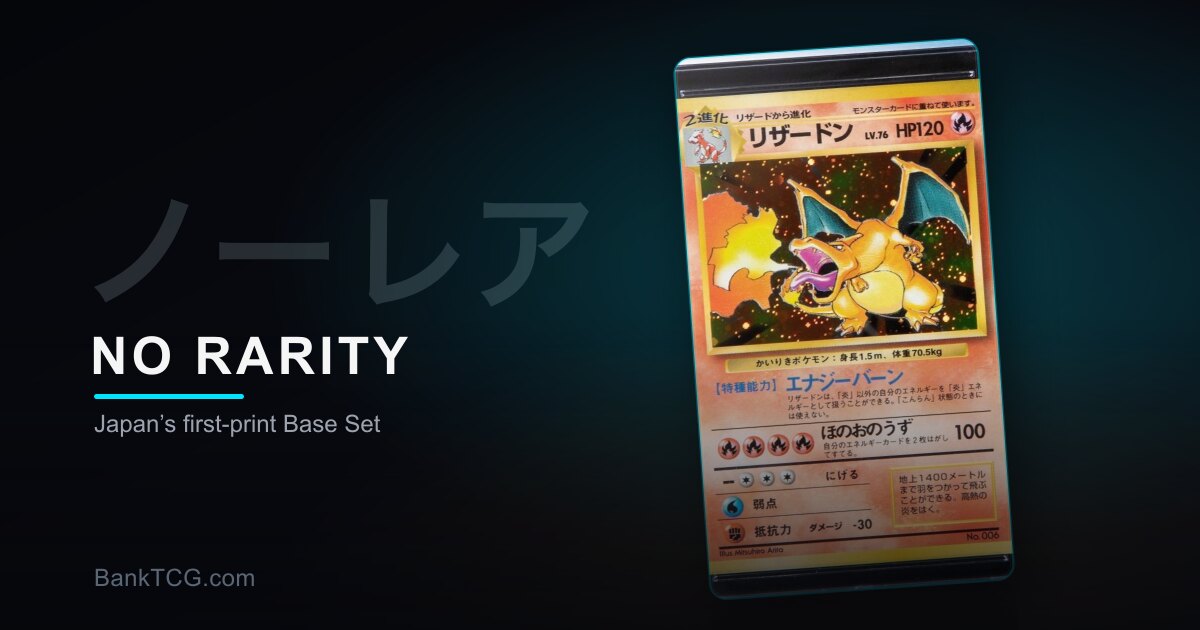
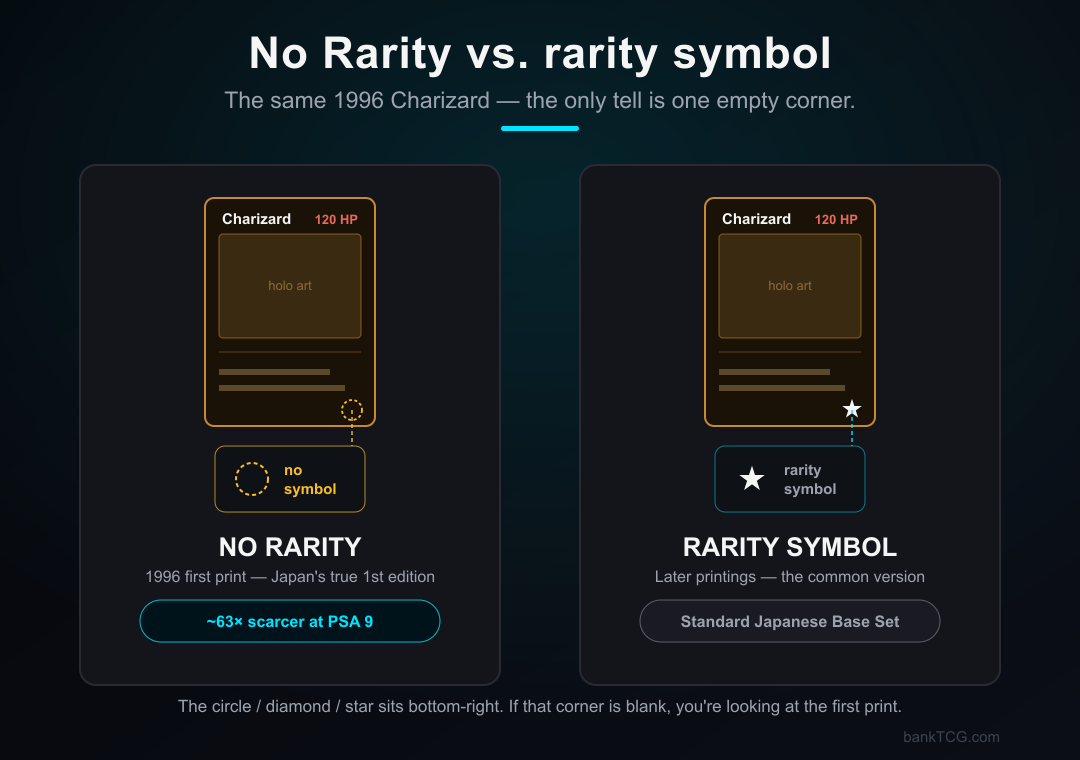
- The original 1996 Japanese Base Set had no rarity symbols at all. Those "No Rarity" cards are Japan's true first print — a PSA 10 No Rarity Charizard reportedly sold privately for $1.7 million in March 2026 (per CardLadder).
- The best supply is domestic-only: Yahoo! Auctions Japan and Mercari Japan effectively require a Japanese address, phone number, and payment method, which is why Western collectors buy through a proxy service.
- Unlimited usually costs less than 1st Edition for the same card — the market still prices the 初版 stamp, even on sets where Unlimited is objectively harder to find. That mismatch is the opportunity.
You've probably seen it happen on eBay: two copies of the same Japanese card, nearly identical photos, and one costs a multiple of the other. The cheap one is almost always the Unlimited print. For most collectors that's a discount. For a surprising number of sets, it's actually the rarer card hiding in plain sight — the exact reverse of how English print runs work. This guide covers what "Unlimited" actually means on Japanese cards, how to spot it in two seconds, which sets flip the rarity script, and where to buy without getting fleeced.
Disclosure: this guide links to Sendico, a Japan proxy service, via a referral link. If you sign up through it, BankTCG may earn a commission at no extra cost to you. We only point to services we'd actually use, and the how-to below works with any proxy.
What "Unlimited" Means on Japanese Cards
"Unlimited" is collector shorthand for any print run after the first. Simple in English: Wizards of the Coast stamped its first runs from Base Set (January 1999) through Neo Destiny (2002) — with two exceptions, Base Set 2 and Legendary Collection, which never had 1st Edition runs at all, so any stamped copy from those sets is fake. When Nintendo took over the TCG, English 1st Edition ended for good. Japan did things differently, and the differences are exactly what create the opportunities.
The three Japanese eras you need to know
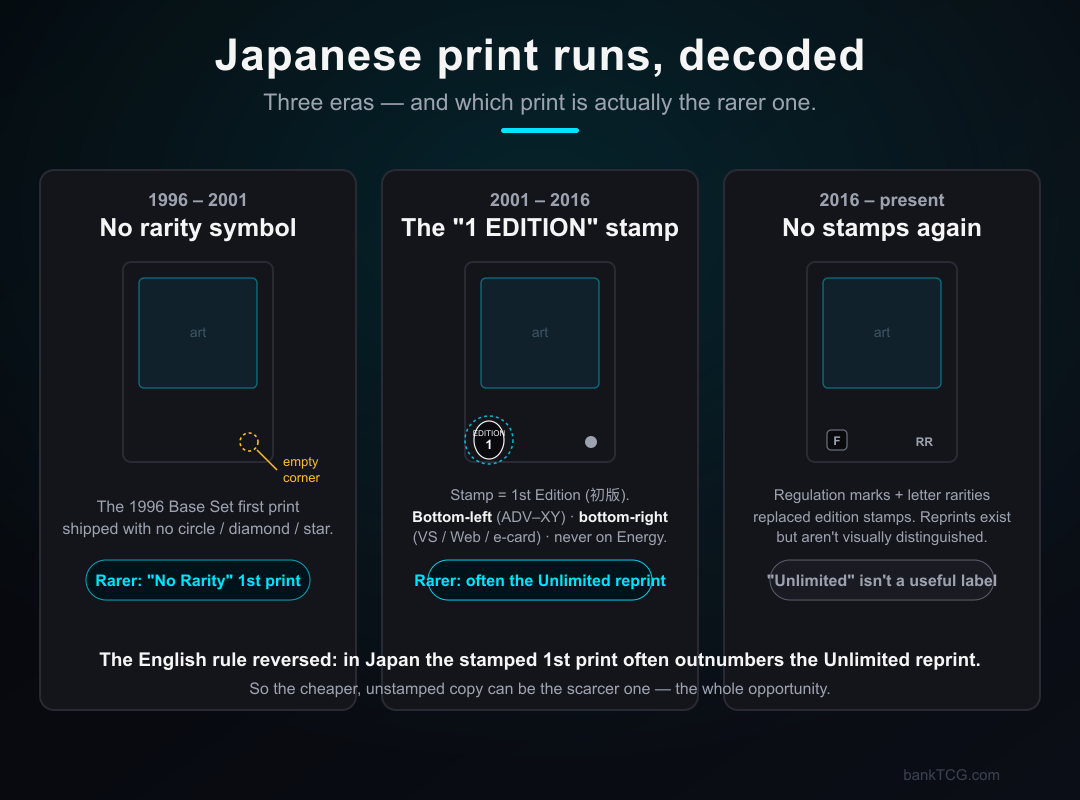
1996–2001: no stamps at all. Early Japanese sets didn't mark print runs with an edition symbol. The famous exception-that-proves-the-rule is the first printing of the Japanese Base Set, released by Media Factory on October 20, 1996 — more than two years before the English release. That first run shipped with no rarity symbol in the corner: no circle, diamond, or star. Rarity symbols were added in later printings (and were standard by Jungle's release in March 1997), which made the "No Rarity" run visually identifiable — and today it's treated as Japan's de facto true first edition. The scarcity is real, not just lore: PSA has graded only 43 No Rarity Charizards in PSA 9 and eight in PSA 10, against roughly 2,692 and 810 for the standard rarity-symbol Japanese Base Set Charizard — about 63× scarcer at PSA 9. The deep-dive research threads on Elite Fourum are the best primary source here, including the finding that No Rarity cards came from both booster packs and the starter deck. Everything printed after the symbol change is, functionally, unlimited — which is why nearly every Japanese Base Set card you'll see for sale looks identical apart from that tiny symbol. If you're hunting this era, start with our early Japanese Pokémon cards guide and our breakdown of true first editions.
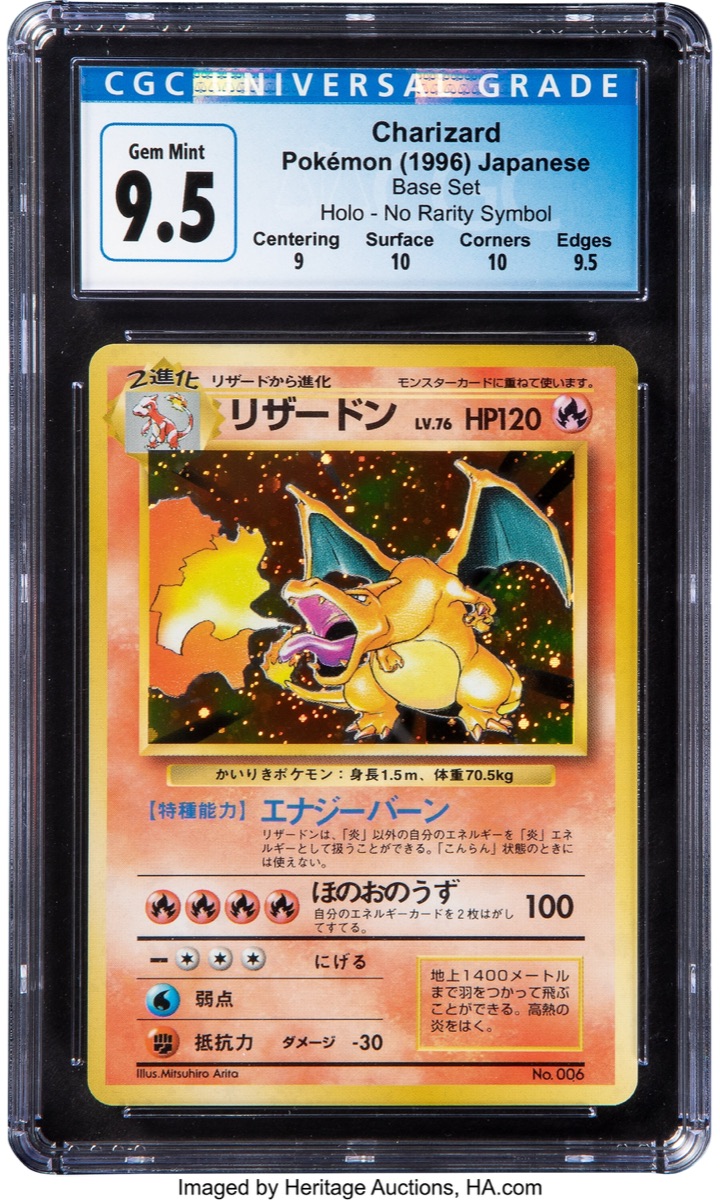 The No Rarity Charizard — the blank bottom-right corner is the whole tell. Photo: Heritage Auctions
2001–2016: the stamped era. Beginning with the Pokémon VS and Pokémon Web sets in 2001 — ironically, right as English 1st Edition was dying — Japan started marking first prints with its own symbol: a large numeral 1 sitting on the word EDITION, printed between two horizontal lines. The practice ran until the 20th Anniversary expansion in 2016. For any set in this window, the rule is binary: stamp = 1st Edition (初版, shohan), no stamp = Unlimited.
2016–present: no stamps again. Modern Japanese sets dropped edition marks entirely in favor of regulation marks and letter-code rarities. Reprint waves exist but aren't visually distinguished, so "Unlimited" isn't a meaningful label for current product.
Where exactly is the stamp? (Most guides get this wrong)
Half the articles online say bottom-right, the other half say bottom-left — and both are half-right. The reliable rule, per Bulbapedia: the mark sits on the opposite side from the rarity symbol (which is always bottom-right on Japanese cards), except on the earliest stamped sets, where it sits next to it.
- Most of the era (ADV/PCG through XY, roughly 2003–2016): stamp in the bottom-left corner.
- Earliest stamped sets (VS, Web, e-card era, 2001–2002): stamp in the bottom-right, beside the rarity symbol.
- Energy cards: never stamped in any era — an unstamped Japanese Energy card tells you nothing about its print run.
- Sealed product: the edition mark appears on booster packs and boxes from the stamped era, so you can identify a box's print run before opening it.
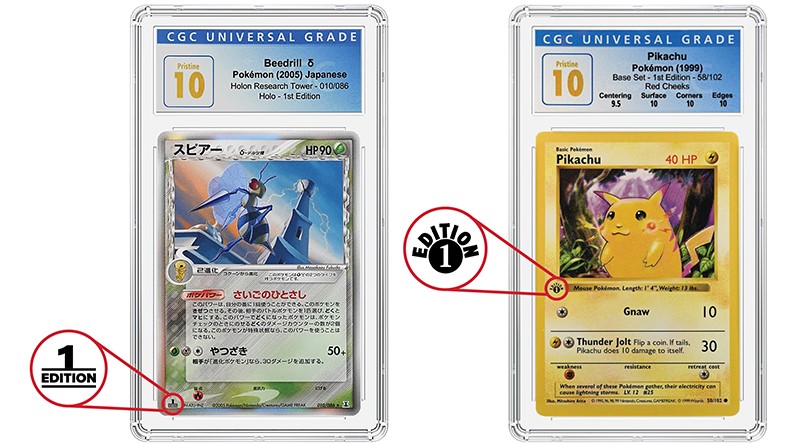 The "1 EDITION" mark, circled on a Japanese card (left) and an English one (right). Photo: CGC Cards
The plot twist: Japanese Unlimited is often the rarer print
Here's what trips up collectors trained on English cards. In the West, 1st Edition runs were small and Unlimited runs were massive. Japan worked the other way around: collectors and shops pre-ordered heavily, sets sold most of their supply in the stamped first print, and Unlimited packs were only produced if demand outlasted the initial run. CGC states it plainly: Japanese first edition releases are often far more common than their unlimited counterparts.
The community research goes further. A long-running Elite Fourum thread ("Sets where Unlimited is rarer than 1st edition") catalogues concrete cases:
- Japanese XY8 (Blue Shock / Red Flash) — a notoriously short Unlimited run, with XY9 and XY10 in similar territory
- World Champions Pack (WCP) — the Unlimited version is considered among the rarest of the PCG era
- L1, L2, and L3 (the Legend-era collections) — L1 Unlimited is confirmed for only a handful of cards
- E1 (the first e-card set) — only around fifteen cards have been confirmed to exist in Unlimited at all
Yet Japanese collectors traditionally prefer 初版, so 1st Edition still usually commands the premium. That means you can sometimes buy the objectively scarcer print for less. That's the whole game.
Why Chase Japanese Unlimited at All?
It's cheaper. For the same card, Unlimited generally sells below 1st Edition, and vintage-era Japanese classics generally sell below their English equivalents — a gap driven by Western nostalgia and market size, not quality. A PSA 10 English 1st Edition Base Set Charizard set a public-auction record of $550,000 at Heritage in December 2025, while high-grade standard Japanese Base Set Charizards trade for a small fraction of that.
Except when Japan is the top of the market. The premium flips for cards with no English equivalent: the Pikachu Illustrator sold for $16.49 million at Goldin in February 2026, and the No Rarity Charizard's reported $1.7 million private sale made it the most expensive Charizard ever. Japan-exclusives — vending series, gift sets, magazine and event promos, the VS set itself — are their own collecting universe, and Unlimited copies are the affordable way in.
Japan gets everything first. Japanese sets typically release two to four months ahead of their international versions, and English sets often merge multiple Japanese ones.
Print quality and condition. Japanese cards are widely regarded as better-printed and better-centered than their English counterparts, and Japanese sellers' condition standards are famously strict — "played" in Japan often means what "near mint" means elsewhere. That makes raw Japanese cards attractive grading candidates; see our comparison of PSA grading for Japanese vs. US slabs before you submit.
The sleeper-rarity angle. Low-population Unlimited copies of the sets listed above are a genuine niche with a dedicated collector base — and pricing that hasn't caught up to the census data everywhere.
Where to Actually Find Japanese Unlimited Cards
Here's the structural problem: the supply lives in Japan, and Japan's marketplaces are built for domestic buyers.
Japanese card shops
Physical shops and their online storefronts carry deep vintage inventory with strict in-house condition grading. A few run international-facing stores, but most online inventory is domestic-only. Shop listings are where you'll find carefully graded singles at fixed prices — ideal when condition matters more than squeezing out the last yen.
Yahoo! Auctions Japan
Japan's eBay-equivalent and the deepest pool of vintage Japanese Pokémon anywhere. Estate lots, binder clear-outs, and No Rarity cards surface here first. Auctions mean deals — especially on mislabeled or badly photographed lots — but the platform doesn't accept foreign payment cards, and almost no sellers ship internationally.
Mercari Japan
Japan's dominant flea-market app: enormous volume of singles and small lots at fixed prices, often from casual sellers who price fast rather than precisely — exactly where underpriced Unlimited copies hide. Same catch: accounts effectively require a Japanese address and phone number.
The international market for graded copies
If you'd rather skip importing, graded Japanese Unlimited cards circulate on eBay and Western auction houses. You'll pay a convenience premium over Japanese market prices, but you get slab-backed authentication. Cross-checking a slab against known label formats takes two minutes — our PSA Label Museum exists for exactly that.
How to Buy Through a Proxy (the Practical Part)
Since the best sources won't ship to you directly, a proxy service is the standard workaround: it buys the item with a Japanese address, receives it at a warehouse in Japan, and forwards it to you. We use Sendico, which fronts Mercari Japan, Yahoo! Auctions (via its JDirectItems Auction interface), Rakuten, Rakuma, Yahoo! Shopping, Suruga-ya, and Amazon Japan through a single English-language interface — and offers 90 days of free warehouse storage, the longest in the mainstream proxy market, which matters for step 4 below. The flow:
- Search in both languages. Search the card's Japanese name as well as English — 「初版」 filters for 1st Edition listings, so its absence plus era knowledge is how you filter for Unlimited. Searching only in English hides most of the market.
- Vet the listing. Check seller ratings, zoom the photos (rarity-symbol corner, edition-mark corner, surface), and be suspicious of stock photos on vintage singles.
- Bid or buy through the proxy. The proxy places the bid or purchase; you pay the item price plus a service fee.
- Consolidate. Let purchases accumulate at the warehouse and ship several wins in one box — consolidation is where proxy buying goes from "convenient" to "actually cheap," since international shipping dwarfs per-item fees. Long free storage means you can shop across multiple auction weekends before shipping once.
- Ship tracked and insured. For anything you'd be sad to lose, pay for tracking and insurance. Customs duties on arrival are on you and vary by country.
We wrote a full step-by-step walkthrough — account setup, bidding tactics, shipping tradeoffs, customs — in our companion guide: How to Buy Pokémon Cards from Japan. If this article is the what and why, that one is the how.
Authentication and Red Flags
- "No Rarity" mislabeling — know the five trap cards. Five Trainer cards from the 1996 Quick Starter Gift Set legitimately lack rarity symbols without being first-print Base Set: Pokémon Trader, Gust of Wind, Switch, Energy Retrieval, and Potion. They're distinguishable from true No Rarity copies only by card-text layout, and Elite Fourum has documented graded populations inflated by mislabeled Gift Set copies — even the big grading companies have gotten these wrong. If a "No Rarity" listing is one of these five, verify the text layout against known references before bidding.
- Fake edition stamps. A stamp can be added to a real Unlimited card. Check the mark's position for the era (bottom-left for ADV–XY, bottom-right for VS/Web/e-card), its size, and print quality against verified examples — and walk away from stamped cards from sets that never had 1st Edition runs.
- Outright counterfeits. Vintage Japanese fakes exist and improve every year. Texture, font weight, color saturation, and the light test all still apply; our guide on how to spot a fake Pokémon card covers the full checklist.
- Resealed packs and boxes. Sealed vintage from auction sites is a minefield; it's a "buy the seller" market. When in doubt, buy singles.
- Photo games. Glare hiding whitening, angles hiding edgewear, and the classic "photo shows 1st Edition, you receive Unlimited." Ask for corner and back photos before committing on anything expensive.
What to Expect on Price
Directional rules, not gospel — the Japanese market moves fast:
- Modern-era commons and uncommons: pocket change; buy in lots to make shipping worthwhile.
- Stamped-era (2001–2016) holos and chase cards, Unlimited: typically a meaningful discount to their 1st Edition twins — small on cards where collectors don't care about the stamp, large where 初版 demand is fierce.
- Sleeper Unlimited prints (XY8–XY10, WCP, L-series, E1): priced inconsistently. Some sellers price them like generic non-1st copies; informed sellers price them above 1st Edition. The inconsistency is the opportunity.
- No Rarity Base Set: trophy-card territory where individual sales make news — the reported $1.7M Charizard is the extreme, but even mid-grade No Rarity holos command serious money. Authenticate obsessively.
- Graded copies internationally: expect to pay above raw-Japan prices for the convenience and the slab.
The honest answer on any specific card: check sold listings on the Japanese platforms themselves (via your proxy) and Western comps, because the gap between the two markets is where both bargains and rip-offs live.
Price-Check Before You Buy
Japanese lots are where discipline pays — a mixed binder on Yahoo! Auctions can hide a sleeper Unlimited holo or forty cents of bulk, and the listing photo won't tell you which.
BankTCG is built for exactly this gut-check:
- Scan a card (or a whole listing photo) and pull live pricing instantly across 96,000+ cards spanning Pokémon, Yu-Gi-Oh!, Magic, and One Piece, so you know the real value before you buy.
- Pre-grade with AI centering analysis to judge whether a raw Japanese card is worth importing and grading.
- Track everything in your Vault and get alerted when a held card moves.
It's free to start: 5 scans a month, no account or credit card required.
FAQ
Are Japanese Unlimited Pokémon cards worth anything? Yes — value depends on the card, not the label. Unlimited copies of desirable vintage cards hold real value, usually below their 1st Edition twins, but for sets like Japanese XY8, World Champions Pack, and the L-series collections, the Unlimited print is actually the scarcer version. Modern-era commons are worth little in any print run.
How do I tell if a Japanese Pokémon card is Unlimited or 1st Edition? For sets from 2001 (Pokémon VS and Web) through the 2016 20th Anniversary set, look for the "1 EDITION" mark: bottom-left corner on most sets (ADV through XY), bottom-right beside the rarity symbol on the earliest stamped sets. A mark means first print; no mark means Unlimited. Energy cards were never stamped, and sets before 2001 or after 2016 don't use the mark at all.
What are "no rarity symbol" Pokémon cards? They're the very first 1996 print run of the Japanese Base Set, which shipped without the circle/diamond/star rarity symbol. Later printings added the symbol, making No Rarity copies identifiable as the true first print — and among the most valuable Japanese cards, topped by a PSA 10 Charizard's reported $1.7M private sale in 2026. Watch out for five Quick Starter Gift Set trainers (Pokémon Trader, Gust of Wind, Switch, Energy Retrieval, Potion) that also lack symbols and get mislabeled as No Rarity.
Is Japanese 1st Edition rarer than Unlimited? Often not — that's the counterintuitive part. Japanese sets sold most of their supply in the stamped first print, so for many sets the Unlimited reprint was smaller and is harder to find today. English cards follow the opposite pattern, which is why so many buyers misjudge Japanese listings.
Where can I buy Japanese Pokémon cards if sellers won't ship internationally? Use a proxy service like Sendico: it purchases from Yahoo! Auctions Japan, Mercari Japan, Rakuten, Suruga-ya, and other Japanese marketplaces on your behalf, receives the items at a warehouse in Japan, and forwards them to you. Full walkthrough in our Japan buying guide.
Sources & Further Reading
- How to Buy Pokémon Cards from Japan — our step-by-step proxy walkthrough
- Early Japanese Pokémon Cards Guide
- True First Editions: Pokémon Cards Guide
- PSA Grading: Japan vs. USA Slabs
- How to Spot a Fake Pokémon Card
- PSA Label Museum — verify slab labels on graded imports
- Sendico — Japan proxy service (referral link; see disclosure above)
- Elite Fourum — "Sets where Unlimited is rarer than 1st edition," "A Guide Explaining Why No Rarity Comes From Packs AND Decks," and "The No Rarity cards that weren't, and the lying POP report" (elitefourum.com)
- Bulbapedia — 1st Edition (TCG) (bulbapedia.bulbagarden.net)
- CGC Cards — "How to Tell if a Pokémon Card is a First Edition" (cgccards.com)
- CardLadder — reporting on the March 2026 No Rarity Charizard private sale