Quick Facts
- The two biggest sources of Japanese Pokémon cards are Mercari Japan and Yahoo! Auctions Japan, both domestic-only, so you can't buy directly from outside Japan without a proxy service.
- A proxy buys the card on your behalf using a Japanese address, holds it in a warehouse, lets you consolidate multiple purchases into one parcel, and forwards it internationally.
- Buying from Japan is usually cheaper for modern cards, gives you access to Japan-only promos and sets, and gets you new releases before the English versions exist.
- Your real cost = card price + a per-item proxy fee + consolidated international shipping + any import duty/tax your country charges. Consolidation is the single biggest lever on that total.
- The risks are the same as any card purchase (fakes, condition, and grading), plus a language barrier the proxy's interface handles for you.
Disclosure: this guide links to Sendico, a Japan proxy service, via a referral link. If you sign up through it, BankTCG may earn a commission at no extra cost to you. We only point to services we'd actually use, and the how-to below works with any proxy.
If you've ever searched a Japanese card on eBay and seen it marked up two or three times over, you've already found the reason collectors buy direct from Japan. The same card, sourced from a Japanese marketplace, is frequently a fraction of the Western resale price, before a reseller's margin gets stacked on top.
The catch is that Japan's biggest secondhand marketplaces don't sell to foreign addresses or take foreign cards. That's the entire reason proxy services exist. This guide walks through why Japan is worth the effort, exactly how proxy buying works, and how to keep the costs (and the risks) under control.
Why Buy Pokémon Cards from Japan?
Four reasons, all of them real:
- Price. For most modern sets, Japanese singles and sealed product are cheaper at the source than their English equivalents, and far cheaper than buying Japanese cards already imported and marked up by a Western seller.
- Exclusives. A large number of Japanese promos, decks, and special sets have never had an English release. If you want them, Japan is the only source.
- They release first. Japanese sets come out months ahead of their English counterparts. Buying from Japan means getting new cards early.
- Condition culture. Japanese sellers are known for meticulous packaging and accurate condition descriptions, which is part of why high-grade Japanese vintage exists at all (see our guide to early Japanese Pokémon cards).
If you're chasing vintage specifically, it's worth understanding how Japanese print runs and stamps differ from the Western ones first. Our guide to Japanese Unlimited cards explains why the unstamped reprint is often the rarer one, and our first editions guide and PSA Japan vs USA slab guide round out the picture.
Where the Cards Actually Are
Two marketplaces dominate, plus a couple of others:
- Mercari Japan: the biggest C2C app in Japan, and the deepest pool of singles and bulk lots. Fixed-price, fast-moving. (Note: Mercari Japan is separate from the US Mercari app and has far more inventory.)
- Yahoo! Auctions Japan: the auction heavyweight, best for vintage, sealed, and higher-end lots. This is where the serious material moves.
- Rakuma / Rakuten and various Japanese card-shop webstores round out the rest.
All of these are built for domestic buyers: Japanese language, Japanese payment methods, Japanese shipping addresses only. You're not locked out because they don't want your money; you're locked out because they were never built to sell abroad. A proxy bridges that gap.
How a Proxy Service Works
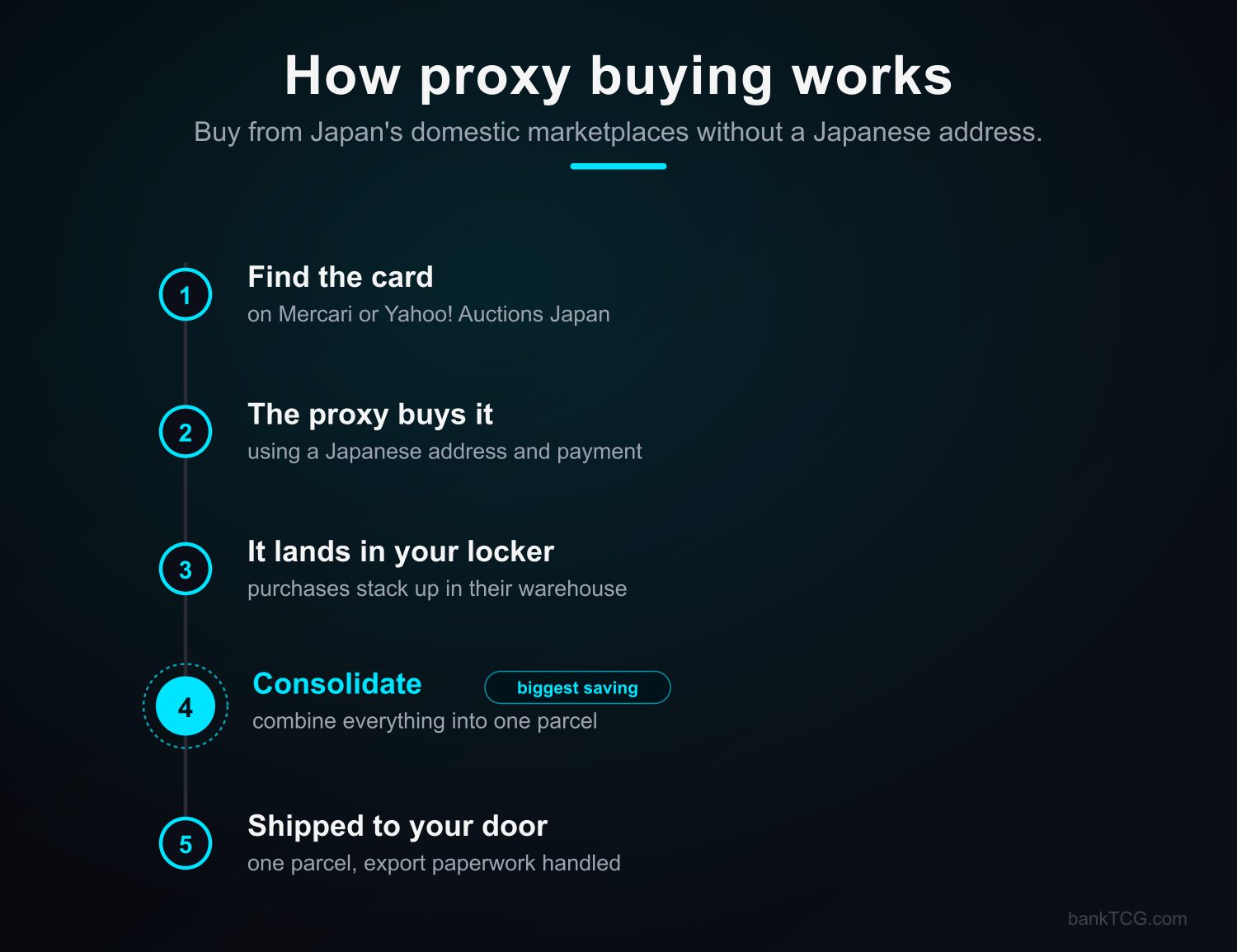
Every proxy runs the same basic loop:
- You find the card on a Japanese marketplace (the proxy gives you an English interface to search Mercari/Yahoo Auctions).
- The proxy buys it for you, paying with a Japanese method and shipping to their Japanese warehouse. For auctions, they place your bid.
- It lands in your warehouse locker. You can let purchases stack up here.
- You consolidate. Combine multiple items into one international parcel. This is where you save the most money.
- They ship it to you by your chosen method, and handle the export paperwork.
The trade-off for that convenience is fees, which we'll break down below.
Using Sendico
Sendico is a Japan shopping-and-consolidation proxy: it lets you buy across Japanese marketplaces, holds your purchases in its warehouse, and consolidates them into a single shipment before forwarding internationally, which is exactly the workflow that keeps per-card shipping cost down when you're buying several cards.
The flow in practice:
- Create an account and find your card on Mercari/Yahoo Auctions through Sendico.
- Place the order (or bid) and pay the item cost up front.
- Let a few purchases accumulate in your warehouse box.
- Request consolidation into one parcel, pick a shipping method, and pay the international shipping.
- Track it to your door.
Because fee schedules and shipping rates change, always check the current rates on the service before committing; don't trust a number from a blog post (including this one). The structure is stable; the exact figures aren't.
What It Actually Costs
Your landed cost has four parts. Budget for all of them:
| Cost | What it is |
|---|---|
| Card price | What you pay the Japanese seller |
| Proxy/service fee | A per-item charge for buying on your behalf |
| International shipping | Charged on the consolidated parcel's weight/size |
| Import duty / tax | Whatever your country charges on imported goods |
Two honest truths most affiliate guides skip:
- Shipping and fees can add a meaningful percentage to a small order. A single cheap card shipped alone from Japan rarely makes sense; the shipping dwarfs the card.
- Import duty depends entirely on your country. Thresholds and rates change, so check your own customs rules before buying anything high-value. Don't assume.
This is why consolidation is the whole game: the per-card shipping cost falls dramatically when you ship ten cards together instead of one at a time. Buy patiently, let them pool, ship in batches.
Don't Skip Authentication
Buying from Japan lowers your odds of a fake compared to some marketplaces, but it does not eliminate them; counterfeits exist everywhere, and sealed product can be resealed. Before you commit real money:
- Know the tells. Our guide to spotting a fake Pokémon card applies directly to Japanese cards.
- Read the condition notes carefully and ask for extra photos (the proxy can relay questions).
- For anything high-value, prefer cards already graded by PSA, BGS, or CGC, and learn to read the slab with the PSA Label Museum.
If you plan to grade what you import, the PSA Japan vs USA slab guide explains the differences, and you can run the math first with the free PSA Profit Calculator and our data-driven grading guide.
Price-Check Before You Bid
The mistake that wipes out the savings is overpaying because you didn't know the going rate. A Yahoo Auctions lot only looks like a deal if you know what the cards inside are worth.
BankTCG is built for exactly this gut-check:
- Scan a card (or a whole listing photo) and pull live pricing instantly across 96,000+ cards spanning Pokémon, Yu-Gi-Oh!, Magic, and One Piece, so you know the real value before you bid.
- Pre-grade with AI centering analysis to judge whether a raw Japanese card is worth importing and grading.
- Track everything in your Vault and get alerted when a held card moves.
It's free to start: 5 scans a month, no account or credit card required.
FAQ
Why can't I just buy from Mercari Japan directly? Mercari Japan (separate from the US app) only ships to Japanese addresses and takes Japanese payment methods. A proxy service buys on your behalf with a local address, then forwards the item to you internationally.
Is it cheaper to buy Pokémon cards from Japan? Often yes, especially for modern singles and sealed product, and almost always cheaper than buying Japanese cards already imported and resold in the West. Just factor in proxy fees, international shipping, and any import duty before deciding.
What's the cheapest way to ship cards from Japan? Consolidate. Combining several purchases into one parcel sharply lowers the per-card shipping cost versus shipping each one separately. Let purchases pool in your proxy warehouse, then ship in batches.
Will I pay customs or import tax? It depends entirely on your country's rules, which change over time. Check your local import thresholds and rates before buying high-value items so there are no surprises on delivery.
Are Japanese cards fake-free? No. Counterfeits and resealed product exist everywhere. Authenticate exactly as you would for any purchase, and for high-value cards, prefer already-graded copies.
Sources & Further Reading
- Sendico: Japan proxy shopping & consolidation service (referral link; see disclosure above)
- BankTCG: Early Japanese Pokémon Cards guide and PSA Japan vs USA slabs
- BankTCG: How to spot a fake Pokémon card