Quick Facts
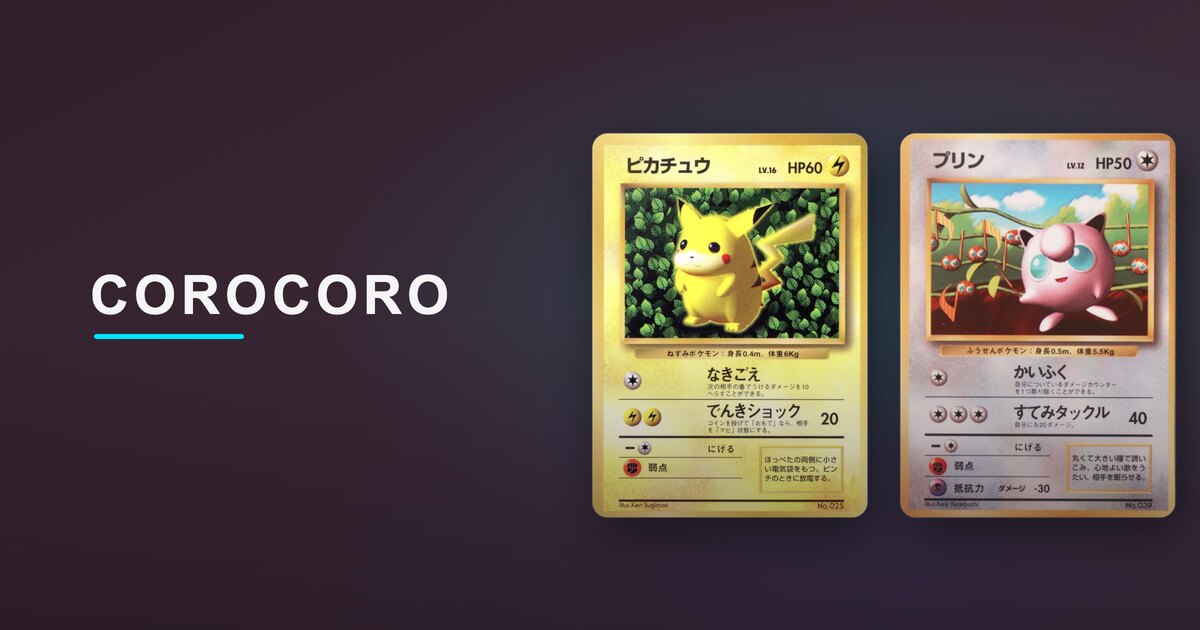
- The first Pokémon TCG cards ever released were the glossy Pikachu and Jigglypuff promos, inserted into the November 1996 issue of CoroCoro Comic on October 15, 1996
- This was five days before the Japanese Base Set (Expansion Pack) launched on October 20, 1996
- The original 1996 Pikachu has an illustrator error: Ken Sugimori is credited instead of the actual artist, Keiji Kinebuchi
- On February 16, 2026, Logan Paul's PSA 10 Pikachu Illustrator sold at Goldin Auctions for $16,492,000, the most expensive trading card of any kind ever sold
- Topsun cards were not released in 1995; the 1995 date on them is the Pokémon copyright date, and Topsun actually released in March 1997
In February 2026, a single Pokémon card sold for $16.49 million. It's the most expensive trading card of any kind ever sold at auction, and it didn't come from a booster pack. It came from an illustration contest run by a Japanese children's magazine.
Pull on that thread and you end up in October 1996, before most Western collectors had heard of Pokémon, at the real starting point of the hobby. Not the Base Set. Not Charizard. Not Wizards of the Coast. A two-card glossy insert tucked into the middle of a magazine.
This is the story of the very first Pokémon cards ever made, and the 1996 to 1998 era that followed.
October 15, 1996: The True First Pokémon TCG Cards
Five days before the Pokémon Trading Card Game officially launched in Japan, the November 1996 issue of CoroCoro Comic hit newsstands with a two-card promotional insert on glossy cardstock. One card featured Pikachu standing in a field of grass. The other featured Jigglypuff. Both were marked as unnumbered promos: not part of any set, not sold in stores, and available only to readers of a monthly manga magazine published by Shogakukan.
These are the first official Pokémon TCG cards ever distributed to the public.
Why they matter
The Base Set (called the "Expansion Pack" in Japan) launched five days later, on October 20, 1996, and it's the set most collectors point to when they talk about "original Pokémon cards." But the CoroCoro Pikachu and Jigglypuff came first. They were the introduction, the sample, designed to build hype for the game that would launch the following week.
They're also playable Pokémon cards in the proper sense. Energy types, HP, attacks, retreat cost, everything the Base Set cards had. They weren't sticker cards or promotional oddities; they were the real thing, just handed out a few days early through a different distribution channel.
The Ken Sugimori illustrator error
This is where it gets interesting for collectors.
The original 1996 glossy Pikachu has a mistake printed on the card. At the bottom-right, where the illustrator is credited, it reads "Illus. Ken Sugimori." Sugimori is the art director of the entire Pokémon franchise and designed most of the original 151 Pokémon, but he didn't actually paint this card. The real artist is Keiji Kinebuchi.
The error was caught quickly. Subsequent printings corrected the credit to Kinebuchi, and this is the single most important identifier for the original version:
- Original 1996 glossy version: credits "Ken Sugimori" (incorrect). This is the first Pokémon TCG card ever made
- November 30, 1996 matte reprint: credits "Keiji Kinebuchi" (corrected), distributed in a booklet called Easily Understand How to Play Pokémon Cards
- September 15, 1998 glossy reprint: credits "Keiji Kinebuchi" (corrected), mailed out to 2,000 prize draw winners via CoroCoro
If you're buying the original 1996 card, confirm "Ken Sugimori" is printed on it before you pay. A glossy finish alone isn't enough; the 1998 reprint is also glossy.
The Jigglypuff was printed on the same 1996 insert and doesn't have the same illustrator error, but it's still part of the two-card set and equally historic. Reprints of Jigglypuff exist and are harder to distinguish from the original; subtle print quality differences are the main tell.
What they're worth in 2026
The 1996 CoroCoro glossies remain surprisingly accessible for cards of their historical importance. CoroCoro Comic had enormous circulation in 1996, and the insert reached millions of children, most of whom eventually bent, folded, or lost their copies.
That's reflected in the pop reports. A raw 1996 original can still be found in the low hundreds to low four figures depending on condition, and even graded copies in mid-grade sit in the four-figure range. PSA 10s are genuinely rare, though an ongoing collector debate flags that some PSA 10-labeled copies may actually be 1998 reprints mislabeled, so for top-grade purchases, buy from auction houses that specialize in vintage Japanese cards and cross-reference the illustrator credit before you commit.
But Wait: What About Topsun? What About Carddass?
If you've read older articles about early Pokémon cards, you've probably seen claims that Topsun cards or Bandai Carddass came first. Let's clear this up, because both claims get repeated constantly and both are partly wrong.
Topsun cards were NOT released in 1995
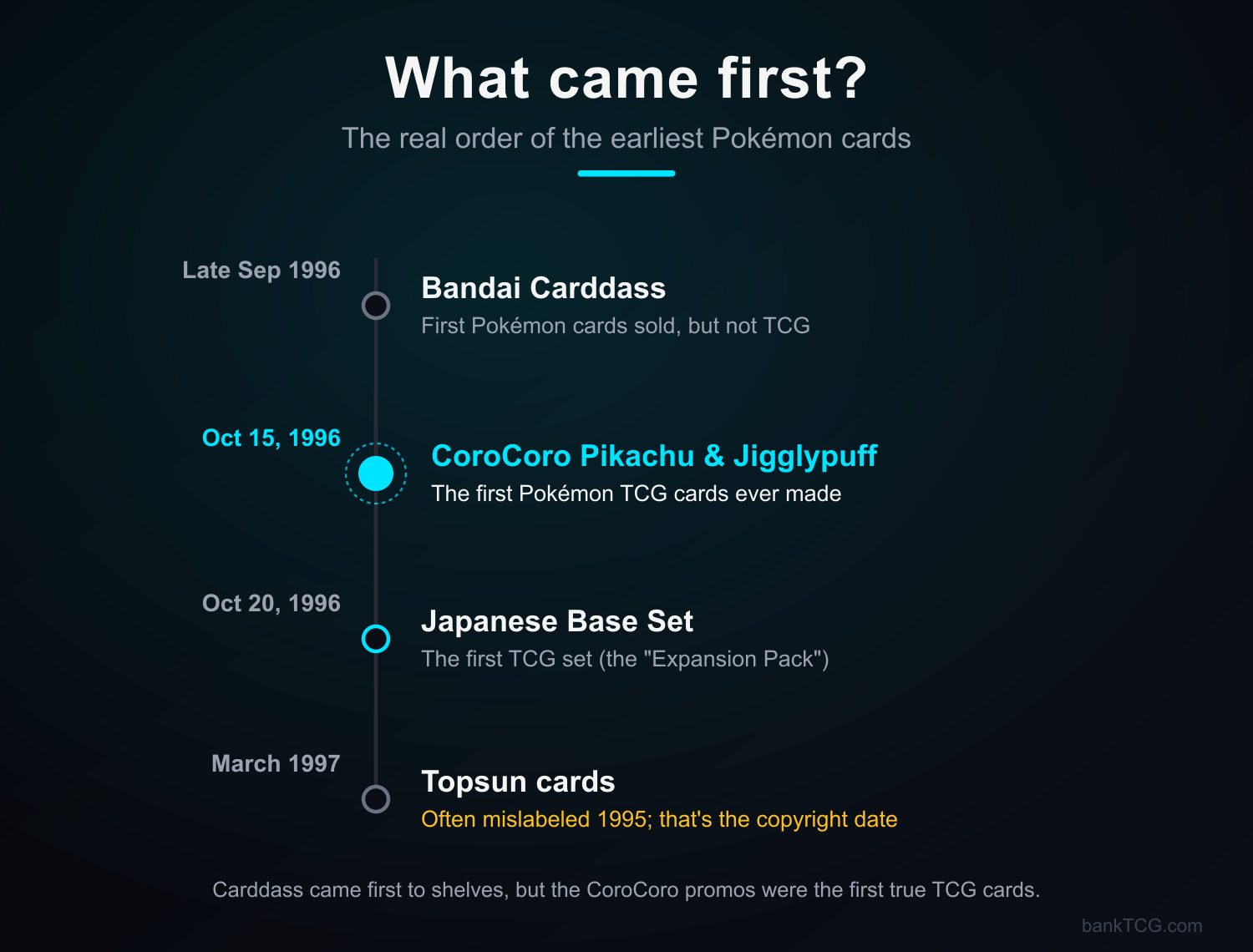
This is the single most repeated piece of misinformation about early Pokémon cards. Topsun cards show a 1995 copyright date, but that's the Pokémon IP copyright, not the card's release date. Top-Seika (the confectionery company) didn't sign its Pokémon licensing agreement with Shogakukan until 1997, and the cards actually hit shelves in March 1997, nearly six months after the TCG launched.
PSA officially updated its labeling from "1995" to "1997" in March 2024 to reflect this. If you see a seller marketing a Topsun card as a 1995 release, they're either misinformed or trying to inflate the card's significance.
Topsun cards are still historically important: they came in blue-back and green-back variants, the prism holofoils are beautiful, and the ultra-rare Blue Back No Number Charizard (only ~50 ever printed) is one of the most valuable Pokémon cards in existence, with a PSA 10 selling for $493,230 in 2021. But they don't predate the TCG.
Bandai Carddass Did Come First, but They're Not TCG Cards
Bandai released "Pokémon Carddass" Parts 1 and 2 in late September 1996, about three weeks before the CoroCoro Pikachu/Jigglypuff insert. These are the earliest commercially distributed Pokémon cards of any kind.
But Carddass cards aren't trading card game cards. They're collectible cards, closer to stickers or trading cards in the traditional sense, sold out of vending machines 20 yen at a time, with artwork pulled directly from the Red/Green games. There's no gameplay, no HP, no attacks. You can't play Pokémon with Carddass cards; you can only collect them.
So the accurate framing is:
- First Pokémon cards ever sold: Bandai Carddass, late September 1996
- First Pokémon TCG cards: CoroCoro Pikachu and Jigglypuff, October 15, 1996
- First Pokémon TCG set: Japanese Base Set, October 20, 1996
The CoroCoro promos are the true starting point of the Pokémon TCG as a game and a collecting hobby.
October 20, 1996: Base Set and the No Rarity Print Run
Five days after the CoroCoro insert, the Japanese Base Set launched, known officially as the "Expansion Pack" (拡張パック), along with a Starter Deck that included a random holo, a random rare, a silver Chansey coin, and a rulebook. This was the game proper, and it's where serious collecting begins.
No Rarity Symbol: the first print run's tell
Japanese Pokémon cards normally show a rarity symbol in the bottom-right corner: a circle for common, diamond for uncommon, star for rare. The very first Base Set print run didn't have any. The bottom-right corner is simply blank.
This wasn't a misprint. The rarity system hadn't been standardized yet when the first sheets went to press. Rarity symbols first appeared with the Jungle set in March 1997, which means anything with a blank bottom-right corner and a Base Set copyright can only have come from the earliest 1996 production run.
How to identify No Rarity cards
- Blank lower-right corner on the card face
- Media Factory credit on the back (Media Factory was the original Japanese publisher)
- No set logo on the right side of the artwork
- Some cards have specific stat typos later corrected (Charizard was originally listed at 2.4m and 200lb before being corrected to 1.7m and 90.5kg)
If a seller is claiming a No Rarity card but the Charizard stats are already corrected, that's a red flag.
2026 values
The No Rarity Charizard is now one of the most valuable Pokémon cards in the world. Only 8 PSA 10 copies exist, less than a tenth of the PSA 10 population for the English 1st Edition Shadowless Charizard. In 2025, a PSA 10 No Rarity Charizard sold for more than $640,000, making it the record-setting most expensive Charizard of any language or printing.
Lower grades remain significantly more accessible. PSA 9 copies sold in the $9,000 to $9,200 range in early 2025. PSA 7 copies cleared around $9,100 in September 2025. Raw and PSA 6 copies trade in the $3,000 to $3,900 range. These aren't cheap cards, but they're within reach for serious vintage collectors, and they carry genuine historical significance that English Base Set equivalents can't match.
1997: The Expansion Era
With Base Set out the door, 1997 became the year the Pokémon TCG went from a curious new product to a cultural phenomenon in Japan. Three expansions were released that year, and CoroCoro kept the promo pipeline running in parallel.
The 1997 expansions
Jungle (ポケモンジャングル), March 5, 1997 The second expansion. This is the set that introduced rarity symbols, which makes it the visual turning point between No Rarity-era cards and everything that came after.
Mystery of the Fossils / Fossil (化石の秘密), June 21, 1997 The third expansion, focused on prehistoric and Rock-type Pokémon. Many older articles (including earlier drafts of this one) date Fossil to August 1997, but the confirmed Japanese release is June 21.
Rocket Gang / Team Rocket (ロケット団), November 21, 1997 The fourth expansion, introducing Dark-type Pokémon and the trainer-versus-trainer narrative that would define the Team Rocket set in English two years later.
The 1997 CoroCoro promo run
Running alongside the expansions, CoroCoro Comic kept inserting exclusive promo cards into issues throughout the year. These are now among the most collectible Japanese cards from the era:
- Glossy Mew (Lily Pad Mew): February 1997 issue (on-sale January 15, 1997), illustrated by Ken Sugimori
- Glossy Mewtwo: June 1997 issue (on-sale May 15, 1997)
- Surfing Pikachu: September 1997 issue (on-sale August 15, 1997)
- Legendary Birds Jumbo card: October 1997 issue (on-sale September 15, 1997), featuring Articuno, Moltres, and Zapdos together on a single oversized card
- Flying Pikachu: November 1997 issue (on-sale October 15, 1997)
Worth flagging one common mistake: the Articuno/Moltres/Zapdos promo is a single jumbo card featuring all three birds, not three individual glossy cards. You'll occasionally see it mis-marketed as separate "bird promos," but the original 1997 distribution was one oversized card per insert.
The glossy CoroCoro promos from this era are generally affordable in mid-grade: a PSA 8 Glossy Mew sold for $152.50 in September 2025, and PSA 9 Glossy Mewtwos have historically cleared in the $150 to $260 range. PSA 10s are substantially rarer because the glossy stock is easily scratched.
1998: The Vending Machines and the Pikachu Illustrator Contest
1998 was the year things got weird, in the best possible way. Japan introduced two innovations that shaped the collecting hobby permanently: a vending-machine-based distribution experiment, and the illustration contest that produced the most valuable trading card ever made.
Vending Machine (Expansion Sheet) series
Officially called Expansion Sheets (拡張シート), these cards were sold directly through vending machines around Japan at 100 yen per sheet. Each sheet contained three cards plus a bonus slot (damage counter or coin in Series 1 and 2; gag or rules cards in Series 3), and you had to tear the cards apart yourself.
All three series launched in 1998, despite what you'll read in many older guides:
- Series 1 (Blue), March 23, 1998
- Series 2 (Red), June 17, 1998
- Series 3 (Green), November 24, 1998
Each series contained 18 sheets × 3 cards, themed by regions of Kanto. The artwork was entirely exclusive; none of it ever appeared in an English set. Because the cards were printed directly onto sheets, they all use glossy card stock (similar to CoroCoro promos), and because they had to be torn from strips, well-centred undamaged examples are notoriously hard to find.
Series 3 launched alongside the Masaki / "Evolution by Mail" Campaign: players who sent in Kadabra, Machoke, Graveler, Haunter, or Omanyte cards together with a Bill's PC Pass Card received holographic evolved versions (Alakazam, Machamp, Golem, Gengar, Omastar) by return mail. These evolved holos, received through the post between November 1998 and April 1999, are now key vintage Japanese promos in their own right.
The Pikachu Illustrator
CoroCoro Comic ran three illustration contests between late 1997 and summer 1998: the original CoroCoro Illustration Contest (November 1997), the Mewtwo's Counterattack Commemoration Contest (May 1998), and the Pikachu's Summer Vacation Commemoration Contest (June 1998). Winners across all three received the same prize: a one-of-a-kind trainer card called Pikachu Illustrator.
Key facts:
- Artwork by Atsuko Nishida, the original designer of Pikachu
- Classified as a Trainer card, not a Pokémon card, adding to its oddity
- Credited with "Illus." in the illustrator field rather than a name, an intentional callback to the contest winners
- Approximately 41 copies were officially distributed (39 to contest winners, plus 2 additional copies that surfaced in 2019 from Yuichi Konno, one of the original TCG rule designers)
- As of early 2026, PSA has graded 44 total copies, suggesting a few more have entered circulation
The $16.49 million sale
In April 2022, YouTuber Logan Paul acquired the only PSA 10 Pikachu Illustrator in existence through a private sale, trading his own PSA 9 copy plus roughly $4 million in cash, for a combined value around $5.275 million. He wore it at WrestleMania 38 in a custom diamond-encrusted Poké Ball pendant.
On February 16, 2026, Paul sold that same PSA 10 at Goldin Auctions for $16,492,000, purchased by A.J. Scaramucci. Guinness World Records confirmed it as the most expensive trading card of any kind ever sold at auction.
Lower grades remain eye-watering. A PSA 9 sold for $4 million on eBay in September 2025. Another PSA 9 cleared $1.4 million at Heritage Auctions in March 2026. A PSA 8.5 sold for $600,000 in December 2025, double what the same grade was fetching a year earlier.
2026 Market Values At a Glance
Prices are volatile and condition-sensitive. Use this as a reference point, not a quote, and always verify current sales on PSA's Auction Prices Realized or recent Goldin / Heritage / PWCC listings before buying or selling.
| Card | Grade | 2026 Value |
|---|---|---|
| Pikachu Illustrator | PSA 10 | $16,492,000 (Feb 2026 record) |
| Pikachu Illustrator | PSA 9 | $1.4M to $4M |
| Pikachu Illustrator | PSA 8.5 | ~$600,000 |
| No Rarity Charizard (Japanese Base Set) | PSA 10 | $640,000+ (2025 record; pop 8) |
| No Rarity Charizard | PSA 9 | ~$9,000 to $9,200 |
| No Rarity Charizard | PSA 7 | ~$9,100 |
| Topsun Blue Back Charizard (No Number variant) | PSA 10 | $493,230 (2021 record; ≤2 in world) |
| Topsun Blue Back Charizard (numbered) | PSA 10 | ~$45,200 (Nov 2025) |
| Topsun Blue Back Charizard | PSA 9 | ~$6,200 to $6,500 |
| 1996 CoroCoro Glossy Pikachu (Sugimori error) | PSA 10 | Low four figures, authentication disputed |
| 1996 CoroCoro Glossy Jigglypuff | PSA 10 | Similar tier, sparse public data |
| 1997 Glossy Mew (Lily Pad Mew) | PSA 8 | ~$152 (Sept 2025) |
| 1997 Glossy Mewtwo | PSA 9 | $150 to $260 |
Authentication Tips and Red Flags
- Card size: Authentic Japanese cards measure approximately 63 × 88 mm with clean, precise cuts. Size discrepancies are a red flag.
- Rip test (on damaged duplicates only): Authentic Pokémon cards have an opaque dark-grey or black middle ply. Counterfeits often have a uniform white or cream interior.
- Font and typography: Sharp, uniform printing. Blurry, misaligned, or oddly-spaced text is the most common counterfeit tell.
- CoroCoro Pikachu authentication: Always verify the illustrator credit. "Ken Sugimori" = 1996 original; "Keiji Kinebuchi" = 1998 reprint or matte booklet version. A PSA 10 slab alone isn't sufficient; Elite Fourum collectors have flagged that some graded copies may be mislabeled.
- No Rarity authentication: Check for the blank lower-right corner AND the original (not corrected) stat lines. A blank corner with corrected stats suggests a removed rarity symbol on a later print, a counterfeit tactic.
- Topsun authentication: The top-left card number and the prism holo pattern are primary verification points. Any raw "Blue Back No Number" should be treated with extreme suspicion given only around 50 ever existed.
- Where to buy: Yahoo Auctions Japan and Mercari Japan (via proxy services like Buyee or Zenmarket) for the deepest domestic market. PWCC, Goldin, Heritage, and Fanatics Collect for high-value graded cards. Avoid AliExpress, Temu, and any seller offering prices significantly below market, since a substantial percentage of online TCG listings are counterfeit.
FAQ
What was the very first Pokémon card ever made?
The first Pokémon TCG cards were the glossy Pikachu and Jigglypuff promos inserted into the November 1996 issue of CoroCoro Comic, released on October 15, 1996, five days before the Japanese Base Set launched. Bandai Carddass cards were released a few weeks earlier in late September 1996, but those are collectible cards, not TCG cards.
What's the Ken Sugimori error on the Pikachu card?
The original 1996 CoroCoro Pikachu credits Ken Sugimori as the illustrator, but the actual artist is Keiji Kinebuchi. Later reprints (November 1996 and September 1998) corrected the credit. "Ken Sugimori" printed on the card is the key identifier of the genuine first print.
Were Topsun cards released in 1995?
No. The 1995 date on Topsun cards is the Pokémon copyright date, not the release date. Topsun cards were released in March 1997, after the TCG had already launched. PSA updated its labeling to reflect this in March 2024.
Why doesn't my 1996 Japanese Base Set card have a rarity symbol?
Because the first print run of the Japanese Base Set (October 1996) was produced before the rarity system was finalized. These "No Rarity" cards are the earliest version and are significantly rarer than later prints with the circle/diamond/star system that was introduced with Jungle in March 1997.
How many Pikachu Illustrator cards exist?
Approximately 41 copies were officially distributed: 39 to winners of three CoroCoro illustration contests in 1997 to 1998, plus 2 additional copies that surfaced in 2019. PSA has graded 44 total copies as of 2026. Only one PSA 10 exists, the copy Logan Paul sold for $16.49 million in February 2026.
Where should I buy early Japanese Pokémon cards?
For the deepest market at domestic Japanese prices, use Yahoo Auctions Japan or Mercari Japan via a proxy service like Buyee or Zenmarket. For high-value graded cards, Goldin, PWCC, Heritage Auctions, and Fanatics Collect are the dominant Western platforms. Always buy graded copies from PSA, CGC, or BGS for No Rarity, CoroCoro, and Illustrator-tier cards, since raw sales at these price points carry too much authentication risk.