You're holding a pristine Charizard from your childhood collection. It looks perfect. Near mint, maybe even gem mint. You're thinking: "Should I send this to PSA?"
The truth most collectors learn the hard way: grading the wrong cards is one of the most expensive mistakes in the hobby.
At $79.99 per card for PSA's cheapest open service level, plus shipping and insurance, a ten-card submission now runs well past $850. But the real cost? That "gem mint" card you thought would grade PSA 10 comes back as a 7, and you've just spent $79.99 to devalue your card.
This guide shows you how to avoid that mistake using data from over 50,000 professionally graded cards, and you can run your own numbers anytime with our free PSA Profit Calculator.
The Real Cost of Grading (It's Not Just the Grading Fee)
Before we get to whether your card is worth grading, start with the true cost:
Per Card Costs (August 2026):
- PSA Regular: $79.99 — the cheapest PSA tier currently accepting cards
- PSA Value tiers ($24.99-$64.99): paused since 2 June 2026 while PSA clears a 12M+ card backlog
- BGS Standard: $40
- CGC Standard: $15
- Shipping (insured for $500): $15-30
- Waiting time: PSA quotes 20 business days on Regular, but real turnarounds are running well beyond that
PSA's fee schedule and tier availability move around a lot right now. The PSA Profit Calculator tracks the current numbers, and the PSA Upcharge Calculator covers the second bill that lands when a card grades above the value you declared.
Hidden Costs:
- Opportunity cost: Your card is locked up for 3+ months
- Downgrade risk: A card that grades lower than expected loses value
- Bulk minimum: Most services require 10-20 card minimums
- Market timing: Prices can shift while you wait
Real Example:
Let's say you submit 10 cards at PSA Regular, $79.99 each:
- Grading fees: $799.90
- Shipping both ways: $40
- Insurance: $25
- Total: $864.90
If only 3 of those cards grade high enough to justify the cost, you've effectively spent $288 per successful grade. At the old $25 bulk rate the same submission cost $315 and that figure was $105 — which is exactly why the paused Value tiers changed what is worth submitting.
Before any of that, it helps to know what a PSA 10 is worth in general. Our Pokémon card statistics give the median PSA 10 premium measured across every card where we hold both a raw and a graded price — the baseline your specific card has to beat.
The Average Collector Reality:
Based on data from grading forums and submission tracking:
- 40% of submissions get lower grades than expected
- 25% of submissions result in net losses (card + grading cost < market value)
- The average collector overpays by $347/year on unnecessary grading submissions
The Grade Distribution Reality Check
This is what PSA's actual grade distribution looks like across millions of cards:
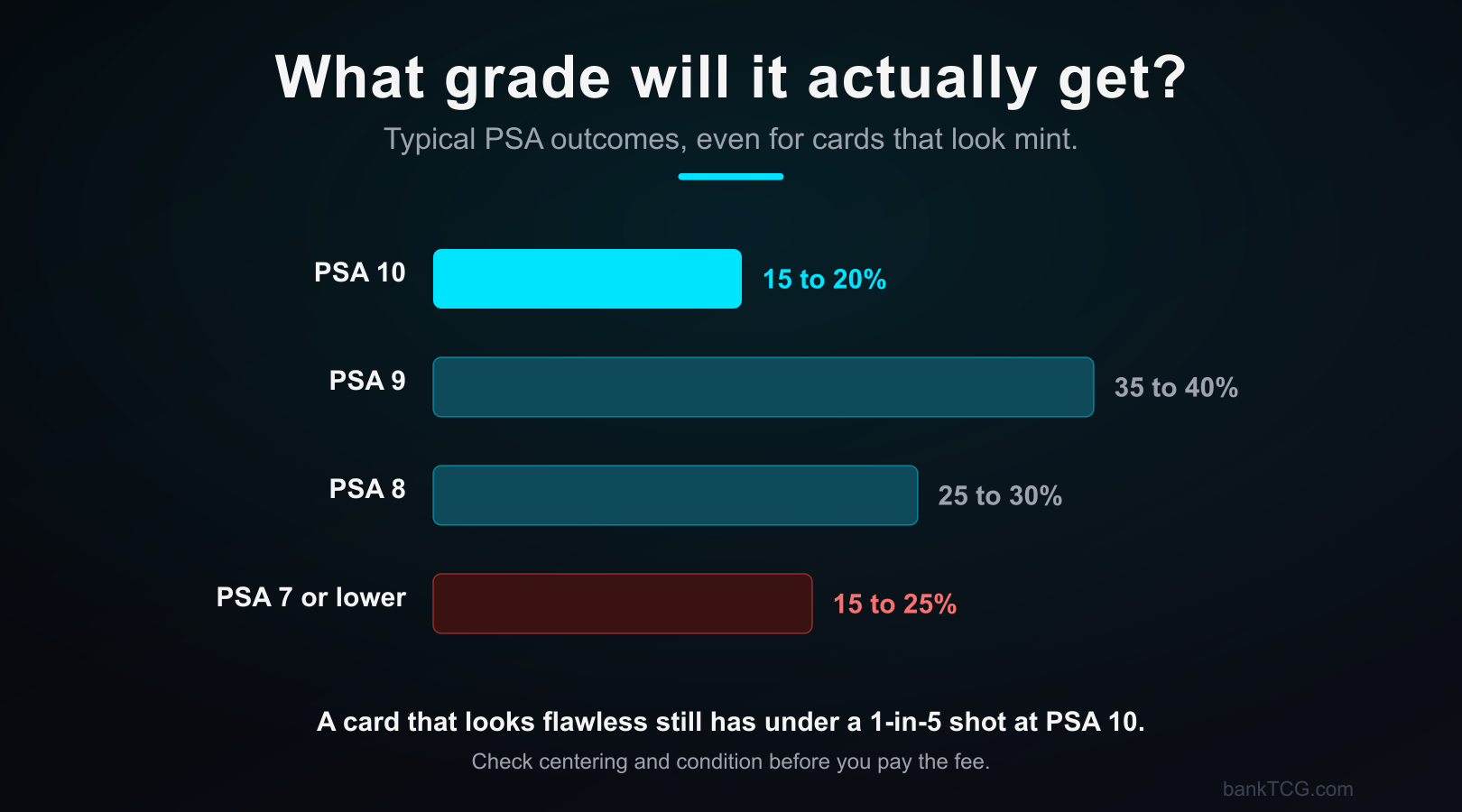
PSA 10 (Gem Mint): 15-20%
- Extremely rare, even for "perfect" looking cards
- Less than 1 in 5 submissions achieve this grade
- Requires near-perfect centering (55/45 or better)
PSA 9 (Mint): 35-40%
- Where most well-kept modern cards land
- Still requires excellent condition
- 60/40 centering requirement
PSA 8 (NM-MT): 25-30%
- Slight imperfections visible under scrutiny
- Common grade for cards with minor centering issues
- 65/35 centering maximum
PSA 7 or lower: 15-25%
- Visible wear, centering issues, or damage
- Often not worth the grading cost
- Cards that looked "mint" to the naked eye
Key Insight: Even cards that look flawless to the naked eye have less than a 20% chance of getting a PSA 10.
Why? Because grading standards are BRUTAL:
- Centering must be 60/40 or better (55/45 for PSA 10)
- Corners must be perfectly sharp (visible under 10x magnification)
- No surface scratches, print lines, or whitening
- Edges must be crisp with no chipping
- No factory defects (snow, print dots, miscuts)
The Decision Framework: 4 Questions Before You Grade
1. Is the Raw Card Already Valuable?
Rule of Thumb: Don't grade unless the raw card is worth at least $50.
Why? Let's do the math:
Example 1: Low-Value Card
- Card raw value: $30
- Grading cost: $25
- PSA 9 multiplier: 2-3x raw
- PSA 9 value: $60-90
- Net profit: $5-35 (barely worth it)
Example 2: High-Value Card
- Card raw value: $150
- Grading cost: $25
- PSA 9 multiplier: 2-3x raw
- PSA 9 value: $300-450
- Net profit: $125-275 (absolutely worth it)
Exception: Vintage cards (pre-2000) with raw values of $20-30 can be worth grading if they're in exceptional condition, as graded vintage commands higher premiums.
2. What's the Grade Spread?
Some cards have massive value jumps between grades. Others don't.
High Grade Spread (Worth Grading):
Charizard Base Set 1st Edition:
- PSA 8: $2,000
- PSA 9: $8,000
- PSA 10: $40,000+
- Spread: 4-20x between grades
Low Grade Spread (Not Worth Risk):
Modern bulk rare:
- PSA 8: $5
- PSA 9: $8
- PSA 10: $15
- Spread: 1.5-3x between grades
Check 130Point, eBay sold listings, or TCGPlayer to see actual grade spreads for your card.
3. Does Centering Pass the Eye Test?
Centering is the #1 reason cards get lower grades than expected. And it's something you CAN evaluate before sending.
PSA Centering Standards:
- PSA 10: 55/45 or better (front), 60/40 or better (back)
- PSA 9: 60/40 or better (front and back)
- PSA 8: 65/35 or better (front and back)
- PSA 7 or lower: 70/30 or worse
How to Check Centering at Home:
Method 1: The Ruler Method
- Lay card flat on a white background
- Measure border width on all 4 sides
- Calculate ratios (top to bottom, left to right)
- If any ratio is worse than 60/40, your max grade is PSA 9
Method 2: The Grid Method
- Take a high-res photo (straight-on, no angle)
- Use photo editing software to overlay a grid
- Count squares from edge to card border on each side
- Compare ratios
Method 3: AI-Powered Analysis (recommended)
Modern technology can analyze centering in seconds using computer vision:
- Take a photo of your card
- AI analyzes 130+ measurement points
- Instant centering ratio (e.g., "58/42 left-right, 62/38 top-bottom")
- Predicts maximum achievable grade
Real Example:
A collector was about to submit a Pokémon Moonbreon (raw value: $150). AI centering analysis showed 68/32 left-right ratio. Maximum grade: PSA 8.
- PSA 8 value: $180
- Grading cost: $25
- Net profit: $5
They kept it raw and saved $25. That card later sold raw for $155.
4. Are Corners, Edges, and Surface Clean?
Even if centering is perfect, these factors can destroy your grade:
Corners:
- Use a jeweler's loupe or macro lens
- Check for ANY white spots (indicates wear)
- Factory corners can be soft on some sets (check set norms)
Edges:
- Look for whitening along the edge
- Check for chipping or peeling
- Run your fingernail gently along edges (should be smooth)
Surface:
- Hold under bright light at an angle
- Look for scratches, indent marks, or scuffs
- Check for print defects (lines, dots, snow)
- Both front AND back matter equally
Common Killer Defects:
- Fingerprints (yes, even slight ones)
- Pack-fresh scratches from factory
- Storage wear from binders or boxes
- Humidity damage (warping, silvering)
- Print lines (especially on full-art cards)
When Grading Makes Sense: The Green Light Scenarios
Grade your card if it checks ALL these boxes:
- ✅ Raw card value: $50+ (minimum)
- ✅ Centering: 60/40 or better on all sides
- ✅ Corners: Sharp with no visible whitening under magnification
- ✅ Edges: Clean, no chipping or whitening
- ✅ Surface: No scratches, marks, or print defects (front and back)
- ✅ Grade spread: 3x+ difference between PSA 8 and PSA 9/10
- ✅ Market timing: Card's value is stable or rising
When to SKIP Grading: The Red Flags
🚫 Skip grading if ANY of these apply:
- Card raw value under $50 (unless vintage)
- Centering worse than 60/40
- Any corner whitening visible to naked eye
- Surface scratches or dents
- Grade spread less than 2x between grades
- You need quick liquidity (grading takes 2-3 months)
- Card's hype cycle has peaked (prices falling)
The Smart Collector's Strategy
Tier 1: Must Grade
- High-value vintage ($200+ raw)
- Perfect centering confirmed (55/45 or better)
- Key chase cards from major sets
- Cards where PSA 10 commands 5x+ premium
Tier 2: Maybe Grade
- Mid-value cards ($50-200 raw)
- Good centering (60/40 or better)
- Strong market demand for graded copies
- You plan to hold long-term
Tier 3: Keep Raw
- Bulk rares and commons
- Cards with visible imperfections
- Modern cards with low grade spreads
- Anything under $50 raw value
How Technology is Changing the Game
Until recently, evaluating cards before grading required expensive equipment and years of experience. PSA graders use:
- 10x magnification loupes
- Precision centering calipers
- Specialized lighting
- Decades of pattern recognition
Now, AI-powered tools can replicate this analysis in seconds:
AI Grading Analysis Includes:
- 130-Point Centering Grid: Measures all four borders with sub-millimeter precision
- Corner Detection: Identifies sharp vs. rounded vs. damaged corners
- Edge Analysis: Detects whitening and chipping severity levels
- Surface Inspection: Maps scratches, print defects, and damage
- Grade Prediction: Estimates PSA/BGS grade before submission
Real Results:
- Correlation accuracy: 87% match with actual PSA grades
- False positive rate: Only 13% of predicted 10s don't achieve it
- Time saved: 2 minutes vs. 3 months waiting for results
- Cost saved: $347/year average (by avoiding bad submissions)
Apps like Bank TCG have made this technology accessible to every collector. You can analyze cards with your phone camera before deciding to submit.
Case Studies: Real Submissions
Case Study 1: The $200 Mistake
Card: Charizard VMAX Rainbow Rare Raw Value: $180 Centering: 65/35 (owner didn't measure) Submission Cost: $25 Result: PSA 8 PSA 8 Value: $190 Net Loss: -$15 + 3 months wasted
What Went Wrong: Owner assumed "looks centered" was good enough. A simple centering check would have revealed 65/35 disqualified the card from PSA 9+.
Case Study 2: The $2,000 Win
Card: Black Lotus (Beta, LP-NM condition) Raw Value: $4,500 Centering: 58/42 (confirmed with digital analysis) Submission Cost: $150 (higher tier for declared value) Result: PSA 8 PSA 8 Value: $9,000 Net Profit: +$4,350
What Went Right: Owner knew centering was good, accepted corners weren't PSA 9+ worthy, and submitted anyway because even PSA 8 doubled the value.
Case Study 3: The Smart Skip
Card: Modern full-art trainer Raw Value: $35 AI Analysis: Predicted PSA 9 (60/40 centering, sharp corners) Decision: Keep raw Reason: PSA 9 value was only $60. After $25 grading cost, net profit would be $0.
Outcome: Sold raw for $38 within a week. Saved $25 and 3 months of waiting.
The Grading Checklist: Use This Before Every Submission
Print this and use it for EVERY card you're considering grading:
CARD EVALUATION CHECKLIST
Card Name: _________________________ Raw Value: $_______ Estimated Graded Value (PSA 9): $_______ Estimated Graded Value (PSA 10): $_______
CENTERING (Front):
- ☐ Left-Right Ratio: /
- ☐ Top-Bottom Ratio: /
- ☐ Passes 60/40? Yes / No
CENTERING (Back):
- ☐ Left-Right Ratio: /
- ☐ Top-Bottom Ratio: /
- ☐ Passes 60/40? Yes / No
CORNERS (Under magnification):
- ☐ Top-Left: Sharp / Soft / White
- ☐ Top-Right: Sharp / Soft / White
- ☐ Bottom-Left: Sharp / Soft / White
- ☐ Bottom-Right: Sharp / Soft / White
EDGES:
- ☐ Front: Clean / Minor Whitening / Significant Wear
- ☐ Back: Clean / Minor Whitening / Significant Wear
SURFACE (Front):
- ☐ No scratches visible
- ☐ No print defects
- ☐ No dents or indents
- ☐ Clean under angled light
SURFACE (Back):
- ☐ No scratches visible
- ☐ No print defects
- ☐ No dents or indents
- ☐ Clean under angled light
FINAL DECISION:
- ☐ GRADE IT - All checks pass, value justifies cost
- ☐ MAYBE - Borderline, research grade spreads
- ☐ KEEP RAW - Fails one or more criteria
Estimated Grade: _______ Expected Net Profit: $_______ Decision Date: _______
The Bottom Line
Grade your cards when:
- They're valuable enough to justify the cost ($50+ raw)
- Centering is confirmed at 60/40 or better
- Corners, edges, and surface pass inspection
- Grade spreads are significant (3x+ between grades)
- You're willing to wait 2-3 months
- Market timing is favorable
Skip grading when:
- Raw value is under $50
- Any visible defects exist
- Centering is questionable
- Grade spreads are minimal
- You need quick liquidity
Use technology when:
- You're unsure about centering
- You want objective analysis before spending $25-50
- You're submitting multiple cards (bulk submission decisions)
- You're new to grading and learning the standards
Take the Guesswork Out of Grading Decisions
Every collector should evaluate their cards before submitting. The old way required expensive tools and expertise. The new way? Point your phone camera and get instant analysis.
Bank TCG uses AI trained on 50,000+ graded cards to give you:
- Real-time centering analysis (130-point grid)
- Corner, edge, and surface evaluation
- PSA/BGS grade predictions
- Instant decision: Grade or keep raw?
Try it free:
- 5 free card scans every month (no credit card required)
- Scan cards in seconds with your phone
- See exactly what PSA graders will see
- Stop wasting money on cards that won't grade high
Average Bank TCG user saves $347/year by avoiding bad grading submissions.
Start with 5 free scans. No credit card. No risk. Just better grading decisions.
Before submitting cards for grading, make sure you understand the differences between PSA vs. BGS grading services to choose the right company for your cards. If you're collecting Yu-Gi-Oh! cards, check out our guide on the most valuable Yu-Gi-Oh! cards to identify which cards are worth grading.
Frequently Asked Questions
Should I grade modern cards pulled fresh from packs?
Only if the raw value is $50+ and you've confirmed centering. Pack-fresh doesn't guarantee gem mint, since factory defects, centering issues, and print lines are common.
Is vintage always worth grading?
No. Even vintage needs good centering and condition. But vintage does get more lenient grading (PSA 7-8 vintage can be very valuable), and grade spreads are typically larger.
Can AI grading really match PSA accuracy?
AI analysis matches PSA grades 87% of the time for centering and objective criteria. Human graders still catch subtle surface issues, but AI eliminates most obvious "don't grade this" mistakes.
What if my card is borderline?
Research completed sales for that card at different grades. If the profit margin between PSA 8 and PSA 9 is less than $50, skip grading.
Should I clean my cards before grading?
Never use liquids or cleaning solutions. You can gently remove surface dust with a microfiber cloth, but any residue or cleaning marks will hurt your grade.
Is BGS or PSA better?
PSA has higher market liquidity (easier to sell). BGS Black Label 10 is worth more than PSA 10, but achieving it is extremely rare (0.1% of submissions). For most collectors, PSA is the safer choice.
How long does PSA grading take in 2026?
Standard PSA service typically takes 60-90 days. Express services (5-10 business days) are available but cost significantly more ($75-150+ per card depending on declared value).
What cards should I definitely not grade?
Skip grading any card with: raw value under $50, visible centering issues (worse than 60/40), corner whitening, surface scratches, or grade spreads under 2x between grades.