Quick Facts
- The English Base Set was released on 9 January 1999. The first English cards reached the public a few weeks earlier, in the December 1998 Demo Game packs.
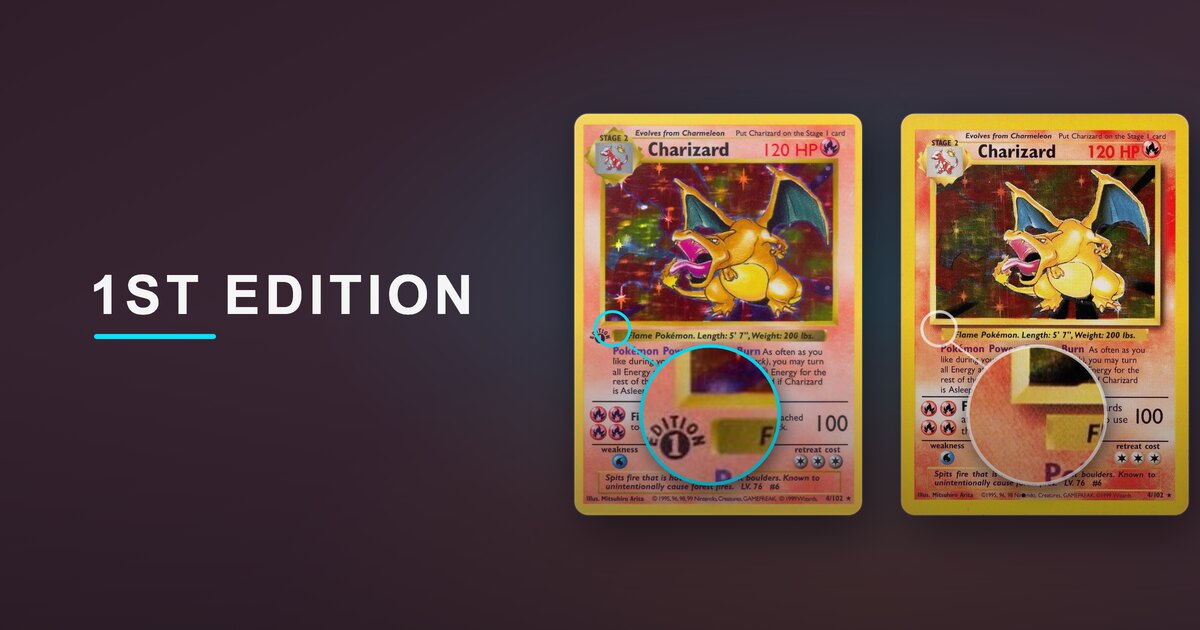
- First Edition cards have an "Edition 1" stamp; Shadowless cards don't. Both lack the drop shadow that later Unlimited cards have.
- Collectors count eight print runs of Base Set, though First Edition, Shadowless and Unlimited covers what most people need.
- A PSA 10 First Edition Charizard sold for $1,385,274 on ALT on 8 October 2026, a reported record, pending payment confirmation.
- Neo Destiny (February 2002) was the last English set printed with First Edition stamps.
A PSA 10 First Edition Base Set Charizard is one of the most expensive Pokémon cards you can buy. PSA has graded 123 copies at that grade, and in October 2026 one of them reportedly sold for $1,385,274. An Unlimited copy of the same card in PSA 10 sells for about $27,000.
That gap comes from print runs: specific, visible differences in how Wizards of the Coast printed the cards through 1999. This guide covers the first English cards, the Base Set print runs and how to tell them apart, the variants worth checking for, and current prices.
Before Base Set: The 1998 Demo Game
The first English Pokémon cards came out in December 1998, a few weeks before Base Set, in the Pokémon Demo Game (a pack for two players). The packs weren't sold. Wizards of the Coast sent them to game stores so customers could try the game, and some were also given away at trade shows.
Each pack held a fixed set of 24 Shadowless Base Set cards and a rules guide. Sealed packs are now collected and graded in their own right.
9 January 1999: Base Set Launches
Wizards of the Coast released the English Base Set on 9 January 1999. The First Edition print run came first and was the smallest, which is why a First Edition Charizard sells for far more than later copies of the same card.
Three Main Printings, Eight Print Runs
Collectors usually describe Base Set as three printings: First Edition, Shadowless and Unlimited. Research by collectors puts the real number at eight print runs, grouped like this:
| Common name | Print run | How to spot it |
|---|---|---|
| 1st Edition | 1st | "Edition 1" stamp, no drop shadow |
| Shadowless | 2nd | No stamp, no drop shadow |
| Unlimited | 3rd to 7th | No stamp, drop shadow on the art frame |
| "1999-2000" print | 8th | Drop shadow, "1999-2000" in the Wizards copyright line |
For most collectors, three printings is enough. Some do chase the eighth run, which you can identify by the "1999-2000" copyright at the bottom of the card. It was long called the "UK print" because most copies were sold in the UK; smaller numbers are reported from Australia and the US. It also corrected an HP error on Vulpix that had run through the previous seven print runs.
1st Edition (January 1999)
The first Base Set cards have two features:
- The "Edition 1" stamp: a small black oval just below the bottom left corner of the artwork.
- No drop shadow: the art frame has the same border all the way round, with no shadow on its right and bottom edges.
PSA has graded 123 First Edition Charizards in PSA 10.
Shadowless (early 1999)
Next came a run without the "Edition 1" stamp, printed on the same template. These Shadowless cards look like First Edition cards minus the stamp. They are:
- the same design as First Edition, without the stamp
- part of the early 1999 printings
- much scarcer than Unlimited
This is the most common point of confusion. Almost every First Edition card is Shadowless, but not every Shadowless card is First Edition. A Shadowless card without a stamp isn't a First Edition missing its stamp. It's a separate printing, and a valuable one.
Unlimited (later 1999)
Wizards then changed the template and added a grey drop shadow to the right and bottom edges of the art frame. Every later Base Set print run uses it.
Unlimited cards are by far the most common version. They are still real Base Set cards, and high grade copies of popular cards like Charizard still sell for a lot, but they sell for less than Shadowless, which sells for less than First Edition.
How to Tell Them Apart
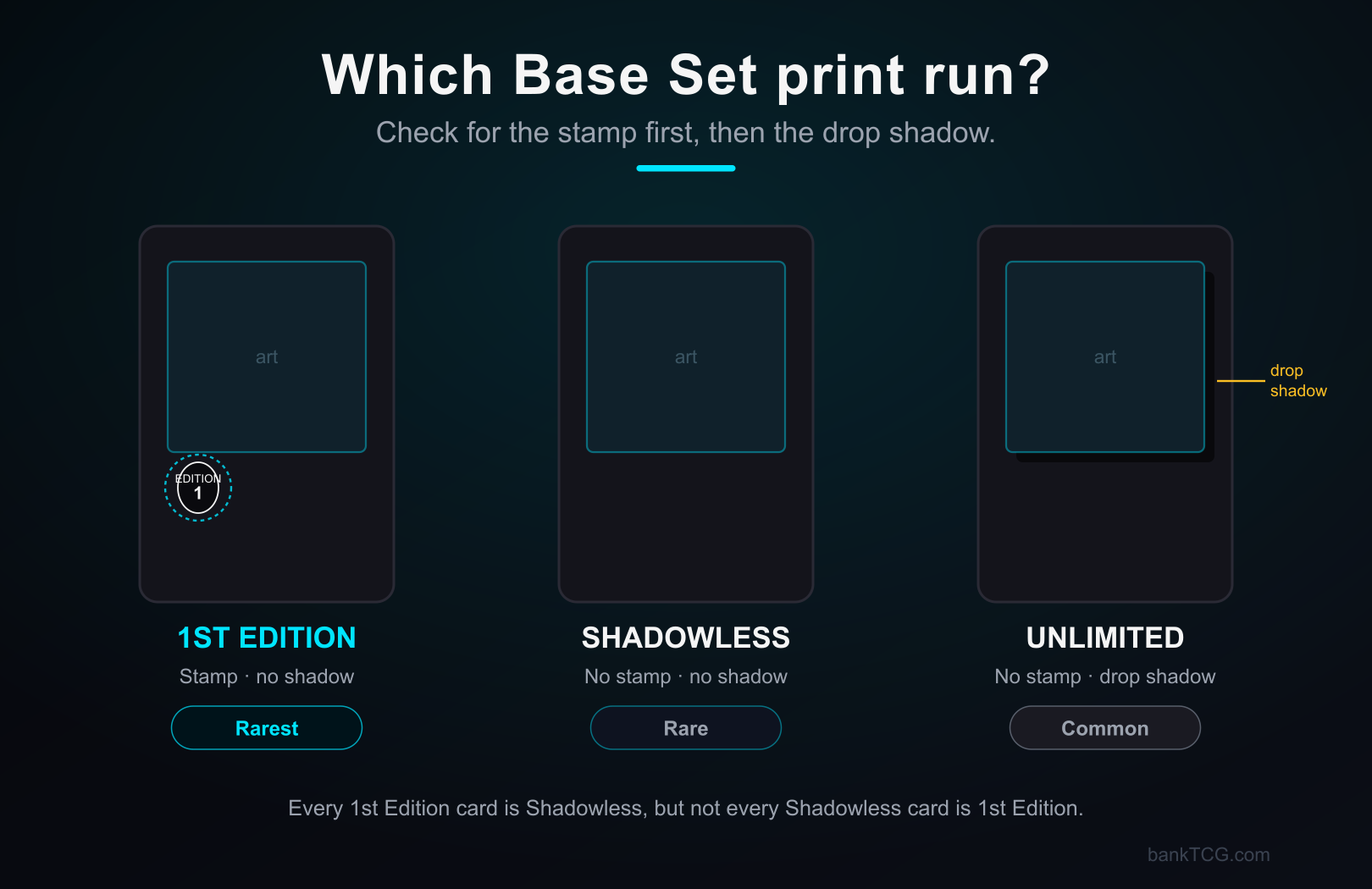
Step 1: Look for the stamp
Check just below the bottom left corner of the artwork for the "Edition 1" oval.
- Stamp → First Edition
- No stamp → go to step 2
Step 2: Look for the drop shadow
Look at the right and bottom edges of the art frame.
- No shadow → Shadowless
- Grey shadow → Unlimited
Step 3 (optional): Read the copyright line
The copyright line at the bottom of the card differs between printings:
- Shadowless: "© 1995, 96, 98, 99 Nintendo, Creatures, GAMEFREAK. © 1999 Wizards."
- Unlimited: the same line without the "99" after 98.
- Eighth print: "© 1999-2000 Wizards."
Trainer and Energy cards never had a drop shadow, so on those the copyright line is the main way to tell the printings apart.
Step 4 (optional): Check the HP text
On Shadowless cards the red "HP" and number are thinner. On Unlimited cards they are bolder.
Summary
| Feature | 1st Edition | Shadowless | Unlimited |
|---|---|---|---|
| "Edition 1" stamp | Yes | No | No |
| Drop shadow | No | No | Yes |
| Print run | 1st | 2nd | 3rd to 7th |
| Scarcity | Scarcest | Scarce | Common |
Variants Worth Checking
Beyond the three main printings, a few variants change what a card is worth.
Thick stamp vs thin stamp
First Edition Base Set cards come with two versions of the stamp. A thick stamp has a thicker "1" and thinner "Edition" lettering; a thin stamp is the opposite. Collectors generally consider thick stamp holos the scarcer version, though that view rests on collector counts rather than grading data. If you're buying an expensive First Edition holo, check which stamp it has.
Red Cheeks Pikachu
Early English prints of Pikachu (#58) have red cheeks; later prints have yellow cheeks. Red Cheeks copies come from the First Edition and Shadowless printings, and every Unlimited Pikachu has yellow cheeks. Why the colour changed has never been officially explained, and collector accounts disagree. PSA names Red Cheeks copies on the label.
Machamp
Machamp (#8) came only in the 2 Player Starter Set, and every copy has the First Edition stamp. It exists in two versions: without the drop shadow and with it. That makes it the one First Edition Base Set card that also comes with a drop shadow, and there is no unstamped Unlimited Machamp.
Faint and partial stamps
Some First Edition cards have a grey, faint or incomplete stamp instead of a clean black one, from uneven ink during stamping. These are different from a stamp that has worn away on a played card.
2026 Prices: First Edition vs Shadowless vs Unlimited
The figures below come from PriceCharting on 19 October 2026. Grade 8 and Grade 9 cover any major grading company; the last column is PSA 10 only. They are averages of recent sales and move often, and on the rarest versions they rest on few sales, so check recent sold prices before you buy or sell.
Charizard (Base Set #4)
| Version | Grade 8 | Grade 9 | PSA 10 |
|---|---|---|---|
| 1st Edition | $31,300 | $34,500 | $334,400 |
| Shadowless | $6,170 | $9,900 | $24,800 |
| Unlimited | $1,240 | $3,420 | $27,100 |
The Shadowless PSA 10 figure sitting below the Unlimited one shows how few Shadowless PSA 10s trade, not that Unlimited is worth more.
Recent PSA 10 First Edition sales:
- $550,000 at Heritage Auctions on 12 December 2025, a record at the time.
- $954,800 at Goldin on 16 February 2026, for a copy from Logan Paul's 2021 box break. Another copy sold shortly afterwards for $528,000.
- $1,385,274 on ALT on 8 October 2026, after 46 bids, reported pending payment confirmation.
Charizard [1st Edition] #4 on eBay
Blastoise (Base Set #2)
| Version | Grade 8 | Grade 9 | PSA 10 |
|---|---|---|---|
| 1st Edition | $5,210 | $8,950 | $19,900 |
| Shadowless | $1,440 | $3,130 | $37,800 |
| Unlimited | $400 | $1,030 | $9,000 |
A PSA 10 First Edition Blastoise from Logan Paul's break sold for $138,880 in February 2026, the highest price paid for an English Blastoise at the time.
Venusaur (Base Set #15)
| Version | Grade 8 | Grade 9 | PSA 10 |
|---|---|---|---|
| 1st Edition | $4,220 | $6,060 | $35,400 |
| Shadowless | $830 | $1,900 | $7,700 |
| Unlimited | $285 | $623 | $5,230 |
Venusaur [1st Edition] #15 on eBay
Complete First Edition sets in PSA 10
- In November 2025, a complete 103 card First Edition Base Set in PSA 10 sold for $911,629 through Rally. It was one of nine complete PSA 10 sets in PSA's registry.
- In June 2026, Heritage Auctions sold a complete 102 card First Edition Base Set in PSA 10 for $1,218,750, which Heritage called a record for such a set at public sale.
The Sets That Followed: Jungle, Fossil and Team Rocket
Base Set wasn't the only English set with a First Edition print run.
Jungle (16 June 1999)
The first English expansion, 64 cards. Its best known holos are the three Eevee evolutions (Vaporeon, Jolteon and Flareon) along with Snorlax, Scyther and Wigglytuff.
Jungle also has three well known errors:
- No Symbol holos: during the Unlimited printing (not First Edition), a batch of the 16 holos was printed without the Jungle set symbol. The symbol was restored later in the run, and complete sets of the 16 No Symbol holos are a collecting target of their own. Our vintage error card guide covers them in more detail.
- "d Edition" Butterfree: on some First Edition copies of Butterfree (33/64), the "1" in the stamp looks like a lowercase "d". PSA had graded 208 in PSA 10 as of October 2026, and a PSA 10 sells for around $700.
- Electrode with Base Set art: every First Edition copy of the non holo Electrode (18/64) was printed with the Base Set Electrode artwork instead of the new Jungle art. The Unlimited print has the correct Jungle art.
Fossil (10 October 1999)
The second expansion, 62 cards. Its best known First Edition holos are Dragonite, Gengar and the three legendary birds, Articuno, Moltres and Zapdos, with Lapras and Aerodactyl also in demand.
Fossil had an Australian Unlimited print, sold in packs with a red "Pokémon" logo. The non holo cards from those packs carry a "1999-2000" copyright and different card stock; the holos from the same packs have the standard 1999 copyright, so only the non holos can be identified.
Team Rocket (24 April 2000)
Team Rocket introduced:
- The first secret rare: Dark Raichu (83/82). Wizards of the Coast made it for the English set; it wasn't in the Japanese Rocket Gang set it was based on.
- Dark Pokémon, new to the English game.
- Holo Trainer and Energy cards for the first time.
Its most valuable First Edition card is Dark Charizard, at about $25,600 in PSA 10 and $3,030 in Grade 9 on PriceCharting. First Edition Dark Dragonite (about $17,800 in PSA 10) and Dark Blastoise (about $17,500) follow.
Base Set 2 (24 February 2000)
Base Set 2 is a 130 card reprint set of popular cards from Base Set and Jungle. It has no First Edition print run; every copy is Unlimited. Its holos use the Cosmos holo pattern rather than the Starlight pattern of Base Set, Jungle and Fossil.
When Did First Editions Stop?
The last English set with a First Edition print run was Neo Destiny, released in February 2002. Ten English sets had one:
- Base Set (January 1999)
- Jungle (June 1999)
- Fossil (October 1999)
- Team Rocket (April 2000)
- Gym Heroes (August 2000)
- Gym Challenge (October 2000)
- Neo Genesis (December 2000)
- Neo Discovery (June 2001)
- Neo Revelation (2001)
- Neo Destiny (February 2002)
The sets after Neo Destiny (Legendary Collection, Expedition, Aquapolis and Skyridge) had no First Edition prints. Skyridge, in May 2003, was the last set Wizards of the Coast published; The Pokémon Company took over in July 2003, and no English set since has used a First Edition stamp. Wizards never published a reason for dropping the stamp.
Neo era First Edition holos can be very scarce in top grade. PSA had graded 45 First Edition Neo Genesis Lugias in PSA 10 as of October 2026. A First Edition Shining Charizard (Neo Destiny 107) sells for about $72,500 in PSA 10 on PriceCharting.
Spotting Fakes
Counterfeits have become much more convincing. PSA's 2025 fraud report says it intercepted more than $200 million in potentially fraudulent cards across all categories, named Pokémon as the most counterfeited category and Charizard the most counterfeited subject, and recorded a 125% increase in Pokémon counterfeits over the year.
For Wizards era cards, check:
- The light test: genuine cards have a thin dark layer in the middle of the card stock, which blocks most light. Many fakes don't.
- Weight and thickness: compare with a genuine common from the same era. A card that feels lighter, thinner or stiffer is a warning sign.
- Texture: genuine backs have a fine texture. Fakes often feel glossy, waxy or completely smooth.
- The stamp: under a 10x loupe a genuine "Edition 1" stamp has crisp edges and even ink. Fake stamps often have fuzzy edges, the wrong thickness or visible printer dots. Compare with verified photos before you pay a First Edition premium.
- The copyright line: each printing has its own wording (see step 3 above), and many fakes get it wrong.
- The holo pattern: Base Set, Jungle and Fossil holos use the Starlight pattern. Fake holos often look darker, oversaturated or use the wrong pattern.
For expensive cards, buy copies already graded by PSA, BGS or CGC. For raw cards worth real money, use a loupe, compare with reference photos and buy from sellers with a track record.
Our guide to spotting a fake Pokémon card covers these checks in more detail.
What to Check in Your Own Collection
If you have Pokémon cards from 1999 or 2000:
- Look for the "Edition 1" stamp on any Base Set, Jungle, Fossil or Team Rocket card.
- Check the drop shadow on Base Set cards. No stamp and no shadow means Shadowless.
- Check Pikachu's cheeks. Red cheeks on a First Edition or Shadowless Pikachu is the earlier variant.
- Don't write off Unlimited. A PSA 10 Unlimited Charizard sells for about $27,000.
- Be honest about condition. Small scratches, edge wear or poor centering can drop a card from PSA 10 to PSA 8, and in the tables above that often means a price ten times lower or more.
FAQ
What's the difference between First Edition and Shadowless Pokémon cards?
First Edition cards have an "Edition 1" stamp; Shadowless cards don't. Neither has the drop shadow on the art frame that Unlimited cards have. Shadowless cards sell for less than First Edition and for more than Unlimited.
How can I tell if my Base Set card is First Edition, Shadowless or Unlimited?
Look just below the bottom left corner of the artwork. A small black "Edition 1" oval means First Edition. If there isn't one, look at the right and bottom edges of the art frame: no shadow means Shadowless, a grey shadow means Unlimited.
Can First Edition stamps be faked?
Yes. Genuine stamps are crisp and evenly inked. Fakes often have fuzzy edges, uneven ink or visible printer dots under magnification. For expensive cards, buy copies already graded by PSA, BGS or CGC.
Did any sets after Base Set have First Edition prints?
Yes. Ten English sets had First Edition print runs, from Base Set (January 1999) to Neo Destiny (February 2002): Base Set, Jungle, Fossil, Team Rocket, both Gym sets and all four Neo sets. Base Set 2 had none, and no English set since Neo Destiny has used the stamp.
What was the very first English Pokémon card?
The earliest English cards given to the public were the 24 Shadowless cards in the Pokémon Demo Game packs, sent to game stores in December 1998, a few weeks before Base Set's release on 9 January 1999.
What's the most valuable First Edition Pokémon card?
The PSA 10 First Edition Base Set Charizard. One sold for $1,385,274 on ALT on 8 October 2026, reported pending payment confirmation. Earlier PSA 10 sales include $954,800 at Goldin in February 2026 and $550,000 at Heritage in December 2025.
Is a Red Cheeks Pikachu worth more than a Yellow Cheeks one?
Red Cheeks is the earlier variant and only exists in the First Edition and Shadowless printings, so collectors treat it as the one to look for. Compare recent sales of both versions in the same grade before buying.
Are Japanese First Edition stamps the same?
No. Japan used a different mark, and only from 2001 (the VS and Web sets) onwards, so the original Japanese Base Set, Jungle, Fossil and Rocket Gang have no First Edition version. See our guide to the first Japanese Pokémon cards and our guide to Japanese Unlimited cards.
Prices: PriceCharting, 19 October 2026. Sales: Heritage Auctions (December 2025, June 2026), Goldin (February 2026), ALT (October 2026, via GempireCards and Vice), Rally (cllct). PSA 10 populations: PSA, as reported October 2026. Counterfeit figures: PSA's 2025 fraud report. Set dates: Wikipedia and Bulbapedia.