Quick Facts
- A cert lookup no longer proves a slab is real. Fake PSA labels sold on AliExpress have carried real, active cert numbers, and genuine PSA, BGS and ARS labels have been sold loose, pulled from their cases (CheckCOA, 8 November 2026).
- They're rare, but they're on the big marketplaces. A scan of 47,786 PSA slabs listed on Alt, eBay, Fanatics Collect, Courtyard, Goldin and Card Hobby in early November 2026 found 5 fake labels, two of them listed at around $20,000.
- The strongest check is the card itself. PSA scans the cards it grades and posts the images on the cert page, and it only posts images it took in-house. If the card in your slab doesn't match those scans, the number doesn't belong to it.
- Read the QR URL, don't just open it. Every fake in that scan had a QR link ending in
/psa. That URL still opens PSA's real site. - Everything below is a red flag, not proof. A real slab can trip one, and a good fake can pass all of them.
In early November 2026, Roman Pioneer, who runs the certificate checker CheckCOA, went through a batch of fake PSA label posts coming out of Japan. On AliExpress, anyone could order PSA front and back labels for any card, with a silver patch that catches the light like the real one. Some of them carried real, active cert numbers (@renoipgp).
That breaks the check most buyers rely on. You type the cert into PSA's site, a genuine record comes up with the right card and grade, and you move on. With a copied number, the record is real. The slab isn't.
This guide covers what these slabs are, how often they turn up, and seven checks you can run on any slab you own or are looking at. It's about the holder and the label. For the card inside, start with our guide on how to spot a fake Pokémon card.
What is a super-clone slab?
Collectors call the best fake slabs "super clones": ones built to pass the checks a buyer actually runs. They come in two kinds:
- A copied label. A printed PSA label carrying the number of a real slab somewhere else. Look it up and PSA shows a real card at a real grade.
- A genuine label in a new case. A real PSA label, removed from its original holder, re-cased with a different card. Every detail on the label is real, because the label is.
A made-up cert number fails a lookup: either the number doesn't exist, or it pulls up the wrong card. A super clone doesn't have that problem, so the checks below start with the card, not the number.
How common are fake PSA slabs?
Rare, going by the largest public check so far.
Between 1 and 5 November 2026, Roman Pioneer scanned every PSA slab listed on Alt, Fanatics Collect, Courtyard, Card Hobby and Goldin, plus part of eBay: 47,786 slabs, with the back-label QR code decoded on 35,216 of them. He found 5 fake labels, and none on a sports card, though about 15,400 of the listings were sports (@renoipgp).
The five, from his results:
- 2009 Advent of Arceus Japanese 1st Edition Charizard, in a live Card Hobby auction
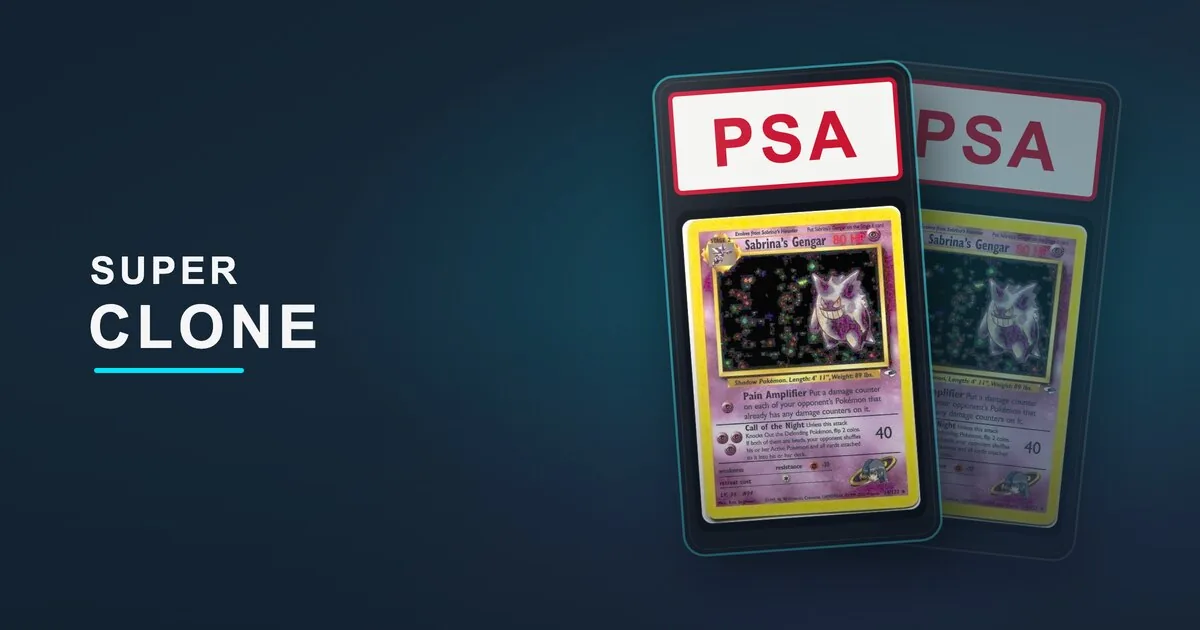
- 2000 Gym Heroes Sabrina's Gengar PSA 10, listed on Fanatics Collect at $19,500
- 2003 Aquapolis Espeon PSA 10, listed on eBay at $20,000
- a 2025 Dragon Ball Super Fusion World card and a 1995 Playboy Chromium card, both on Alt
That's about 1 in 7,000 of the slabs whose QR could be read. Two caveats keep it from being the whole picture. The scan only catches fakes that make one particular QR mistake (check 3 below), so a fake with a clean QR passes it. And a genuine label in a new case would pass it too. Treat 5 as a floor.
He's now checking new PSA listings on those marketplaces as they go up.
What's being sold
CheckCOA traced three kinds of listing in its write-up:
- Label and case kits. One AliExpress kit paired a PSA front label from one cert with a back label from another. The back label led to a real PSA record for a different card. PSA has since deactivated the front label's number.
- Labels made to order. A second store printed custom PSA-style front and back labels for whatever card the buyer named. One number in the seller's video still pulls up a real PSA 10 record for a different card.
- Genuine labels, sold loose. A flea-market bundle in Japan held real PSA, BGS and ARS labels, removed from their cases, for ¥6,800. These aren't fakes. The risk is that a real label goes into a new case with a different card, and that's hard to tell from the original slab.
CheckCOA added all 11 readable numbers to its fraud database: six PSA labels marked fake, and five (three PSA, two BGS) marked suspected.
Why the cert lookup isn't enough anymore
A cert lookup answers one question: does this number exist, and what card was graded under it? It doesn't tell you the card in front of you is that card.
What the lookup does give you is PSA's own pictures. PSA images the cards it grades and uploads them to the cert page, and it won't accept images from customers: the item has to be in-house and imaged by PSA (PSA FAQ). A faker can copy a cert number. They can't change PSA's photos of the card it belongs to.
Seven checks, in order
Start with the card. The label and holder checks after it matter most when the cert page has no images.
1. Compare the card with PSA's scans for that cert
Look the cert up yourself at psacard.com/cert or in the PSA app. Don't use a link or screenshot from the seller.
If the cert page has images, put them next to the card in the slab and compare details that can't be faked by picking the same card:
- Centering. The border widths on all four sides should match PSA's scan.
- Print marks. Specks, small ink lines and holo flaws sit in the same places on the same copy of a card. Two copies of the same card rarely share them.
- Edges and corners. A white nick on the back edge in PSA's scan should be on your card too.
Same card name and same grade isn't a match. The question is whether it's the same physical card. If the cert has no images, you can't run this check, and that's worth knowing before you rely on the slab.
2. Check that the label matches the card
Read the label line by line against the card. It sounds obvious, but it was missed on this $10,000 listing.
In September 2026, a listing badged "Great Deal" showed a 1996 Japanese Blastoise in a PSA 9 slab labelled NO RARITY SYMBOL. Zoom into the bottom of the card and there's a rarity symbol right next to "No. 009" (@norarity1996). No Rarity Symbol is the first Japanese Base Set print, and the label is what the price is built on. Whether that's a label error or a different card in the case, the label doesn't describe what's inside it.
If you're not sure what a variant should look like, our guides on Japanese Unlimited cards and rarity symbols cover where to look.
3. Scan the QR code and read the whole URL
PSA's LightHouse label, in use since 2017, carries a QR code on the back that opens the cert's verification page (PSA). A genuine label stores:
psacard.com/cert/12345678/
All five fakes in Roman Pioneer's scan stored:
psacard.com/cert/12345678/psa
CheckCOA's results explain where the second form comes from: it's what your browser's address bar shows on a PSA cert page. The fakes look like someone copied the link from PSA's site and printed it. The same pattern came up a week earlier in a warning shared by @hellaorganics, from @keezycards on Instagram: a collector on Elite Fourum reportedly scanned around 1,300 real PSA QR codes and none ended in /psa.
The catch is that both URLs open PSA's real site and show the real cert. If you scan and see a PSA page, you've learned nothing. Read the URL your camera shows before you tap it.
A clean URL doesn't make a slab real. A QR code is only a link, and anyone can print a correct one.
4. Look for PSA's label security features
PSA added these to its labels in 2017, and they're harder to copy than the text (PSA, PSA's label article):
- Fugitive ink. On the front, the background behind the label text is wave-like brush strokes, not plain white. On the back, the area below the blue background carries the same ink. It's the ink used on cheques: it dissolves when cleaning chemicals touch it, so a washed or altered label shows it. Look for the pattern; don't test it with anything wet. PSA's cert pages for these labels list the label type as "with fugitive ink technology", so a post-2017 cert on a plain white label is worth a closer look.
- The LightHouse hologram. The hologram at the bottom centre of the front label switches on and off as you tilt the slab.
- UV. Under a UV torch, the PSA logo on the lower left of the back label lights up and shows smaller PSA logos inside it.
PSA also says the logo carries security elements "undetectable to the naked eye", and that there are other covert features it doesn't describe.
5. Put a loupe on the label
Collectors have started putting a 10× loupe on their labels. Up close, a genuine PSA label's printed background breaks into a fine pattern of small dots.
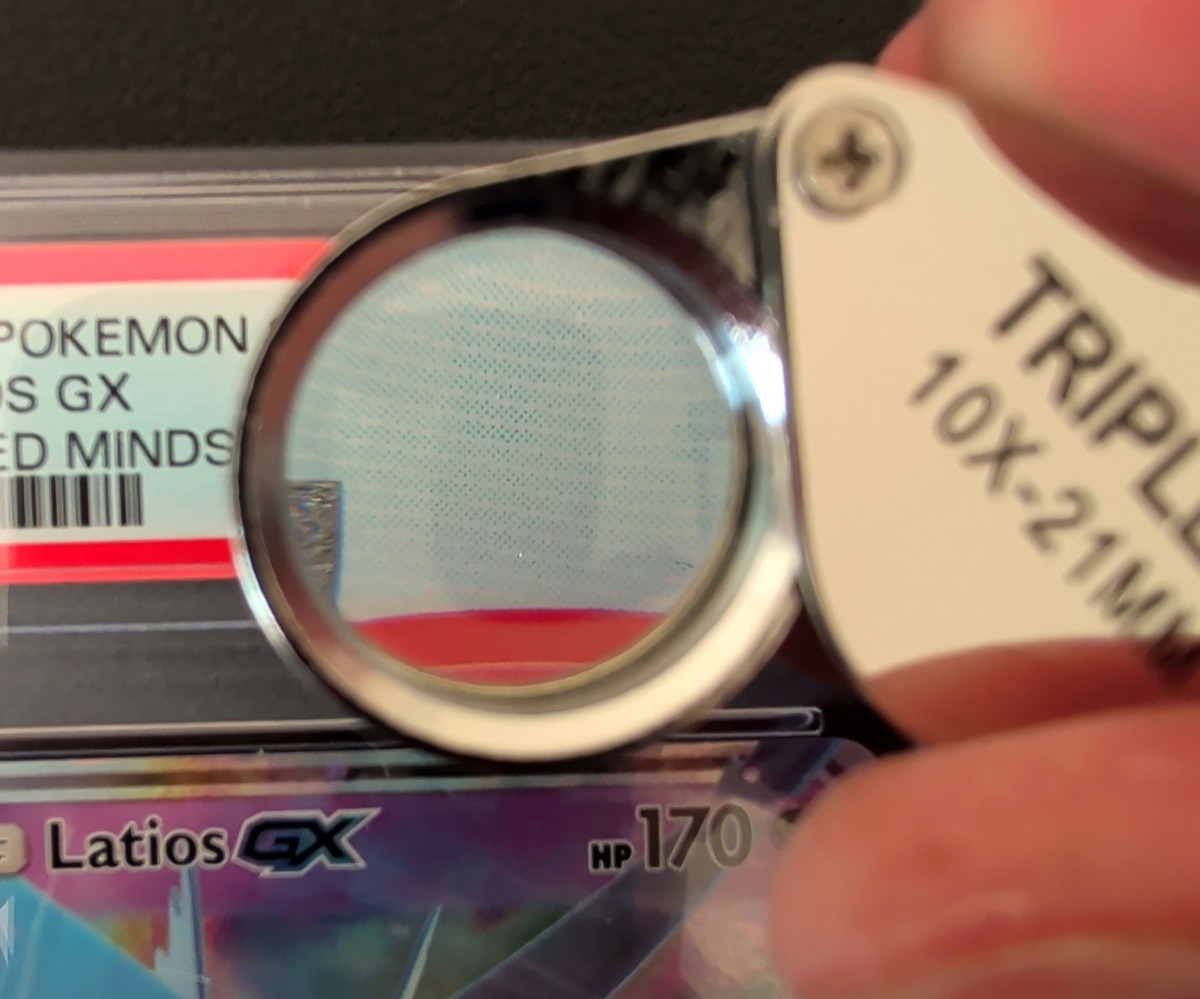
Photo: @arnoldmoger, a genuine PSA label under a 10× loupe.
Compare yours against a slab you know is real from the same era. PSA hasn't published what its hidden print features look like, so this is a comparison, not a spec: a label whose pattern looks different from your known-good slab is a reason to run checks 1 and 3 again, not a verdict.
6. Look at the holder: the molded "21"
Turn the slab over and look near the bottom corners for a "21" molded into the plastic. According to the October warning, certs starting with 2 to 7 usually shouldn't have the bigger "21" that newer holders carry, while certs starting with 8 and up can.
A big "21" on an old cert is a reason to look harder. PSA reholders old certs into its current holders, so a genuine old card can sit in new plastic. Our PSA Japan vs USA slab guide has photos of the mark on both holders, and the PSA label history shows which label style goes with which era of cert.
7. Ask PSA about the reholder history
PSA's reholder service takes a card out of its current holder and puts it in PSA's latest holder and label. Generally the grade, the authentication result and the cert number stay the same (PSA).
So an old cert in a new holder has an innocent explanation, and PSA is the one who can confirm it. If the holder and the cert don't line up, contact PSA's customer service with the cert number and ask whether that card was reholdered. A seller who had it done should also have the order paperwork.
What about BGS and CGC?
The same weak spot applies to every grader with a public lookup. Genuine BGS 10 labels have been sold loose alongside PSA 10s (@renoipgp).
Beckett's new label, launched in 2026, puts a QR code on every slab: "scan to verify your cert instantly at beckett.com" (Beckett; launch covered by Sports Collectors Digest). That's convenient, but as Roman Pioneer put it, a QR code is a link and anyone can print one. Look a BGS number up yourself at beckett.com/grading/card-lookup and compare the card against the record, the same as with PSA.
For Chinese slabs, which verify through WeChat instead of a website, see what CCIC graded slabs are and how to check one. For how the graders compare more broadly, see PSA vs BGS vs CGC.
Red flags, not proof
None of these checks is a guarantee on its own:
- A real slab can fail one. A legitimate reholder breaks the "21" pattern.
- A fake can pass most of them. A genuine loose label passes every label check, and a copied number passes the lookup.
- The card-to-scan comparison is the hardest to fake, because it doesn't depend on the label at all.
If a slab trips a flag, the useful next step is more information: clear photos of both sides, PSA's scans side by side with the card, and an answer from PSA on the reholder history. CheckCOA asks collectors to report label kits, loose labels and mismatched slabs, and PSA's customer service is the place to ask about a specific PSA cert.
Sealed product has its own version of this problem. Our piece on X-raying Pokémon packs covers what an authentication certificate does and doesn't prove for boxes.
Track what your slabs are worth
The BankTCG app reads a PSA slab's cert label with your camera and pulls up that card's sold prices by grade from market data. It tells you what the slab should be worth, not whether it's real, so run the checks above as well.
FAQ
What is a super clone PSA slab?
A fake slab made to pass the usual checks: a printed copy of a real PSA label carrying a real, active cert number, or a genuine label moved into a new case with a different card. The cert lookup shows a real record, just not for the card in the slab.
Does a valid PSA cert number mean the slab is real?
No. Fake PSA labels sold online have carried real, active cert numbers, so the lookup shows a genuine record for a card that isn't in your slab. Compare the card in the slab with PSA's own scans for that cert.
How common are fake PSA slabs?
Rare, going by the biggest public check. In early November 2026, CheckCOA's founder decoded the back-label QR codes on 35,216 PSA slabs listed on the big card marketplaces and found 5 fake labels. That scan only catches fakes with one specific QR mistake, so it's a floor, not a full count.
How do I check the QR code on a PSA slab?
Scan it and read the whole URL before opening it. Genuine labels store psacard.com/cert/ followed by the number. Every fake found in the November 2026 scan stored a link ending in /psa instead. Both open PSA's real cert page, so seeing the page proves nothing on its own, and a clean URL doesn't prove the slab is real either.
What is the 21 on the bottom of a PSA slab?
A mark molded into the plastic near the bottom corners. Collectors report that the larger 21 belongs to newer holders, so an older cert in a holder with the big 21 is worth a closer look. PSA reholders old certs into new plastic, so on its own it doesn't mean the slab is fake.
Can PSA tell me if a slab was reholdered?
Ask PSA's customer service with the cert number. PSA's reholder service moves a card into its latest holder and label and normally keeps the same cert number, so an old cert in new plastic can be legitimate.
Are fake BGS slabs a problem too?
Yes. Genuine BGS 10 labels have been sold loose, pulled from their cases, and Beckett's new labels use a QR code, which anyone can print. The same rule applies: compare the card with Beckett's record, not just the number.
Sources
- CheckCOA, Fake PSA labels on AliExpress and loose graded labels (8 November 2026)
- Roman Pioneer (@renoipgp), founder of CheckCOA: the 47,786-slab marketplace scan (5 November 2026) and fake PSA labels from Japan, loose PSA/BGS labels (8 November 2026)
- @hellaorganics on X, the "21" mark and QR URL warning, with screenshots from @keezycards (29 October 2026)
- @arnoldmoger on X, a genuine PSA label under a 10× loupe (13 November 2026)
- @norarity1996 on X, the No Rarity Symbol Blastoise listing (3 September 2026)
- PSA: Security, PSA Labels Get New Look, New Technology, Trading Card Reholder, FAQ, Cert Verification
- Beckett: Grading, Graded Card Lookup
- Sports Collectors Digest, Beckett brings back heritage logo, launches new card-grading label
