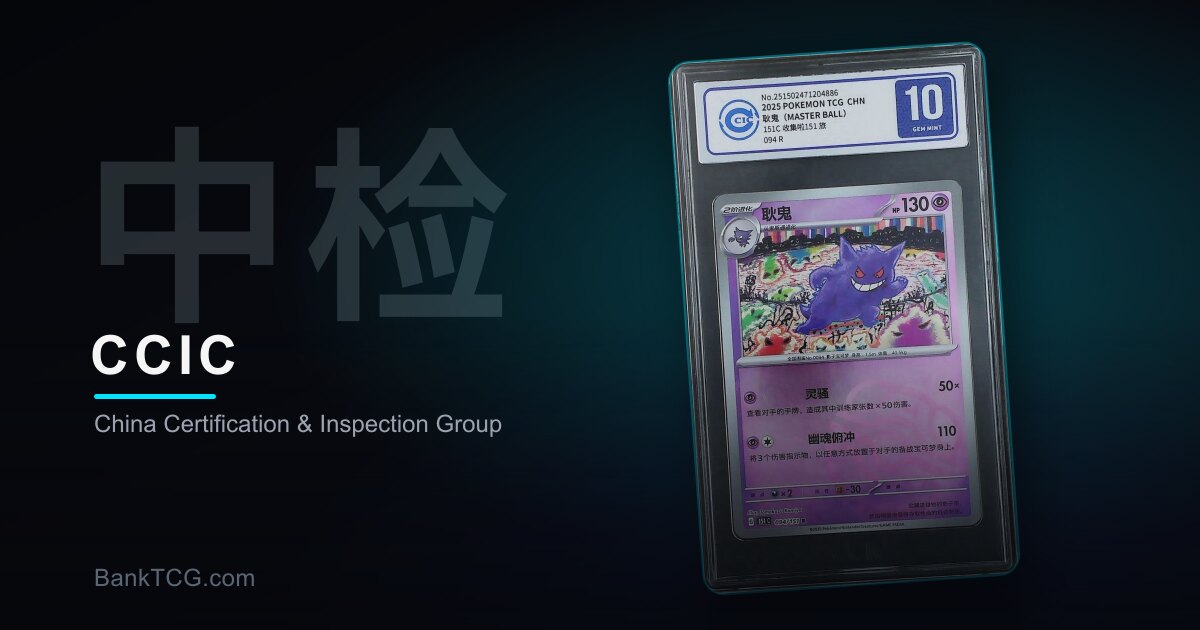
Quick Facts
- CCIC stands for China Certification & Inspection Group, a state-owned enterprise approved by China's State Council. Its core business is inspecting and certifying import and export goods; card grading came later.
- CCIC is widely regarded as the biggest and most official grading name in mainland China, where the government backing carries real weight.
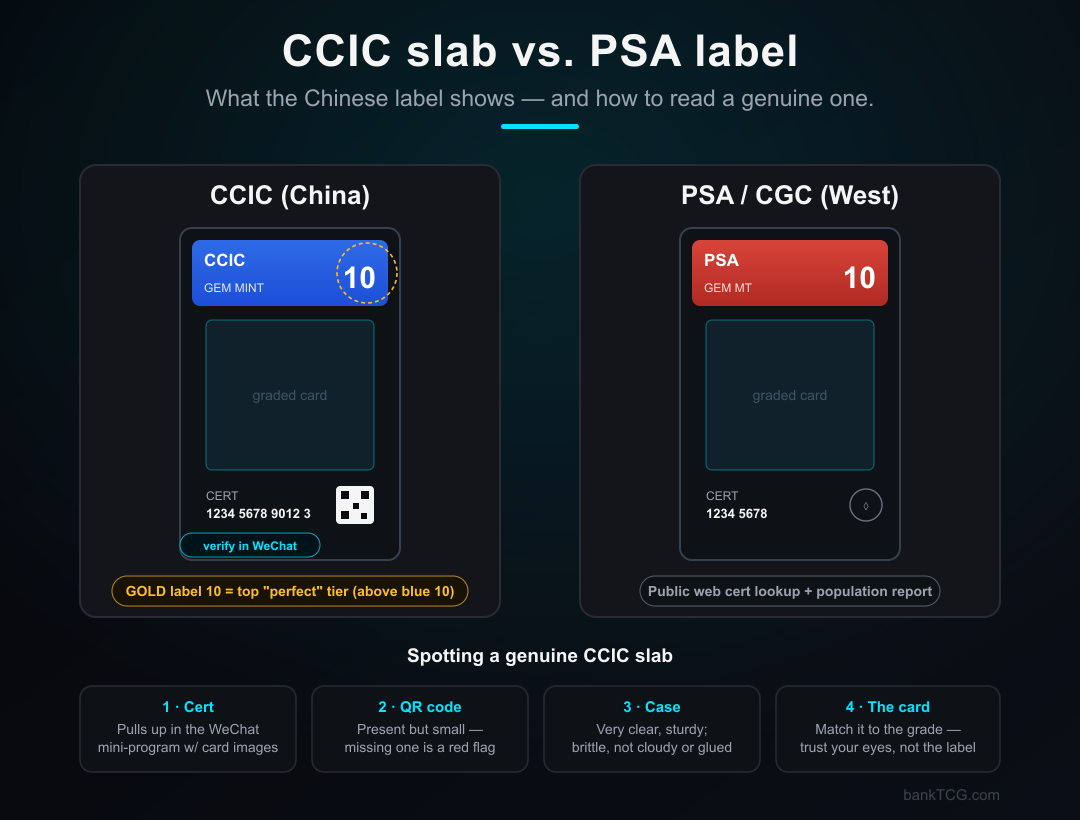
- The scale runs on a familiar ten-point system, with a standard blue label for grades like Gem Mint 10 and a gold label reserved for the top "perfect" grade. Many Chinese collectors treat a CCIC Gold 10 as roughly comparable to a PSA 10.
- In Western markets, CCIC slabs sell at a steep discount to PSA, which is exactly why they look so cheap on eBay and AliExpress.
- Grading in China is inexpensive, with collectors reporting bulk submissions at only a few dollars per card, a fraction of PSA or CGC pricing.
- Verification happens through a WeChat mini program, a real hurdle for buyers outside China who want to check a cert number.
If you've been browsing eBay or AliExpress for Pokémon singles lately, you've probably run into them: clean, very transparent slabs with an unfamiliar label, priced well below the same card in a PSA case. That label usually says CCIC. English coverage of the company is nearly nonexistent, so buyers are left guessing whether these slabs are legit and whether the cheap price is an opportunity or a trap. Here's everything worth knowing.
What Is CCIC?
CCIC is short for China Certification & Inspection Group. It is not a hobby startup. It's a state-owned enterprise approved by the State Council and managed under SASAC, the body overseeing China's central government-owned companies. Its primary business is inspection, verification, certification, and testing of import and export goods. Think of it as a government-backed quality assurance giant, not a card shop that started grading on the side.
That background explains how CCIC entered card grading. As the trading card boom hit China, counterfeits became a serious trust problem, and a certification body with actual state authority was well positioned to solve it. Rather than copying the PSA playbook, CCIC leaned on its official status, emphasized authenticity and security, and partnered with Chinese e-commerce platforms so grading plugged directly into how cards get bought and sold there. Collectors have even claimed that submitting counterfeits to CCIC can carry criminal consequences in China, which, if accurate, is a deterrent no Western grader can match.
The result: inside mainland China, CCIC is generally seen as the most serious and official grading option. Outside China, almost nobody has heard of it. That gap is where all the confusion (and all the cheap listings) comes from.
The CCIC Grade Scale and How to Read the Label
CCIC uses a ten-point scale that will feel familiar if you know PSA or CGC. The details that matter for a buyer:
The two label tiers
- Standard blue label. This covers the normal run of grades, including Gem Mint 10. It's the label you'll see most often on marketplace listings.
- Gold label 10. CCIC's top-tier "perfect" grade, sitting above the standard 10. Collector shared data suggests it's genuinely hard to earn, with some hobbyists comparing its scarcity to a BGS Black Label. Treat that as community sentiment rather than an official stat, but the two-tier top end is real.
Half grades like 9.5 exist below that, and one collector who compared grading distributions concluded CCIC's strictness lands somewhere near CGC's. That's a single community analysis, so hold it loosely.
Label anatomy
A genuine CCIC label carries the card's identifying details, the numeric grade, a certification number, and a QR code. Two quirks stand out against Western slabs: the cert number is reportedly longer than a PSA cert, and the QR code is small enough that collectors have complained about phone cameras struggling to focus on it, forcing manual entry instead.
The slab itself
This is the part that surprises people. Collectors who own both consistently describe the CCIC case as clearer and better looking than a PSA case. One longtime PSA collector on Elite Fourum wrote that his first CCIC slab made him realize how low quality the PSA holder is by comparison. The plastic is very transparent and feels sturdy in hand, though the material is brittle and shatters rather than flexing when cracked open.
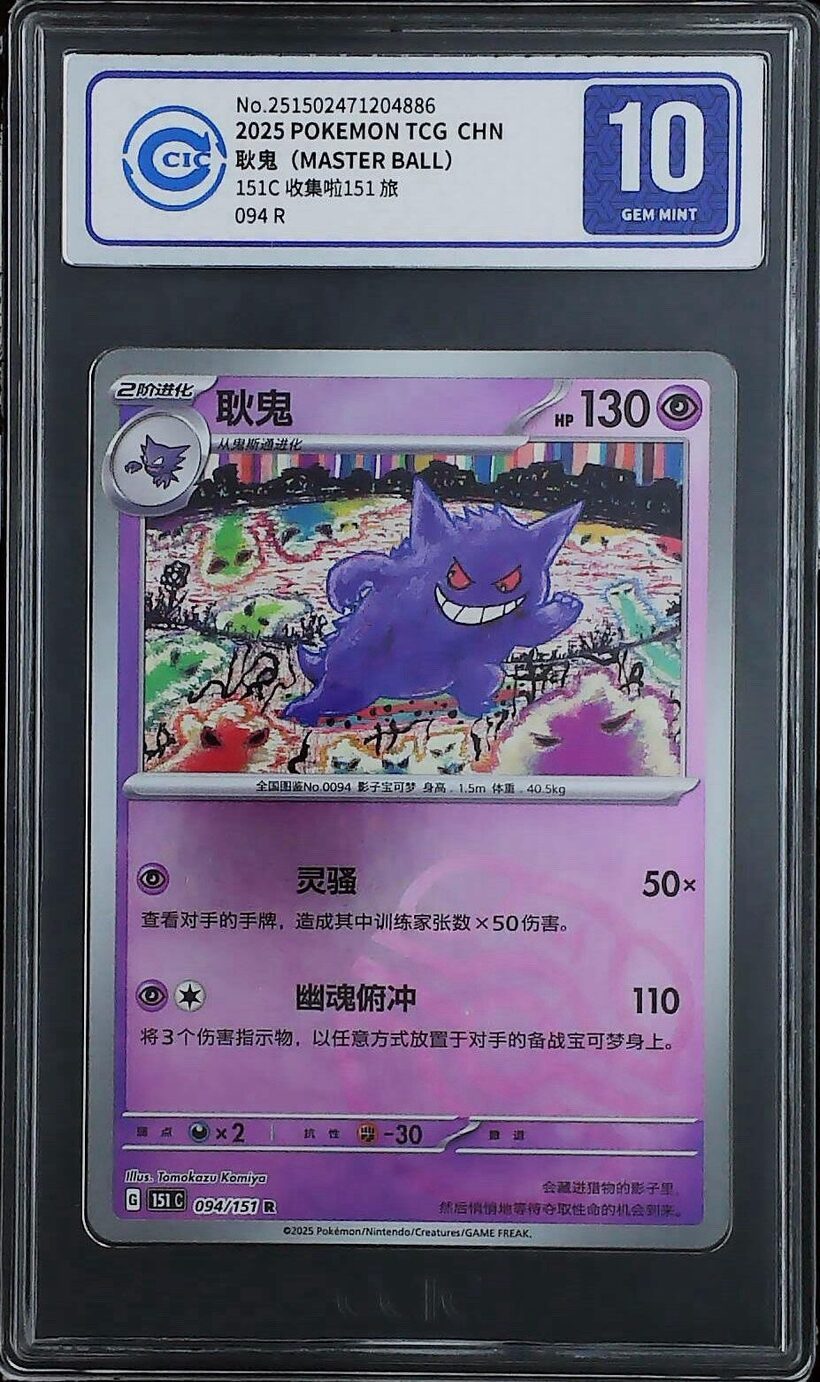 A real CCIC blue-label Gem Mint 10 slab — the very clear case collectors keep pointing to. Photo: Elite Fourum — Bellsprout
CCIC vs PSA, BGS, and CGC
Here's where the honest, slightly uncomfortable truth comes in: slab quality and grade accuracy are not what sets resale value. Market trust is. And market trust is regional.
Inside China, CCIC arguably wins. Its state backing solves the counterfeit anxiety that plagues the local market, and one collector active there reports a gold CCIC 10 selling for around 30 percent more than the equivalent PSA 10 on Chinese platforms. That figure is anecdotal, but it matches everything else we know about CCIC's standing at home.
In Western markets, PSA remains king by a wide margin, with CGC and BGS behind it and CCIC far behind that. A CCIC 10 listed to a Western audience typically sells closer to raw near-mint pricing than to PSA 10 pricing. Buyers don't recognize the label, can't easily verify it, and can't pull a population report the way they can with PSA. Our PSA vs BGS vs CGC comparison covers how the big three stack up on value and trust; for Western sellers, CCIC sits outside that hierarchy entirely.
On cost, CCIC is cheap by any Western standard. Forum reports put bulk grading in China at roughly two to six dollars per card, versus twenty dollars and up for entry-level PSA service. Turnaround times aren't well documented in English.
On transparency, CCIC lags for anyone outside China. PSA, CGC, and BGS all offer public cert lookups and population reports on the open web. CCIC's verification lives inside WeChat, with no easily accessible English population report.
Are CCIC Slabs Legit?
Yes, with two big caveats.
The first caveat is the value question covered above. A real CCIC slab with an accurate grade is still worth far less to a Western buyer than the same card in a PSA case, because the label doesn't carry trust here. Legit and valuable are different things.
The second caveat is authenticity of the slab itself. Any grading label that trades at a premium eventually gets counterfeited, and fake PSA, BGS, and CGC slabs are a well-documented problem. For CCIC specifically, there is much less English documentation either way. What we do know is that Chinese collectors habitually verify CCIC certs through the official WeChat mini program before buying, which tells you the community there treats verification as necessary rather than optional. There's also a related risk that exists across every grading company: a genuine slab holding a counterfeit card that fooled the grader, or a case with a swapped label.
So the practical rule is the same one that applies everywhere in this hobby: verify the cert, inspect the card, and judge the card, not just the label. If you're still learning to evaluate raw cards, our guide on how to spot a fake Pokémon card covers the fundamentals that apply whether a card is slabbed or not.
How to Spot a Fake CCIC Slab
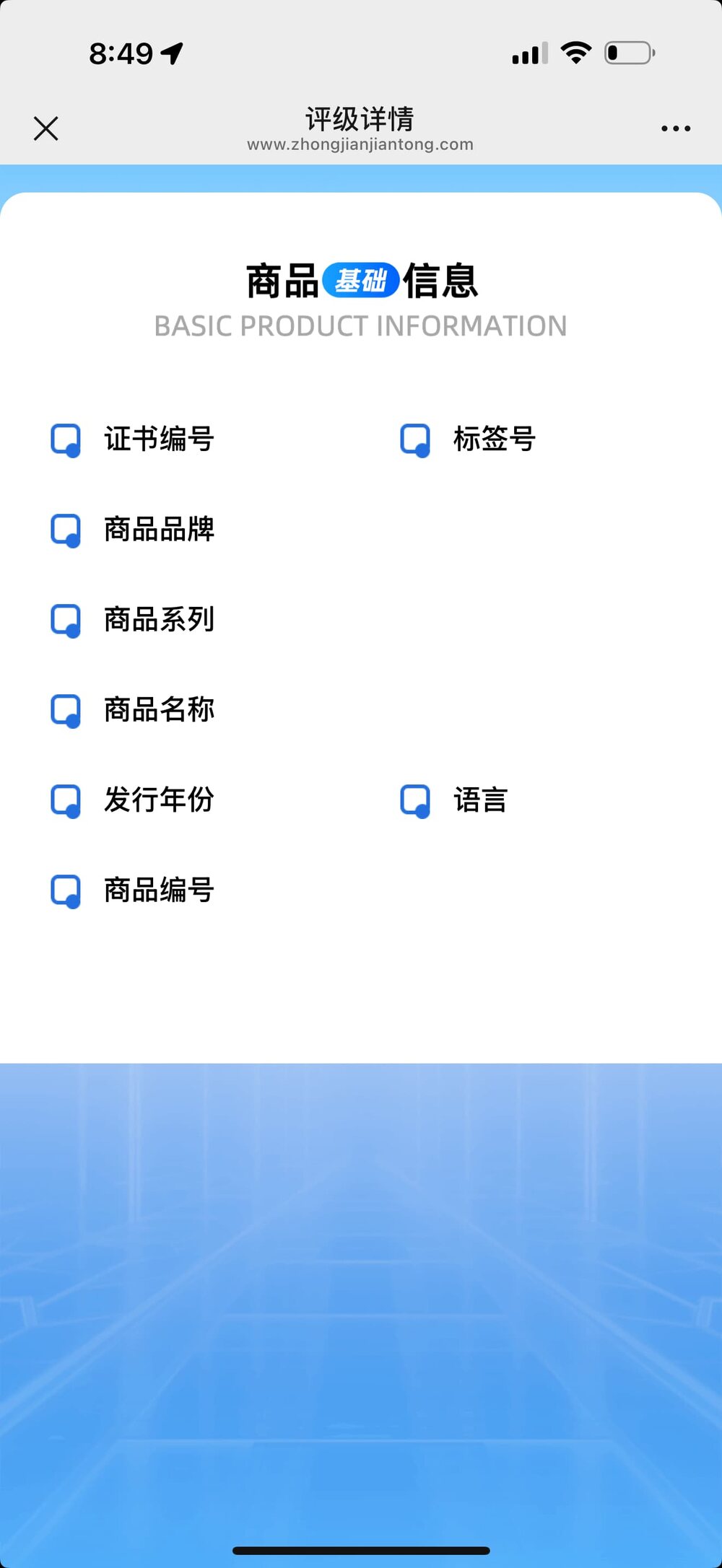 CCIC's verification screen — you enter the cert and label number to pull up a slab's record. This lookup is the step Chinese collectors treat as mandatory before buying. Photo: Elite Fourum — Dsdoodle
Because documented fake CCIC slabs are thin on the ground in English sources, treat this as a checklist adapted to what's known about genuine CCIC holders:
- Verify the cert number. The official route is CCIC's WeChat mini program, which pulls up the graded card's record, reportedly including front and back images you can match against the slab. If a seller can't provide a verifiable cert, walk away.
- Check the QR code. A genuine slab has one, even if it's annoyingly small. A missing or non-functional QR code is a red flag.
- Assess the case quality. Genuine CCIC cases are notably clear and well made. A cloudy, flimsy, or glue-seamed case doesn't match what collectors describe.
- Match the card to the grade. A supposed gold 10 with visible whitening, scratches, or bad centering is telling you something. Trust your eyes over the label.
- Price sanity check. CCIC slabs are cheap in the West, but a high-value card at an absurd price from a zero-feedback seller is the same trap it always is.
If you want a feel for how legitimate grading labels are constructed and what security features look like across companies, our PSA Label Museum is a useful reference point for comparison.
Should You Buy CCIC Graded Cards?
It depends entirely on what you're doing.
Buying to collect Chinese language cards: CCIC makes a lot of sense. It's the dominant grader for that market, the slabs display beautifully, and if you ever sell into China the label helps rather than hurts.
Buying purely for the card: CCIC slabs can be genuine bargains. Because the label carries little Western premium, you often pay close to raw price for a card that has passed at least one professional review. Just verify before you buy.
Buying to flip in Western markets: Be careful. The label won't add PSA-style value, and your buyer pool will be small.
Buying to crack and regrade: This is the play that has quietly caught on. Experienced collectors report buying CCIC 9.5s and 10s at small premiums over raw price, cracking them, and submitting to PSA. Some have crossed CCIC 10s straight into PSA 10s. The economics can work because the entry price is so low, but it's a gamble on the grade holding up under PSA's eye. Run the numbers with our PSA profit calculator first, and read our data-driven guide to whether grading is worth it if you're new to the math.
A practical note on cracking: the case material is brittle. The method collectors recommend is cutting around the entire perimeter with cable cutters, corners included, then gently prying the halves apart. People who tried to pop them open like a PSA case ended up with shattered plastic flying, so work slowly, ideally inside a bag.
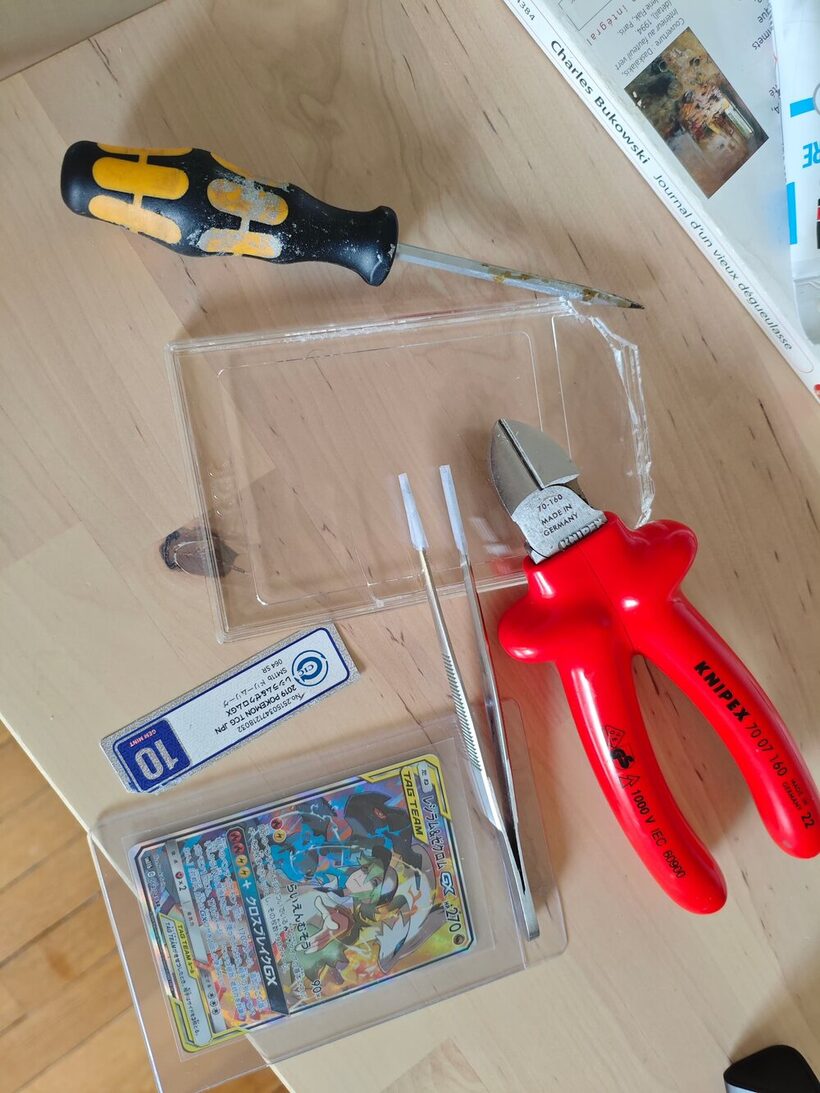 Cracking a CCIC slab — the brittle plastic shatters rather than flexing, so collectors cut the full perimeter first. Photo: Elite Fourum — Bellsprout
Check the Card, Not Just the Slab
Whether a card sits in a CCIC case, a PSA case, or no case at all, the grade only tells you half the story. The other half is what the card itself is actually worth right now.
BankTCG is built for exactly that:
- Scan any card and pull live pricing instantly across 96,000+ cards spanning Pokémon, Yu-Gi-Oh!, Magic, and One Piece — so you know what the card's worth regardless of who slabbed it.
- Pre-grade with AI centering analysis to judge whether a raw card is worth sending to a top-tier grader.
- Track everything in your Vault and get alerted when a held card moves.
It's free to start: 5 scans a month, no account or credit card required.
FAQ
Is CCIC grading legit? Yes. CCIC is a real, state-owned Chinese certification giant whose grading arm is widely trusted inside China. The catch is that its label carries little resale premium in the West, so a legit CCIC slab is still usually priced near raw value on eBay.
CCIC vs PSA, which is better? It depends on the market. In China, a gold CCIC 10 reportedly sells for more than the equivalent PSA 10. In North America and Europe, PSA wins on resale value, brand recognition, and easy verification by a huge margin. If you plan to sell to Western buyers, PSA is the safer label.
Can you crack a CCIC slab and regrade with PSA? Yes, and plenty of collectors do exactly that, since CCIC graded cards often sell barely above raw price. The case is brittle, so cut around the full perimeter with cable cutters and pry gently rather than snapping it open. Some collectors have crossed CCIC 10s into PSA 10s, but there's no guarantee the grade holds.
Do CCIC slabs hold value? In China, yes, especially gold label 10s. In Western markets, CCIC slabs trade at a heavy discount to PSA and CGC equivalents and are mostly valued for the card inside, not the grade on the label.
How do I verify a CCIC slab? Through CCIC's mini program inside WeChat, where you enter the cert number from the label and view the graded card's record. The QR code on the slab links to verification too, though its small size makes scanning fiddly. There is currently no convenient English web lookup comparable to PSA's cert database.
Sources & Further Reading
- PSA vs BGS vs CGC: The Full Grading Comparison
- Should You Grade Your Cards? A Data Driven Guide
- How to Spot a Fake Pokémon Card
- PSA Grading in Japan vs the USA
- PSA Label Museum
- PSA Profit Calculator
- Elite Fourum thread: "CCIC grading in China" (firsthand collector reports on slabs, cracking, pricing, and verification)
- China Inspection and Certification Group corporate site (company identity and state ownership)
- "Business Model Innovation in the Trading Card Grading Industry" (ResearchGate, 2025) covering PSA, CCIC, and SQC