Quick Facts
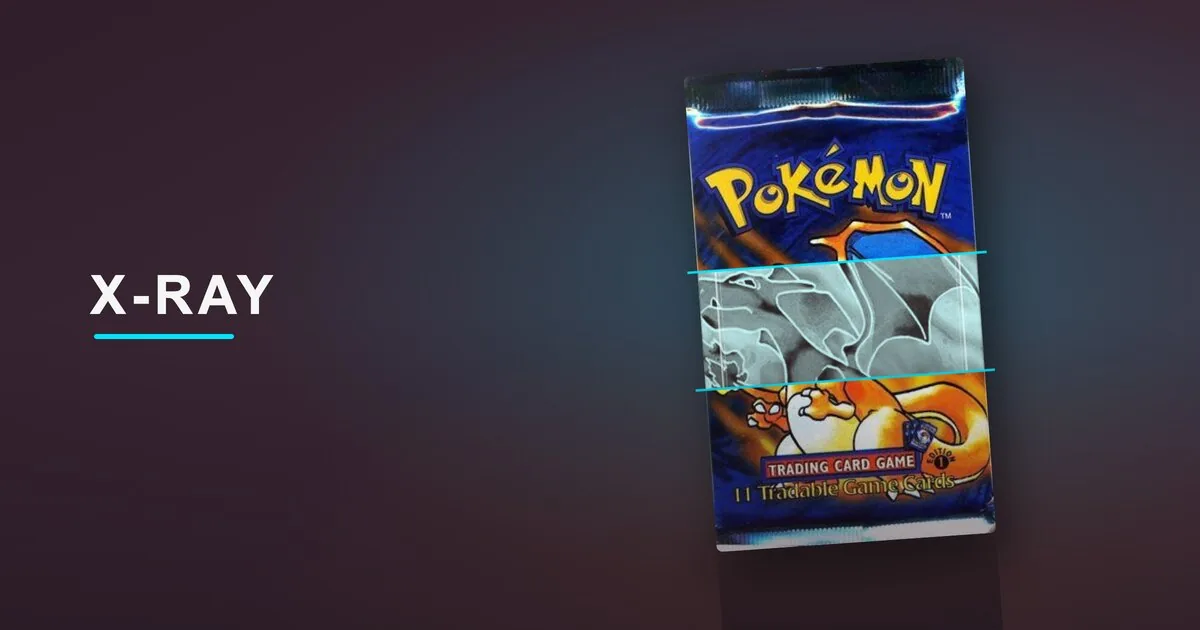
- Sealed Pokémon product can now be CT-scanned. Industrial X-ray labs reconstruct the inside of a pack well enough to see the foil layer of a holo card through the wrapper.
- One US lab, X-Ray Authority, sells both sides of it. A public authentication of a ~36-pack booster box costs $300 and ends in a serialised certificate. A private characterization that will "characterize each holographic card" costs $75 a pack, or $450 a box.
- An authentication certificate is not a guarantee of untouched packs. Collectors on Elite Fourum doubt CT can tell a factory box from a careful reseal, and the lab doesn't publish what its report checks.
- There's no published way to tell whether a pack has already been scanned. A patent describes wrappers that change colour under scan-level radiation, but nothing like that is on shelves.
- Single loose packs carry the most risk. They're the cheapest product to scan and look the same afterwards. For expensive sealed product, the seller's history still tells you more than any certificate.
For years the worry with sealed Pokémon was weighing: people put loose packs on a scale, kept the heavy ones that held a holo, and sold the light ones. X-rays and CT scanners are the same idea with a much better instrument. Instead of guessing from a fraction of a gram, a scan can show the foil inside.
That's good news if you're buying a five- or six-figure vintage box and want proof it's real. It's bad news if you're buying a single loose pack from a stranger. The rest of this guide covers what's being offered, what a scan can and can't prove, and what to check on sealed product now.
How X-raying a pack works
A plain X-ray is a single shadow, with every card in a pack stacked on top of each other. A CT scan takes thousands of those shadows from different angles and rebuilds them into a 3D volume, so a computer can pull out one card at a time.
What makes a holo readable is the foil. Techeblog's write-up of the 2024 pack scans put it simply: the method extracts the Pokémon "due to slight density differences in the cards and foils." The holographic layer is denser than printed cardstock, so it shows up as a shape you can recognise.
The best-documented rig belongs to Ahron Wayne, an X-ray applications engineer who bought decommissioned GE Explore Locus SP micro-CT scanners and rebuilt them. His build log on Hackaday describes about 25 µm resolution and around 2,500 projections over a 200° rotation. That's lab equipment, not something anyone carries into a shop. We found no portable pack scanner on sale, so the packs at risk are the ones that pass through the mail, not the ones on a store shelf.
The two services: authenticate a box, or find the holos
X-Ray Authority trades as Industrial Inspection & Consulting, LLC, in Norton Shores, Michigan. Its price list splits into two kinds of work, and the difference matters.
| Service | Price (as listed) | What you get |
|---|---|---|
| Public authentication, Pokémon or other TCG booster box (~36 packs) | $300 | "Receive authentication report, serialize, and enter into public registry" |
| Public authentication, hobby box (5–10 packs) | from $125 | Same |
| Private characterization, loose pack (~10 cards) | $75 | "Characterize each holographic card" |
| Private characterization, extra packs | +$20 per pack, up to six per scan | Same |
| Private characterization, Pokémon booster box (~36 packs) | $450 | "Characterize each holographic card, flat rate independent of product value" |
Prices from xrayauthority.com, read 16 November 2026. The site calls them non-binding estimates. An expedite fee of 50% is extra.
The public side is what you see on auction listings. A box gets a numbered letter of authenticity (the company's own example is XRA-0067, a 1st Edition Base Set box linked to Goldin's 2026 Pokémon auction). The certificate number can then be looked up in its Collectibles Registry, which promises "reports, images, product packaging & seal images, and product weights."
The private side is the part collectors argue about. Characterizing each holographic card in a pack is, in plain terms, telling the owner which packs hold the hits. The result isn't entered in any public registry, so a buyer later has no record that it happened.
To be fair to the lab, the page doesn't say what "characterize" reveals. It may mean a holo's outline, not its exact identity. But for a seller deciding which packs to open and which to sell, an outline is enough.
What an X-ray certificate does prove
A CT authentication is a real step up from photos when it comes to the box itself. A scan can check that the packs inside are the right shape and count, that the cards are where packs should be, and that nothing is obviously replaced. Weight and seal images in the registry give a buyer something to compare against. For vintage boxes, where reproductions and reseals are the main risk, that's useful evidence.
What it doesn't prove
That nobody opened it and resealed it. When an Elite Fourum thread discussed X-ray-authenticated boxes in April 2026, collectors questioned whether CT can catch a skilled reseal. One wrote that resealing "does not involve substances that are incredibly noticeable using CT." Another pointed out that resealed boxes change hands many times before anyone notices. The service would only settle that if it could detect it reliably.
What the lab checked. The services page doesn't describe the report's contents. In the same thread, a collector noted the public cert checker only seemed to work for the sample cert "XRA-TEST" at the time. A certificate is only as strong as what's behind it, so ask to see the full report and the registry entry before paying a premium for one.
That the box wasn't scanned for contents, too. A box that went through public authentication could also have been characterized privately, before or after. The certificate tells you what was published, not everything that was looked at.
The sealed-product verifier DJR Authentication puts the general point well: sealed boxes "cannot be fully authenticated through visual inspection alone," and any evaluation is risk assessment, not certainty. A scan adds evidence. It doesn't make sealed product risk-free.
The problem nobody has solved: scanned packs look like every other pack
There is no published way for a buyer to tell a pack has already been scanned. A scan leaves no mark on the wrapper.
The fix exists only on paper. Ahron Wayne's patent, US 12,306,116 B1 (granted May 2025), covers card authentication and grading by CT. It also covers "anti-scanning protection" for manufacturers: material in the packaging that wrecks the image, cards mounted loosely enough to blur the scan, and photochromic film that changes colour after scan-level radiation, so a scanned wrapper would show it. None of that is on Pokémon packaging today.
Until it is, every loose pack sold for more than its price at retail carries the same question that weighed packs did. The economics are simple. At $75 a pack, scanning only pays off on packs worth well above that. That points straight at vintage loose packs and graded or sealed singles on resale marketplaces, not at modern packs off the shelf.
In the Elite Fourum thread, one collector predicted that unscanned boxes with older provenance will earn a premium. Another expected scanning to follow the path of pack weighing, with companies scanning packs for hits.
What to check on sealed product
- Know where the risk sits. A single vintage pack from an unknown seller is the cheapest product to scan ($75) and looks the same afterwards. A searched pack sold as a random one is the scam this whole section is about.
- Look at the seller's history. For high-value sealed, years of feedback on the same kind of product is evidence a certificate can't replace. A new account with one perfect listing has none.
- Ask for the full report behind a certificate. If a listing leans on an X-ray cert, look the number up in the registry yourself and ask what was checked. A cert you can't verify adds nothing. Graded cards have the same gap: a real cert number can sit on a fake PSA label, which our guide to spotting a fake PSA slab covers.
- Check the old tells anyway. Weight against a known-good example, crimps and seams, wrapper print quality, and a price that's too good for the market. Our guide to spotting fake Pokémon cards covers the card-level checks. For vintage, our 1st Edition guide covers what real Base Set print runs look like.
- Price the pack against what's inside. Look up what the set's chase cards actually sell for before you pay a premium for a sealed pack. If the pack costs close to its best pull, that's a sign someone already knows what's in it. The free BankTCG app scans and prices cards across Pokémon, Magic, Yu-Gi-Oh! and One Piece, so you can look up the chase cards' sold prices.
Is X-raying packs legal?
Scanning your own property isn't illegal. Selling a pack you know has no hit, while presenting it as a random sealed pack, is a different matter. Buyers pay sealed prices for the chance at a pull, and removing that chance without saying so misleads them. Marketplace rules and consumer law in most places cover misdescribed items. The hobby treats searched packs the same way it treated weighed ones: as a scam.
FAQ
Can you X-ray a Pokémon pack to see what's inside?
Yes, with an industrial CT scanner. The denser foil layer of a holo card shows up in the reconstruction, so a scan can show which packs hold holographic cards. One US lab lists this at $75 a pack. We found no portable scanner, so this happens in a lab, not in a shop.
What is an X-Ray Authority certificate?
A numbered letter of authenticity from X-Ray Authority (Industrial Inspection & Consulting, LLC) for a sealed product it has CT-scanned. Public authentications cost $300 for a ~36-pack Pokémon booster box and are listed in the company's online registry by cert number.
Does an X-ray certificate mean a box hasn't been resealed?
Not on its own. Collectors doubt CT can reliably catch a skilled reseal, and the lab doesn't publish what its report checks. Look up the cert, read the full report, and weigh the seller's history alongside it.
Can you tell if a Pokémon pack has been scanned?
No. A scan leaves no visible mark. A 2025 patent describes wrappers that change colour under scan-level radiation, but no Pokémon packaging uses it.
Are scanned packs worth less?
A pack that was scanned and then sold is likely one without the hit, so collectors treat it that way. That's why single loose vintage packs from unknown sellers carry the most risk.
Sources & Further Reading
- X-Ray Authority: Services & pricing · Collectibles Registry · 1st Edition Base Set box, XRA-0067
- Elite Fourum: Grading & authenticating booster boxes (April 2026)
- Techeblog: CT scanner reveals what's inside unopened Pokémon packs (August 2024)
- Hackaday.io: X-ray CT scanners get new life (Ahron Wayne's build log)
- Google Patents: US 12,306,116 B1
- DJR Authentication: Why sealed booster box authentication claims are often misunderstood
