Quick Facts
- Nobody wants to buy a $200 card from an account with no feedback. Build a record first with cheap sales, and buy a few things too: buyer feedback counts toward your score, though buyers can see the two apart.
- New sellers are limited. eBay caps how much a new account can list each month and holds payouts until delivery. On eBay US the faster payouts start after 10 completed sales totalling $150, with no more than 2 problems in a year.
- eBay's Authenticity Guarantee helps newer sellers. On eBay US, single cards selling for $200 or more, raw or graded, now go to PSA for a check before they reach the buyer. The threshold dropped from $250 at the end of July 2026.
- Sort before you list. Most cards in a modern set sell for under $1. List the cards worth a few dollars or more one by one, and sell the rest in lots.
- Cheap cards ship cheaply. eBay Standard Envelope covers raw cards up to $20 each on eBay US, with tracking, for around a dollar.
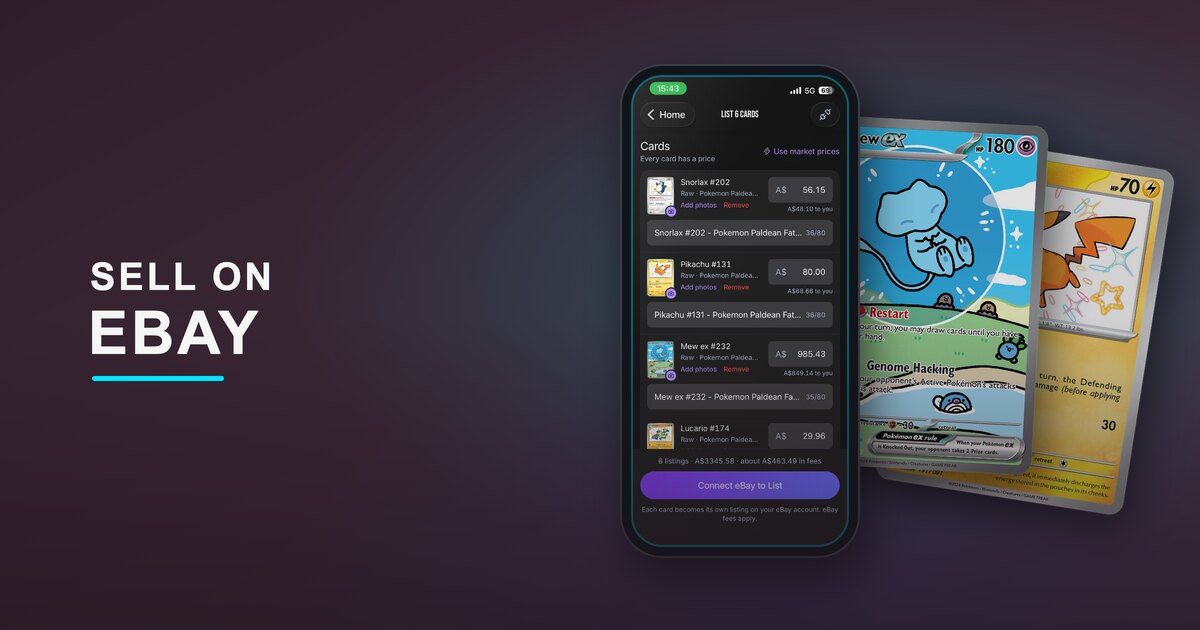
- The BankTCG app lists up to 25 cards at once, with titles built from the card's details and one tap to price them all.
Selling a Pokémon collection on eBay looks simple until you try it with a brand new account. The cards don't sell, the money you do make sits on hold, and eBay stops you listing after a handful. None of that is a bug. eBay is careful with new sellers, and so are buyers.
This guide is for anyone with a binder, a box or a whole collection to sell. It starts with the reputation part most guides skip, then covers sorting, pricing, listing and shipping. Prices, fees and limits below are for eBay US unless we say otherwise, checked on 7 November 2026.
Step 1: Set up your account
If you don't have an eBay account yet, register on the eBay site for your country. A personal account is fine for selling your own collection; a business account makes sense if you sell cards as a business.
Before your first payout, eBay asks you to set up selling: where to send your money, plus some details to confirm who you are. Have your bank details ready. It takes a few minutes and you only do it once.
Step 2: Build a reputation before you list the good cards
This is the step that decides whether your collection sells.
Why zero feedback doesn't sell
Your feedback score is the number in brackets next to your username. A buyer about to spend real money on a card checks it, and a 0 there is a reason to buy from someone else. Collectors on eBay's own community boards give new sellers the same advice: start with low value items until you have some feedback.
Feedback from buying counts, but not completely
eBay's feedback score combines what you receive as a buyer and as a seller, so buying a few cheap things (sleeves, toploaders, a single card you want anyway) gets your number off zero. You earn a yellow star at a score of 10.
Your profile shows buyer and seller feedback on separate tabs, though, and careful buyers check the seller tab. Buying gets you started. Selling is what builds trust.
How much feedback is enough?
eBay doesn't publish a number, and anyone who quotes you one is guessing. What reassures a buyer is a seller tab showing recent, positive sales of similar cards at similar prices.
A rule of thumb we'd follow: don't list a single card for much more than your biggest completed sale so far. Sell a stack of $5 to $20 cards first, ship them fast, and step your prices up as the feedback comes in.
What eBay does to new sellers
Selling limits. eBay sets a monthly limit on how many items and how much value a new account can list, and active and sold listings both count. It reviews accounts monthly and raises the limit as you sell. You can ask for an increase from Seller Hub (Overview, then Monthly limits, then Request to list more). eBay may end listings that go over your limit, so don't put up 300 cards on day one. Opening extra accounts to get around a limit is against eBay's rules and can get every account suspended.
Payment holds. Until you qualify, eBay US releases a new private seller's money:
- about 2 days after delivery if you used an eBay shipping label,
- about 7 days after delivery with another tracked label,
- 31 days after payment if the item had no tracking.
You qualify for payouts within about 48 hours of payment once you have at least 10 completed sales totalling $150 or more in the last 5 years, and no more than 2 open requests, cases or transaction defects in the last 12 months. Refunded, returned and cancelled sales don't count toward the 10.
That's another reason to start with a batch of cheaper cards: it gets you past the holds before the expensive ones sell.
The Authenticity Guarantee makes this easier
On eBay US, single trading cards that sell for $200 or more, raw or graded, go through eBay's Authenticity Guarantee. The card ships to an authentication facility, PSA checks that it's real and matches the listing (graded cards aren't regraded, but the slab and label are checked), and then it goes on to the buyer. Listings need at least two photos to qualify.
eBay lowered the threshold from $250 to $200 at the end of July 2026; its own seller page still said $250 when we checked on 7 November. Sets, lots and sealed product aren't covered.
For a newer seller, that matters. The buyer isn't relying on your feedback alone, because someone independent checks the card before it arrives. The trade off is time: the sale takes longer to complete because the card makes a stop on the way. eBay says the service costs the seller nothing, and recommends signature confirmation on cards over $750.
Step 3: Sort the collection
Go through everything once and split it into three piles:
- Singles worth listing on their own. Anything that sells for a few dollars or more raw, plus every graded card.
- Lots. Cheaper cards grouped in a way buyers search for: a complete or near complete set, all the holos from one set, one Pokémon across sets, or a bulk lot of commons and uncommons.
- Cards to check first. Anything that might be valuable but you're not sure of: old holos, Japanese cards, first editions, anything that looks like a misprint. Look these up before you price them; a few of them could be worth more than the rest of the box. Our guide to vintage error cards helps here, and so does knowing how to spot a fake before you list one.
Expect pile 2 to be the biggest. When we checked six recent sets for our guide to what Pokémon cards to collect, between 52% and 73% of the cards sold for under $1. Listing those one at a time costs more in time and postage than they're worth.
If a card is worth a lot raw, check whether grading it first pays before you sell: the PSA profit calculator works it out.
Step 4: Price from what actually sold
Price from sold listings, not from what other sellers are asking. Asking prices are wishes. Match the exact card, the printing (holo, reverse holo, first edition, Japanese) and the condition or grade.
As a new seller, price at or a little under recent sales, and use Buy It Now rather than auctions until you have feedback. An auction from a zero feedback account tends to end low, because the bidders who'd pay most are the ones who check sellers.
Remember the fees when you price. On eBay US without a Store, the final value fee for trading cards is 13.25% of the total sale, shipping and tax included, up to $7,500 (2.35% on anything above that), plus $0.30 per order of $10 or less and $0.40 above that. On a cheap card the per order fee takes a big share. eBay changes fees from time to time, so check its fee page before you set prices.
You can look up any card's current price on BankTCG.
Step 5: Write listings buyers find
Titles. Buyers search for exact cards, so put the details in the title in a readable order: card name, card number, set, then what makes it special (holo, first edition, Japanese), then the grade if it has one. For example: Umbreon ex 161/131 Prismatic Evolutions Special Illustration Rare PSA 10. eBay's own advice for trading cards is the same: the relevant keywords in a logical order, with grading details.
Photos. The front, the back, a close up of any flaw, and the label if it's graded. eBay recommends a plain white background with the flash off. Photograph the card you're actually selling, not a stock image of the card: buyers want to see the copy they'll get.
Condition. Be strict. A card you call near mint that arrives with whitening on the back is a return and possibly a negative, and a new account has no record to absorb one. When you're unsure, pick the lower condition.
Step 6: List dozens of cards at once with BankTCG
Listing a collection one card at a time on eBay is slow: search the card, write the title, set the price, add photos, repeat. The free BankTCG app does most of that for you, up to 25 cards at a time.
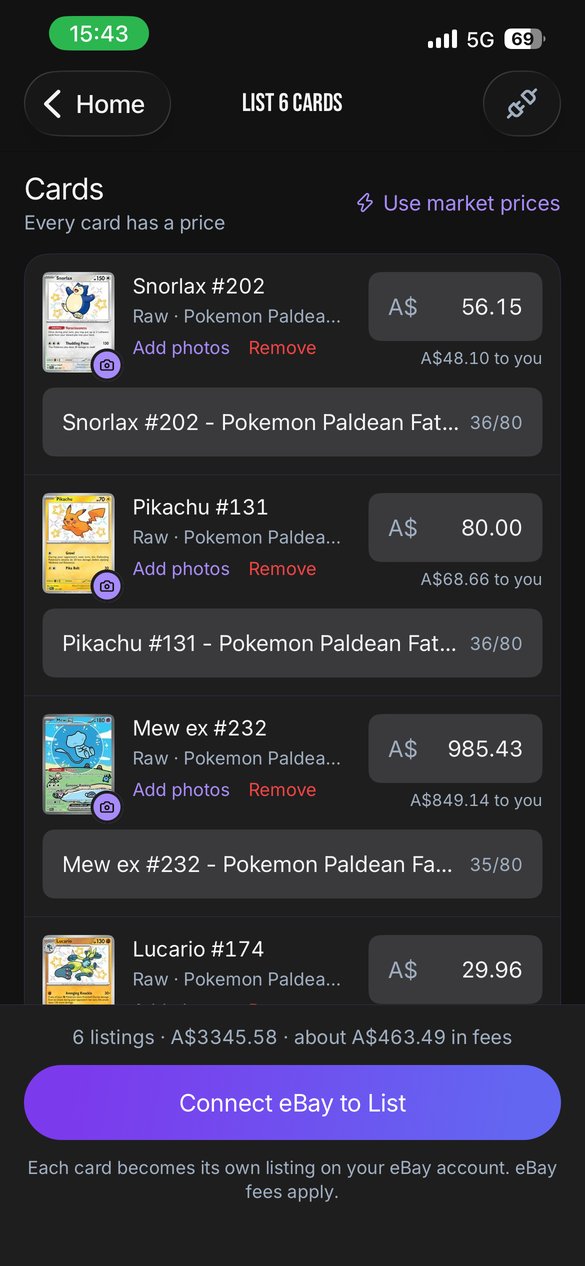
- Add your cards to your collection in the app. Scanning is the fastest way.
- In your vault, tap Select, tick up to 25 cards and tap List on eBay.
- The first time, tap Connect eBay to List and sign in to eBay. You only do this once.
- Tap Use market prices to price every card from BankTCG's market data, then change any you want. Each card shows roughly what you'll get after fees.
- Check the titles. Each one is built from the card's name, number, set and grade, and you can edit any of them.
- Add photos of your own cards, front and back.
- Set the format, shipping and condition once for the whole batch, and tap Create. Each card becomes its own listing on your eBay account, which you can edit on eBay afterwards like any other.
The app also has a step by step guide for this, from creating your eBay account onwards, in Settings, under Help & Tutorial, then Guides.
Step 7: Ship it properly
Cards up to $20 (eBay US): eBay Standard Envelope. It's eBay's cheap tracked option for raw cards. The rules, from eBay's help page:
- each item sells for $20 or less,
- up to 24 raw cards per envelope, and no more than 2 in toploaders,
- no graded cards,
- up to 3 oz,
- US addresses only, with the label bought through eBay.
Tracking updates come from the mail sorting machines rather than a scan at the door, so expect fewer updates than a parcel.
Anything over $20, every graded card, and anything going abroad: a padded mailer or a small box with full tracking. Pack each card in a sleeve, then a toploader, taped shut so the card can't slide out, then sandwiched between two pieces of cardboard.
Ship fast. Dispatching within a business day is one of the easiest ways to earn good feedback, and on a new account every review counts. Upload the tracking number as soon as you have it.
FAQ
How much feedback do I need before selling expensive cards on eBay?
eBay doesn't set a number. Buyers look at your feedback as a seller, and at whether you've sold similar cards at similar prices. Start with cheaper cards, and raise your prices as your record grows.
Does feedback from buying count on eBay?
It counts toward your feedback score, which combines feedback you get as a buyer and as a seller. Your profile shows the two on separate tabs, though, and careful buyers check what you've sold.
Why is eBay holding my money as a new seller?
New sellers' payouts are held until the item is delivered. On eBay US the hold ends sooner once you have at least 10 completed sales totalling $150 or more in the last 5 years and no more than 2 open cases or defects in the last 12 months.
Should I sell Pokémon cards one by one or in lots?
List cards that sell for a few dollars or more one by one, and put the rest in lots. Most cards in a modern set sell for under a dollar, which isn't worth a listing and a stamp on its own.
How much does eBay charge to sell Pokémon cards?
On eBay US, without a Store, the final value fee for trading cards is 13.25% of the total sale (including shipping and tax) up to $7,500, plus $0.30 per order of $10 or less and $0.40 above that, according to eBay's fee page in November 2026. eBay changes fees from time to time, so check before you price.
List your collection faster. The free BankTCG app scans your cards, prices them from market data and puts up to 25 on eBay at once.
Sources & Further Reading
- eBay Help, Transaction holds: hold times and the 10 sales / $150 criteria (checked 7 November 2026)
- eBay Help, Selling limits
- eBay Help, Feedback profiles
- eBay Help, eBay standard envelope
- eBay Seller Center, Selling trading cards: titles, photos, Authenticity Guarantee (still states $250 on 7 November 2026)
- Sports Illustrated Collectibles, eBay's Authenticity Guarantee introduces new, lower threshold (31 July 2026)
- Sports Collectors Daily, eBay expands Authenticity Guarantee to trading cards selling for $200 and up
- eBay Help, Selling fees: trading card final value fee and per order fee (checked 7 November 2026)
- What Pokémon cards to collect: the six-set price data
- How to start collecting Pokémon cards, our beginner's guide
