
Quick Facts
- Most Expensive Card Ever: Logan Paul's PSA 10 Pikachu Illustrator sold for $16,492,000 at Goldin in February 2026.
- Franchise Scale: Pokémon is the highest-grossing media franchise in history, around $288 billion lifetime.
- Market Returns: Pokémon prices are up roughly 1,350% since 2020, per the PSA-owned Collectors index.
- Buyer Behavior: 19% of US adults bought Pokémon cards in a recent six-month window, and only about a quarter of them actually play the game.
- The Catch: The same market that mints millionaires fell 18% in a single week in late 2025.
The $16 Million Pikachu
On February 16, 2026, confetti rained down on a livestream as Logan Paul watched a card he'd bought for about $5.275 million sell for $16,492,000. The 1998 Pikachu Illustrator, the only PSA Gem Mint 10 in existence, became the most expensive trading card ever sold at auction, beating a 1952 Mickey Mantle and earning Paul north of $8 million in profit. Guinness sent a representative. The winning bidder, A.J. Scaramucci, runs an investment fund.
That last detail, the buyer runs an investment fund, is the whole story. Somewhere in the last five years, Pokémon cards stopped being toys and started being treated like an asset class. The question worth asking in 2026 isn't whether that happened. It's whether it should have.
From Schoolyard to Spreadsheet
The scale is genuinely hard to comprehend. Pokémon is the highest-grossing media franchise ever, roughly $288 billion in lifetime revenue as of December 2025, more than triple second-place Hello Kitty ($88.5B) and bigger than Star Wars, Marvel, and Mickey Mouse. The Pokémon Company printed 10.2 billion cards in its 2024-25 fiscal year alone.
The secondary market has gone vertical. Per the index run by Collectors, PSA's parent company, Pokémon card prices rose 282% between 2004 and 2020, and then exploded by around 1,350% since 2020. Card Ladder pegs the broader market up 170% in the year to early 2026. During key windows, Pokémon has outrun the S&P 500's long-run 10 to 12% annual average by a wide margin.
That outperformance is the hook for a new kind of buyer. Circana's March 2025 survey found that 19% of US adults bought Pokémon cards for themselves in a recent six-month period, and only about a quarter of those buyers actually play the game. The rest are collecting, displaying, or flipping. The cards have moved from the play mat to the portfolio.
The Economy Young People Don't Trust
This is the part that makes it more than a hobby story. Ask why twenty-somethings are pouring money into cardboard and you land squarely on the economy.
Seventy percent of Americans told a December 2025 NPR/PBS/Marist poll that the cost of living where they live isn't affordable, the highest reading since Marist first asked the question in 2011, and up from 45% just six months earlier. US credit-card debt has hit $1.23 trillion. Groceries and electricity cost more than 30% above 2020 levels. And it isn't just America; the cost-of-living crunch spans the UK, Australia, and Canada too.
When a paycheck buys less every year and a house feels impossible, a $5 pack that might contain a $500 chase card starts to look like a lottery ticket with better vibes. NPR's The Indicator captured it bluntly in April 2026: Card Ladder co-founder Joshua Johnson believes the boom reflects how the younger generation doesn't believe the economy is working for them: that older generations "have all the real estate," the stock market "seems like it's a bit manipulated," and many young people feel like they're just hoping to earn enough to survive in an apartment.
A Bank of America study found 94% of wealthy under-44s are interested in collectibles, holding more than three times as much of their portfolios in alternatives as older investors. Cards now sit alongside crypto, sneakers, and watches in a generational shrug at "trust the system."
The Reality Check
Now the cold water, because the honest answer owes you both halves.
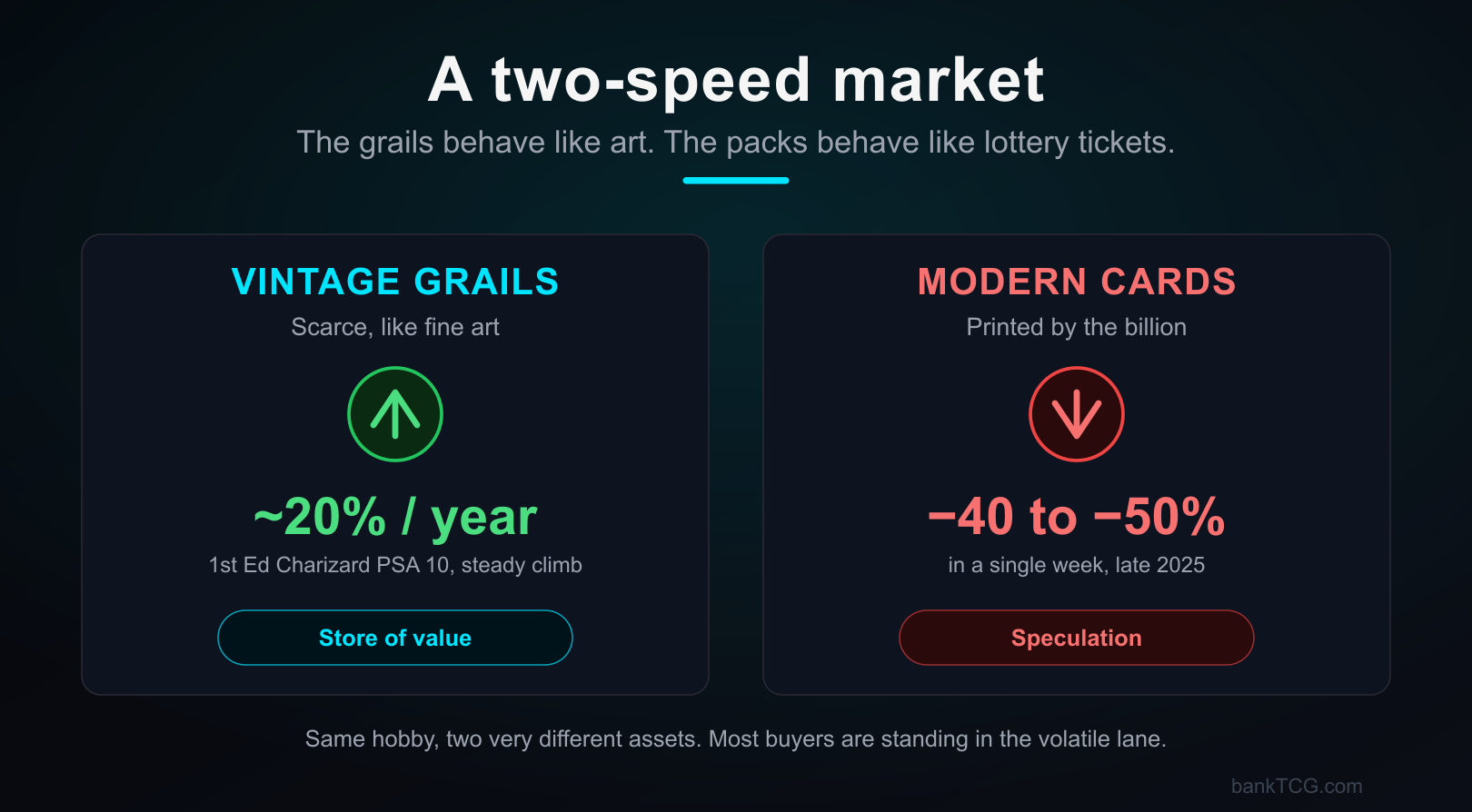
This is a two-speed market, and most people are in the slow lane. The headline grails (the Pikachu Illustrator, the 1st Edition Charizard PSA 10 that fetched $954,808 at that same Goldin sale) are genuinely scarce assets, like fine art. But the modern cards most young flippers actually buy are printed by the billion. In late October to November 2025, the overall market fell 18% in a single week, with some modern cards shedding 40 to 50%. Analysts have warned certain modern singles could ultimately drop 80 to 90%.
Then there's fraud. PSA's first-ever fraud report found counterfeit and altered cards jumped 45% year-over-year in 2025 (Pokémon fakes up 125%), with the company intercepting over $200 million in fakes, and six of the ten most-counterfeited subjects were Pokémon. Before chasing any expensive card, it pays to know how to spot a fake Pokémon card. A late-2025 PSA "buyback regrade" controversy also dented confidence in the grading system the entire market leans on; rival grader CGC recalled more than a thousand cards it had wrongly authenticated.
Liquidity is the quiet killer: a six-figure card can take months to sell, and grading turnaround can outlast the very price spike you were chasing. Economists keep reaching for the same point: cards have no cash flow. They behave like art, where value flows entirely from scarcity, culture, and demand, all of which can evaporate. The cautionary tales are real: one caller to Dave Ramsey's show admitted racking up $26,000 in credit-card debt flipping cards behind his pregnant wife's back.
So, Is It the New Economy?
Yes and no. At the very top, Pokémon has earned its place as a legitimate alternative store of value: scarce, globally liquid among the wealthy, and culturally bulletproof after 30 years. A Base Set Charizard PSA 10 appreciating roughly 20% a year is a real asset, and these are the cards that dominate any list of the most valuable Pokémon cards.
But "the new economy" oversells what's on offer to most people. Our own Pokémon card statistics, computed across every card in our database, put a number on it: the median card is worth a small fraction of the average, because a few hundred chase cards carry the whole distribution. For the average buyer ripping packs to top up rent, this is speculation wearing the costume of investing. The vintage grails that beat the S&P are already owned by people who can afford to never sell. The cards you can actually grab off a store shelf are the ones most exposed to the next correction.
The healthiest way to read the 2025-26 boom isn't "cards are the new stocks." It's that a generation priced out of the old economy is voting with its wallet for assets it understands and enjoys. If you're going to play, play with money you'd spend on the hobby anyway: buy what you love, grade strategically, track real comps, and treat any profit as a bonus, not a salary.
How Bank TCG Helps You Invest Smarter
Treating cards as an asset only works if you know what you actually own. The Bank TCG scanner lets you scan your entire collection, estimate each card's grade before you pay for submission, and track real-time market prices right from your phone. In a market this volatile, knowing your collection's true value, and whether a card is worth grading, is the difference between investing and guessing. Explore the full feature set to see how it works.
Frequently Asked Questions
Are Pokémon cards a good investment in 2026?
It depends entirely on which cards. Scarce vintage grails, like 1st Edition Base Set holos in high grades, have behaved like genuine alternative assets, appreciating steadily and selling for six and seven figures. Modern cards, which are printed in the billions, are far more speculative and corrected 40 to 60% from their peaks in late 2025. As a rule, vintage scarcity is investable; modern packs are closer to a lottery ticket.
What is the most expensive Pokémon card ever sold?
Logan Paul's PSA 10 Pikachu Illustrator sold for $16,492,000 at Goldin Auctions in February 2026, making it the most expensive trading card of any kind ever sold at auction. It is the only PSA Gem Mint 10 copy in existence.
Why are young people investing in Pokémon cards?
A mix of cultural nostalgia and economic anxiety. With 70% of Americans calling their cost of living unaffordable and traditional assets like housing feeling out of reach, many Gen Z and Millennial buyers see cards as an accessible alternative store of value they understand and enjoy. Surveys show younger investors allocate a far larger share of their portfolios to alternatives, including collectibles, than older generations.
How much has the Pokémon card market grown?
According to the Collectors index (run by PSA's parent company), Pokémon card prices rose 282% between 2004 and 2020, then surged roughly 1,350% from 2020 onward. Card Ladder reported the broader market up about 170% in the year to early 2026. However, the market also fell 18% in a single week in late 2025, underscoring its volatility.
Is the Pokémon card market a bubble?
It shows classic warning signs: rapid price spikes, a flood of speculative new buyers, sharp corrections, and a surge in fraud (counterfeits rose 45% in 2025). Vintage scarce cards have proven resilient across cycles, but mass-printed modern cards are highly exposed to corrections. Most economists treat cards as a speculative alternative asset, not a guaranteed investment, because they generate no cash flow and rely entirely on demand.
How do I protect myself when buying expensive Pokémon cards?
Authenticate before you buy using the standard fake-detection tests, purchase only graded cards from reputable auction houses or verified sellers, check recent sold comps rather than asking prices, and never spend money you can't afford to lose. For grading decisions, scan cards first to estimate their grade before paying submission fees.