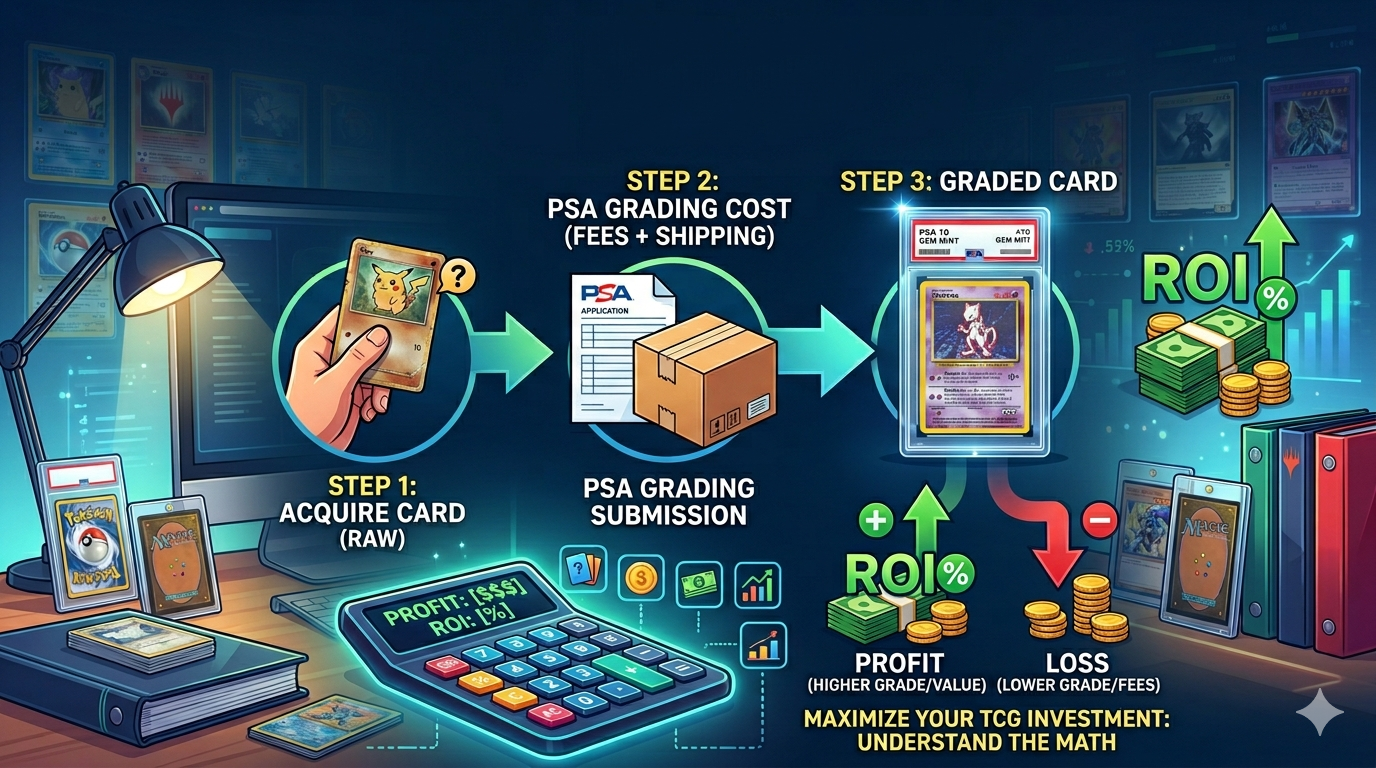
Most collectors decide to grade cards based on gut feel: "This looks gem mint, I'll send it." Then three months later they get back a PSA 8 and wonder where the profit went.
A submission that looks like a clear winner can destroy value when you factor in grading fees, shipping, platform commissions, and grade distribution risk. But submissions that seem borderline on paper can generate 40-60% ROI when the numbers actually work.
This guide gives you the complete framework, including the exact formula, real example submissions, and our free PSA Profit Calculator to run the numbers on your own cards before you commit.
Updated August 2026 — PSA fees have changed, and the Value tiers are closed. PSA's February 2026 revision moved the schedule to Value Bulk $24.99, Value $32.99, Value Plus $49.99, Value Max $64.99, Regular $79.99, Express $149, Super Express $349 and Walk Through $599. Then, on 2 June 2026, PSA paused all four Value tiers for new US trading-card submissions while it works down a backlog that has passed 12 million cards. Regular at $79.99 is the cheapest service level accepting cards today. Every worked example below has been recalculated at these fees. Run your own numbers in the PSA Profit Calculator, and check your tier-bump risk in the PSA Upcharge Calculator.
The Full Cost of a PSA Submission
Before calculating profit, you need to know your real all-in cost. Most collectors undercount this by 20-35%.
Direct Costs Per Card
| Cost | Typical Range |
|---|---|
| Card purchase price | Varies |
| PSA grading fee | $24.99-$599 per card (Regular $79.99 is the cheapest tier currently open) |
| Round-trip shipping | $15-$40 per submission |
| Insurance | 1-2% of declared value |
| Packaging supplies | $1-$3 per card |
PSA Grading Tiers (2026)
| Tier | Fee | Max declared value | Turnaround | Status |
|---|---|---|---|---|
| Value Bulk | $24.99/card | $500 | 95 business days | Paused |
| Value | $32.99/card | $500 | 75 business days | Paused |
| Value Plus | $49.99/card | $500 | 45 business days | Paused |
| Value Max | $64.99/card | $1,000 | 30 business days | Paused |
| Regular | $79.99/card | $1,500 | 20 business days | Open |
| Express | $149/card | $2,500 | 15 business days | Open |
| Super Express | $349/card | $5,000 | 10-15 business days | Open |
| Walk Through | $599/card | $10,000 | 7 business days | Open |
Above $10,000 declared value you move onto PSA's Premium service levels, which are quoted individually.
Two things matter here, and most collectors only track one of them.
The fee decides whether the submission clears costs. A card where PSA 9 sells for $80 and PSA 10 sells for $180 was a profitable bulk submission at $25 a card. At $79.99 it is not close.
The declared value cap decides whether you get a second bill. If PSA judges your card to be worth more than your tier's cap once it is graded, it rebills you at the tier that does cover the value — an upcharge. A card sent at Regular that comes back worth $2,000 is rebilled at Express, adding $69.01. Budget for the grade you are hoping for, not the one you expect.
Platform Fees on the Sale
This is the most commonly forgotten cost:
- eBay: 13.25% on the total sale amount including shipping
- TCGplayer: 10%
- PWCC: 15%
- Facebook Marketplace: 0% but harder to reach serious buyers
On a $150 PSA 10 eBay sale, you lose $19.87 in platform fees alone before shipping to the buyer. Run every submission with platform fees included.
The Profit Formula
Here is the full calculation:
Expected Revenue =
  (Expected PSA 10 cards × PSA 10 sell price) +
  (Expected PSA 9 cards × PSA 9 sell price)
  × (1 - platform fee %)

Total Cost =
  (Card purchase price + grading fee) × number of cards +
  shipping & insurance

Expected Profit = Expected Revenue - Total Cost

ROI % = (Expected Profit / Total Cost) × 100
Because you do not know how many cards will grade PSA 10, you use your estimated pop rate to calculate the statistical expectation.
Breaking Down the Pop Rate
If you are submitting 10 cards with an estimated 50% PSA 10 rate:
- Expected PSA 10s: 5 cards
- Expected PSA 9s: 5 cards
Multiply each by the respective sell price, subtract platform fees, and that is your expected revenue.
Three Real Submission Examples
Example 1: Modern Bulk Pokemon
Setup:
- Card: Charizard ex from Obsidian Flames, pulled fresh
- Raw purchase price: $35/card
- 20 cards, round-trip shipping: $30
- PSA 10 rate: 45% (reasonable for modern ex cards)
- PSA 10 eBay sold: $110
- PSA 9 eBay sold: $55
- eBay fee: 13.25%
Revenue is the same either way:
- Expected PSA 10s: 20 × 0.45 = 9 cards
- Expected PSA 9s: 20 × 0.55 = 11 cards
- Expected revenue: (9 × $110 + 11 × $55) × 0.8675 = $1,383.66
At the old bulk rate ($25/card):
- Total cost: (35 + 25) × 20 + 30 = $1,230.00
- Expected profit: $153.66 · ROI: 12.5%
At Regular ($79.99/card), the cheapest tier now open:
- Total cost: (35 + 79.99) × 20 + 30 = $2,329.80
- Expected profit: −$946.14 · ROI: −40.6%
There is no break-even PSA 10 rate for the second version. Even if all 20 cards graded PSA 10, revenue would be 20 × $110 × 0.8675 = $1,908.50 against $2,329.80 of cost. The card cannot carry an $79.99 fee at a $110 ceiling, no matter how well it grades.
This is the clearest single consequence of the Value tier pause: a submission that was thin-but-positive is now unsalvageable, and no amount of card selection fixes it. For modern bulk at these price points, the correct move today is to hold the cards raw until the Value tiers reopen.
Example 2: Vintage Pokemon (Regular Tier)
Setup:
- Card: Base Set Charizard (Unlimited), purchasing at $400 raw
- PSA grading fee: $79.99/card (Regular, declared value $400)
- 5 cards, shipping: $35
- PSA 10 rate: 8% (vintage, tough grade)
- PSA 10 eBay sold: $6,000
- PSA 9 eBay sold: $1,200
- PSA 8 eBay sold: $600
- Grade distribution: 8% PSA 10, 45% PSA 9, 47% PSA 8
- eBay fee: 13.25%
Calculation:
- Total cost: (400 + 79.99) × 5 + 35 = $2,434.95
- Expected PSA 10s: 5 × 0.08 = 0.4
- Expected PSA 9s: 5 × 0.45 = 2.25
- Expected PSA 8s: 5 × 0.47 = 2.35
- Expected revenue: (0.4 × $6,000 + 2.25 × $1,200 + 2.35 × $600) × 0.8675 = $5,647.42
- Expected profit: $3,212.47
- ROI: 131.9%
Now the part most people miss. A PSA 10 here is worth $6,000, which is four times Regular's $1,500 declared value cap. PSA prices the card on what it's worth after grading, so every copy that gems gets rebilled at Walk Through — $599 instead of $79.99, an upcharge of $519.01 per card. The PSA 9s at $1,200 and PSA 8s at $600 sit safely under the cap and are untouched.
- Expected upcharge: 0.4 × $519.01 = $207.60
- Adjusted total cost: $2,642.55
- Adjusted profit: $3,004.87 · ROI: 113.7%
Still an excellent submission — an 18-point ROI haircut does not change the decision here. But on a thinner card that same $519 can be the entire margin, which is why it belongs in the model rather than in a surprise invoice. Run your own numbers through the PSA Upcharge Calculator.
Even with a brutal 8% PSA 10 rate, vintage Charizard is overwhelmingly profitable because the price premiums between grades are so large. Low pop rates do not kill the math when the premiums are this wide — the opposite of Example 1, where a healthy 45% gem rate could not rescue a card with nowhere to grow.
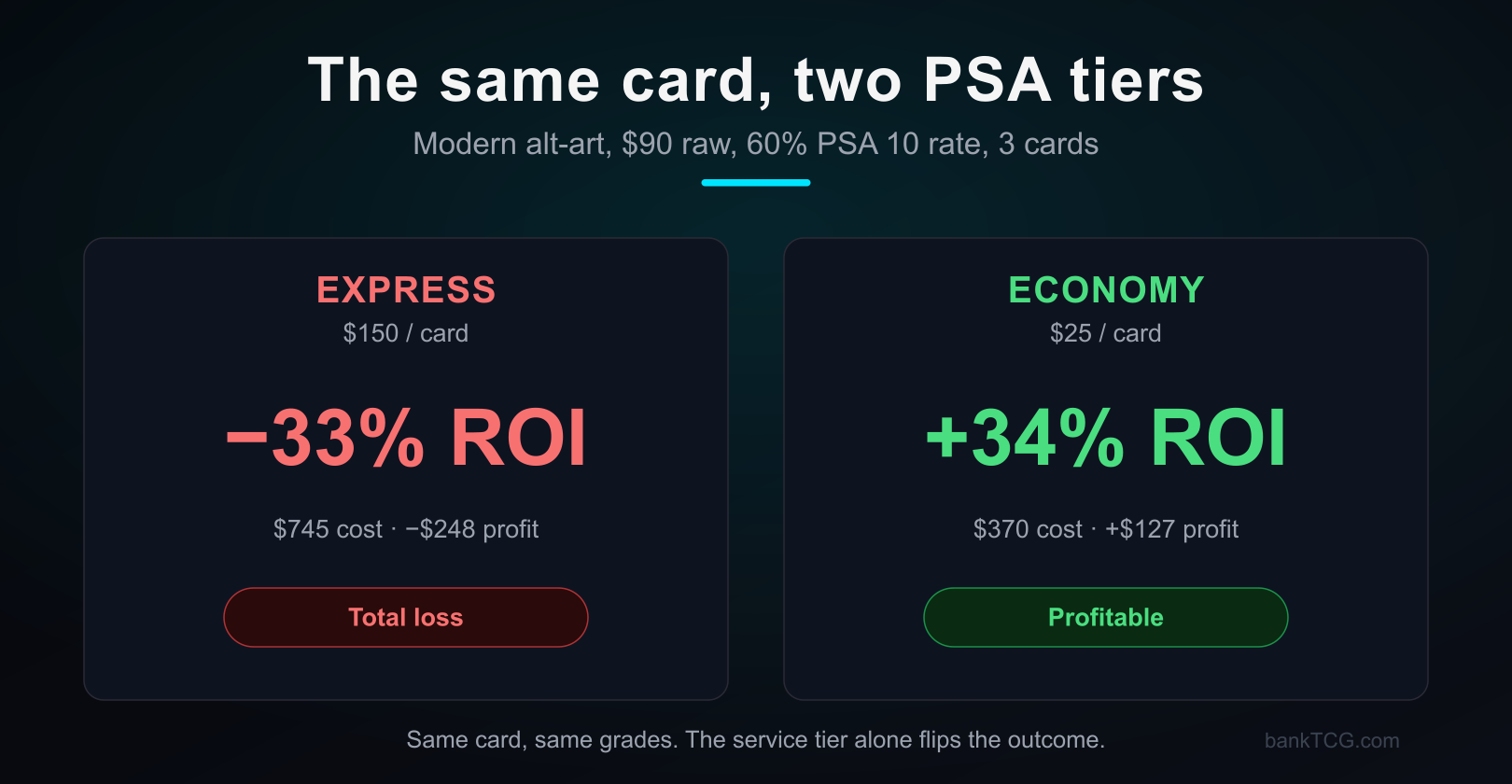
Example 3: The Trap Submission (Modern Alt-Art)
Setup:
- Card: Modern alt-art, raw price $90
- 3 cards, shipping: $25
- PSA 10 rate: 60%
- PSA 10 eBay sold: $250
- PSA 9 eBay sold: $110
- eBay fee: 13.25%
Revenue, identical in all three cases:
- Expected PSA 10s: 3 × 0.60 = 1.8
- Expected PSA 9s: 3 × 0.40 = 1.2
- Expected revenue: (1.8 × $250 + 1.2 × $110) × 0.8675 = $504.88
| Tier | Fee/card | Total cost | Profit | ROI | Break-even PSA 10 rate |
|---|---|---|---|---|---|
| Bulk (paused) | $25 | $370.00 | +$134.88 | +36.5% | 23% |
| Regular | $79.99 | $534.97 | −$30.09 | −5.6% | 68% |
| Express | $149 | $742.00 | −$237.12 | −32.0% | 125% — impossible |
Two lessons sit on top of each other here.
The old one still holds: never use a high-service tier unless the card's declared value actually requires it. At $149 a card, a $90 alt-art needs a PSA 10 rate of 125% to break even, which is another way of saying the submission cannot work at any grade outcome.
The new one is harsher. Regular loses money too. The break-even rate moved from 23% to 68% purely because the fee went from $25 to $79.99 — the card didn't change, the market didn't change, the grader didn't get stricter. A submission that comfortably cleared its costs a year ago now needs a gem rate most modern cards never hit.
Finding Real Pop Rate Data
Your profit estimate is only as good as your pop rate assumption.
PSA Population Report
Go to psacard.com/pop and search your exact card by set, card number, and year. Look at the total graded count and grade distribution to find the percentage at PSA 10 vs PSA 9 vs lower.
Population reports reflect historical submissions, which skew toward better-condition cards. Real pop rates for bulk submissions of average pulls are typically 5-15 percentage points lower than pop report data.
Community Data
- Pokemon TCG communities on Reddit (r/PokemonTCG) regularly share pop data
- eBay sold listings filtered by grade show real-world volume at each grade level
- Discord servers for specific sets often track pack-fresh submission results
The BankTCG App
BankTCG's AI grades your card from a photo before you submit. It checks centering ratios, surface condition, corner sharpness, and edge quality. If the AI grades it a likely PSA 8, do not waste $79.99 finding out the hard way.
Break-Even Analysis
Before running the full profit calculation, ask: what PSA 10 rate do I need just to cover my costs?
Break-even PSA 10 rate formula:
Break-even rate =
  (Total Cost - n × PSA9_price × platform_mult) /
  (n × (PSA10_price - PSA9_price) × platform_mult)
  × 100
Where n is the number of cards and platform_mult is (1 - platform_fee / 100).
This is exactly what our free PSA Profit Calculator computes in real time.
If your expected pop rate is comfortably above the break-even rate, submit. If they are close, factor in variance. Actual results can swing 15-20 percentage points either way across a small submission batch.
ROI Thresholds
| ROI | Assessment |
|---|---|
| Under 15% | Marginal: small errors in pricing or pop rate will flip it to a loss |
| 15-30% | Acceptable: worth doing if you are confident in your pop rate estimate |
| 30-50% | Good: solid margin for real-world variance |
| 50-100% | Excellent: prioritise these submissions |
| 100%+ | Usually vintage or high-value rare cards |
Capital efficiency matters too. A 30% ROI on a $2,000 submission that takes 60 days ties up more capital than a 30% ROI on a $200 bulk submission. High-value Express submissions need higher ROI targets to justify the opportunity cost, and with current backlogs your capital is tied up considerably longer than the quoted turnaround suggests.
Common Mistakes That Kill Grading Profit
1. Using the Wrong PSA Tier
The most common and most expensive mistake. Always match the tier to the card's actual value and the realistic profit margin. Since the Value tiers were paused, Regular at $79.99 is the floor for most submitters — but paying up to Express only makes sense when the card's post-grade value would breach Regular's $1,500 cap anyway, or when timing genuinely matters.
2. Not Accounting for Platform Fees
Forgetting eBay's 13.25% on a $300 sale means you have miscalculated revenue by $39.75 per card. Across a 20-card submission that is nearly $800.
3. Using Pop Report Data Without Adjustment
Population report PSA 10 rates are not the same as real-world submission pop rates for average cards. Pop reports are biased toward successful submissions. Adjust down by 5-15 points for conservative estimates.
4. Ignoring PSA 8 Outcomes
If there is any chance some cards grade PSA 8, include that in your calculation. A card that grades PSA 8 instead of PSA 9 can erase the profit from two PSA 10 results.
5. Not Accounting for Shipping to the Buyer
Shipping costs to sell graded cards, usually $5-$12 depending on method, eat into revenue on every sale. Some platforms include this in their fee structure; others do not.
The Grading Decision Matrix
Likely profitable:
- Card raw value $75 or above
- PSA 10 / PSA 9 price ratio 2.5x or higher
- Centering visually 60/40 or better
- No visible corner or surface issues
- Break-even PSA 10 rate is comfortably below your expected pop rate
Borderline, model carefully:
- Card raw value $35-$75
- Price ratio 1.5-2.5x
- Centering looks close but not confirmed
- Using Regular or Express tier
Skip grading:
- Card raw value under $35
- Price ratio under 1.5x
- Any visible centering, corner, or surface issues
- Break-even PSA 10 rate exceeds your realistic pop rate estimate
- Service tier fee is more than 30% of the card's raw value
Run the Numbers Before You Commit
Every submission decision should start with the numbers, not the feeling. The variables that matter (card cost, tier, pop rate, price spread, platform fees) interact in ways that are genuinely hard to model in your head.
Use the free BankTCG PSA Profit Calculator to model any submission in under 60 seconds. It handles:
- All PSA grading tiers with auto-filled fees
- 8 currencies (USD, AUD, GBP, EUR, JPY, CAD, SGD, NZD)
- PSA 8, 9, and 10 grade distributions
- eBay, TCGplayer, and PWCC platform fee deduction
- Break-even PSA 10 rate calculation
- ROI percentage output
- Max PSA 9s allowed to hit your target profit
Once you know the numbers work, use the BankTCG app to check your card's condition before the envelope closes. A bad submission is one where you did the math right but sent the wrong card.
For more on evaluating whether a card is worth grading at all, read our data-driven guide to grading decisions. For a comparison of PSA vs BGS, see our PSA vs BGS grading guide. For the premium a PSA 10 actually carries across the market rather than on one card, see our Pokémon card statistics.
Frequently Asked Questions
What is a realistic PSA 10 pop rate for modern Pokemon cards?
For modern Pokemon cards pulled fresh from packs, real-world PSA 10 rates typically range from 30-65% depending on the set and card type. Full-art and alt-art cards often grade harder at 25-40% PSA 10 because their large illustrated surfaces are more prone to surface scratches. Standard reverse holos can grade at 50-70% PSA 10 from fresh pulls with careful handling.
Does PSA grading add value to all cards?
No. PSA grading only adds significant value when the price premium for the graded copy is large enough to cover costs and generate acceptable return. For most bulk commons and uncommons, raw value is too low for grading to be profitable. The sweet spot is mid-to-high value singles with strong PSA 10 premiums and achievable pop rates.
How long do PSA submissions take in 2026?
Far longer than the service names suggest. PSA's own site currently quotes Regular at 70-80 business days — roughly four months — with Express at 20-30, Super Express at 10-15 and Walk Through at 7-10. Those are the backlog-adjusted estimates, not the nominal service windows the tiers are named after, and the backlog passed 12 million cards in August 2026. The four Value tiers, which were the slow-and-cheap option, have been paused for new submissions since 2 June 2026. PSA publishes a live backlog tracker and updates these estimates on its own site.
This matters to your ROI more than most collectors price in. Regular ties up your capital for a third of a year before you can sell a single card.
Can I mix cards of different values in one submission?
Every card in a submission must sit under that service level's declared value cap — $1,500 for Regular, $2,500 for Express, and so on. If one card exceeds it, that card needs a higher tier even if the rest of the order is fine where it is. Get this wrong and PSA rebills the offending card at the correct tier, which is the upcharge. Because upcharges are assessed per card, pulling one likely tier-jumper out into its own submission is almost always cheaper than moving the whole order up a level.
Should I grade cards pulled from ETBs or booster boxes I bought?
Yes, if the raw value justifies it. Cards pulled from product bought at retail or below typically have better profit margins than cards bought raw at near-market-peak prices. Your acquisition cost is the key variable: lower cost means the submission works at lower PSA 10 rates.